
Pest Control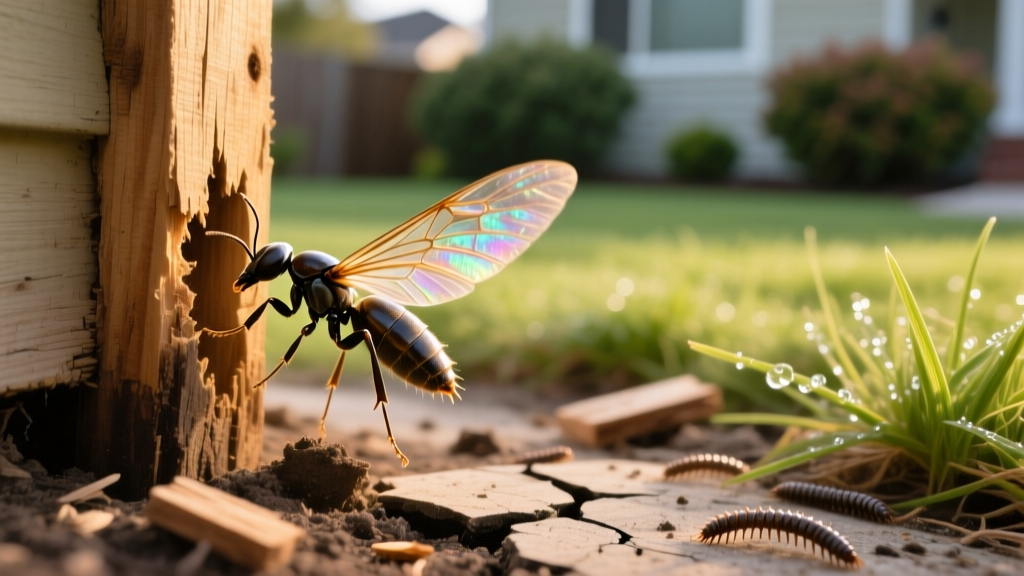
Winged Termites in House: Yard Perimeter Defense & ID Guide
The Swarmer Threat: Why Yard Defense is Your First Line
Finding winged termites in house interiors—often clustered around window sills, light fixtures, or baseboards—is a glaring red flag. These reproductive alates, commonly called swarmers, do not eat wood. Their sole biological purpose is to leave their parent colony, mate, and establish new satellite colonies. When you see them indoors, it typically indicates a mature subterranean termite colony (often Reticulitermes flavipes or the aggressive Formosan Coptotermes formosanus) has already breached your perimeter and established a foothold in your yard or crawlspace.
Effective pest management requires shifting the battleground outward. By fortifying your yard's perimeter and altering the microclimate around your foundation, you can intercept foraging workers before they ever produce the next generation of swarmers. This guide details the exact identification metrics, chemical barriers, and landscaping modifications required to secure your property.
Swarmer Identification Matrix: Termites vs. Carpenter Ants
Homeowners frequently confuse termite swarmers with carpenter ant alates. Misidentification leads to incorrect treatment protocols and wasted budget. Use this morphological matrix to confirm the threat before purchasing termiticides.
| Feature | Termite Swarmers | Carpenter Ant Swarmers |
|---|---|---|
| Wings | Two pairs of equal length; translucent, milky-white, extending far past the abdomen. | Two pairs of unequal length; dark, smoky tint, ending near the abdomen tip. |
| Waist | Thick, broad, and uniform (no constriction between thorax and abdomen). | Pinched, narrow, hourglass-shaped pedicel. |
| Antennae | Straight, bead-like (moniliform). | Elbowed (geniculate) with a distinct bend. |
| Shed Wings | Often found in massive, uniform piles near light sources; wings break off easily at the base. | Rarely shed in large piles; wings remain attached or are scattered randomly. |
According to the NC State Extension Entomology Department, the presence of discarded, equal-length wings on exterior windowsills is one of the most reliable early indicators of a subterranean termite swarm originating from the adjacent soil.
The Yard-to-House Invasion Pathway
Subterranean termites require constant contact with soil moisture to survive. To reach the cellulose in your home's framing, foraging workers construct shelter tubes. Understanding these pathways is critical for targeting your yard defense strategy.
Critical Perimeter Vulnerabilities
- Exterior Mud Tubes: Pencil-sized (1/4 to 1 inch wide) tunnels made of soil, saliva, and feces climbing from the mulch bed up the concrete foundation. They protect workers from desiccation and predators.
- Slab Cracks and Utility Penetrations: Termites can squeeze through a gap as narrow as 1/32 of an inch. Unsealed plumbing penetrations, HVAC lines, and expansion joints in concrete slabs act as direct highways from the soil into your interior walls.
- Wood-to-Soil Contact: Fence posts, deck stairs, and siding that touch the soil bypass the need for mud tubes entirely, providing hidden, direct access to structural lumber.
Warning: Never break open an active exterior mud tube to 'check' for termites. This alerts the colony to the breach, causing them to abandon the visible tube and reroute their foraging through hidden cracks inside the foundation, making professional detection vastly more difficult.
Exterior Defense Strategy: Trenching and Baiting
When defending against winged termites in house perimeters, you must choose between a liquid soil barrier and a baiting system. Both are highly effective when installed to exact specifications, but they operate on entirely different biological principles.
Liquid Termiticide Barriers (The Trenching Method)
Liquid barriers utilize non-repellent active ingredients, primarily Fipronil (found in Termidor SC). Because termites cannot detect the chemical, they tunnel through the treated soil, pick up a lethal dose, and transfer it to the rest of the colony via grooming and trophallaxis (food sharing).
- Preparation: Dig a continuous trench 6 inches wide and 6 inches deep directly against the foundation.
- Mixing Ratio: Mix 0.8 fluid ounces of Termidor SC per gallon of water.
- Application Rate: Apply exactly 4 gallons of the finished solution per 10 linear feet of trench. For an average 2,000 sq. ft. home (approx. 200 linear feet), you will need 80 gallons of solution and roughly three 20oz bottles of Termidor SC (costing $210-$270 total for DIY materials).
- Backfilling: Mix the excavated soil with the remaining solution before backfilling the trench to ensure a continuous chemical envelope.
Termite Bait Stations (The Monitoring Method)
Bait systems like Trelona ATBS (Active Ingredient: Novaluron, an insect growth regulator) or Sentricon rely on foraging workers finding the stations and sharing the chitin-synthesis inhibitor with the colony, preventing nymphs from molting and eventually collapsing the population.
- Placement: Install stations flush with the soil surface every 10 feet around the perimeter, and within 3 feet of any known conducive conditions (like AC drip lines).
- Cost Analysis: Professional installation typically runs $15 to $25 per station, plus a $300-$400 annual monitoring fee. A standard home requires 20-25 stations.
The Environmental Protection Agency (EPA) notes that while bait systems are less invasive and use significantly less pesticide volume, they act slower than liquid barriers. If your home is currently experiencing active interior swarming, a liquid barrier is generally recommended for immediate halt of the intrusion.
Landscaping Modifications to Deter Alates
Chemical treatments will degrade prematurely if your yard's microclimate is optimized for termite survival. Implement these strict landscaping parameters to make your perimeter inhospitable.
The Mulch Mandate
Cellulose-based mulches (pine bark, hardwood, cypress) retain moisture and provide a secondary food source. You do not need to eliminate mulch, but you must restrict it:
- Limit mulch depth to a maximum of 2 to 3 inches. Deeper layers create excessive moisture retention and harbor colonies.
- Maintain a strict 6-inch 'no-mulch' buffer zone between the mulch edge and the foundation wall. Use inorganic materials like crushed gravel or river rock in this 6-inch gap to promote rapid soil drying.
Irrigation and Grading Corrections
Subterranean termites require high soil moisture. Chronic dampness against a foundation accelerates wood decay and attracts foragers.
- Sprinkler Heads: Redirect all rotor and spray heads so they do not hit the foundation. Maintain a minimum 12-inch dry zone around the house.
- AC Condensate Lines: Route HVAC drip lines at least 5 feet away from the foundation using PVC extenders. Constant dripping creates localized moisture hotspots that are highly attractive to termites.
- Positive Grading: Ensure the soil slopes away from the foundation at a minimum grade of 6 inches of drop over the first 10 horizontal feet to prevent water pooling.
Frequently Asked Questions
Do winged termites in house interiors mean the wood is already destroyed?
Not necessarily. The presence of swarmers indicates the colony is mature (usually 3 to 5 years old for Eastern Subterranean termites). While structural damage is likely occurring in hidden areas like wall voids or subflooring, the swarmers themselves do not chew wood. You must hire a licensed pest control professional to perform a destructive inspection or use borescopes to assess the actual extent of the framing damage.
Will exterior yard treatments stop indoor swarming immediately?
Liquid Fipronil barriers will kill foraging workers within days, cutting off the colony's resource lines and eventually stopping indoor swarming. However, if the primary colony nest is physically located inside your crawlspace or wall voids (a secondary nest), exterior trenching alone will not eliminate the indoor swarmers. Interior localized treatments or whole-structure fumigation (for drywood termites) may be required.
Are termite-resistant mulches a reliable defense?
Mulches made from cedar heartwood or cypress heartwood contain natural resins (like thujopsene) that are toxic or repellent to termites. However, as the mulch ages, breaks down, and loses these volatile oils (usually within 1 to 2 years), it becomes just as susceptible to termite feeding as standard pine bark. Relying solely on 'resistant' mulch without a chemical soil barrier is a high-risk strategy.
For comprehensive guidelines on selecting licensed pest management professionals and understanding warranty structures, consult the National Pest Management Association (NPMA) termite resources.

