
Pest Control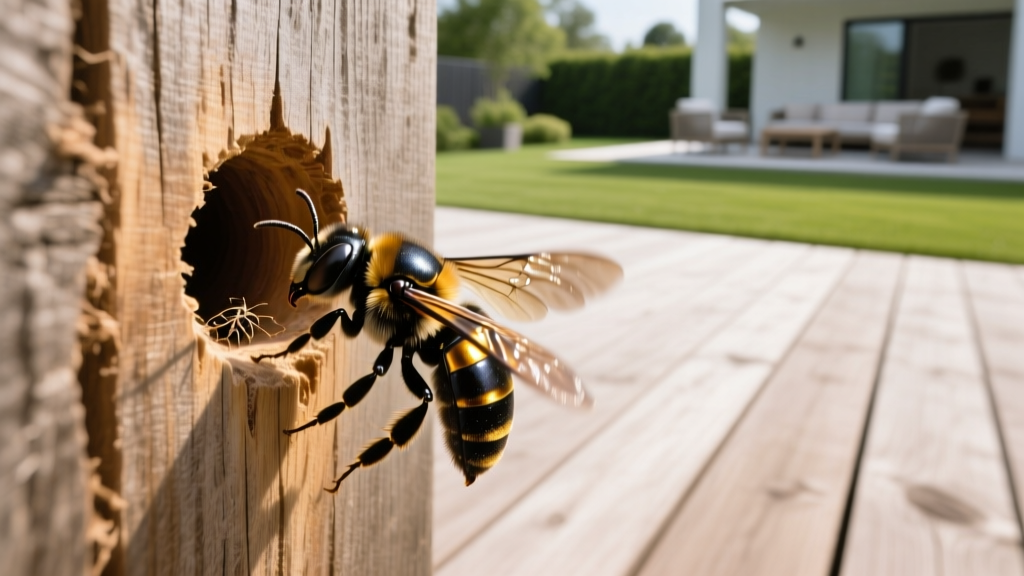
Wood Boring Bees: How to Get Rid of Them and Save Your Deck
The 1/2-Inch Threat: Identifying Wood Boring Bees
When you notice perfectly circular, half-inch (12.7 mm) holes appearing in your deck railings, fascia boards, or untreated outdoor furniture, you are likely dealing with carpenter bees (Xylocopa species). Unlike termites, these insects do not consume wood for nutrition; they excavate it to create nesting galleries. The Eastern carpenter bee (Xylocopa virginica) and Western carpenter bee (Xylocopa californica) are the primary culprits in North American yards. Left untreated, a single female can tunnel up to 10 feet into a structural beam over successive seasons, inviting woodpecker damage and moisture rot.
Accurate identification is the first step in effective yard defense. Homeowners frequently confuse carpenter bees with bumblebees, leading to ineffective treatment strategies. According to Penn State Extension, distinguishing between the two is critical because their nesting behaviors dictate entirely different eradication protocols.
| Feature | Carpenter Bee (Target Pest) | Bumblebee (Beneficial) | Mason Bee (Beneficial) |
|---|---|---|---|
| Abdomen Appearance | Shiny, hairless, black metallic | Fuzzy, hairy, yellow/black bands | Metallic blue/green, fuzzy |
| Nesting Location | Bores into solid, untreated wood | Underground in abandoned rodent burrows | Pre-existing cavities, hollow stems |
| Entrance Hole | Perfectly round, exactly 1/2-inch wide | No visible wood entrance holes | Small, irregular mud-plugged holes |
| Yard Evidence | Coarse sawdust (frass) directly below hole | None on wooden structures | Mud tubes or leaf fragments |
The Excavation Cycle: Understanding the Damage
To effectively eliminate a boring bee infestation, you must understand their tunneling architecture. The female initiates a nest by drilling a perfectly round entrance hole, usually against the grain of softwoods like cedar, pine, and redwood. After penetrating about an inch, she makes a sharp 90-degree turn and tunnels parallel to the wood grain.
Warning: The Structural Cascade Effect
A single gallery averages 4 to 6 inches in its first year. However, subsequent generations often reuse and extend these tunnels. By year three, a network of lateral chambers can compromise the load-bearing integrity of a 4x4 deck post. Furthermore, the entrance holes allow rainwater to infiltrate the heartwood, accelerating fungal decay long after the bees are gone.
Targeted Eradication: Chemical and Dust Protocols
Liquid sprays are largely ineffective for deep gallery treatment because they soak into the wood grain and fail to reach the posterior nesting chambers where the larvae reside. The industry standard for boring bee removal relies on residual insecticidal dusts and specialized foaming agents.
Step 1: Timing the Application
Treat active holes at dusk or after dark. During the day, foraging females are out of the nest. At night, they retreat into the galleries, ensuring direct contact with the treatment. Wear protective eyewear and a N95 respirator when applying dusts overhead on eaves.
Step 2: Applying Residual Dust
Use a hand-held bulb duster or a specialized bellows duster to puff insecticidal dust directly into the entrance hole. The bee will track the dust deep into the lateral chambers, distributing it to the larvae.
- Deltamethrin (e.g., DeltaDust): The gold standard for moisture-prone areas like eaves and deck undersides. It remains active for up to 8 months and does not clump in high humidity. Cost: ~$22 for a 1 lb applicator bottle.
- Drione Dust (Silica Gel + Pyrethrin): Highly desiccating. Excellent for dry, shaded fascia boards. It destroys the insect's waxy exoskeleton. Cost: ~$35 per pound.
Step 3: Foaming Sprays for Immediate Knockdown
If you need to treat during the day or want an immediate visual confirmation, use an expanding foam specifically labeled for carpenter bees. Products containing prallethrin (such as Spectracide Carpenter Bee & Wasp Foaming Spray, ~$8 per can) expand to fill the void, trapping and killing the occupants on contact. However, foam lacks the long-term residual transfer effect of dust.
Step 4: Plugging the Gallery (Crucial Final Step)
According to research from the University of Kentucky Entomology Department, failing to plug the hole guarantees re-infestation, as the pheromone scent of the old nest attracts new females the following spring. Wait 48 hours after dusting to ensure all occupants are dead.
Do not use standard silicone caulk or wood filler alone. Carpenter bees can easily chew through soft caulking. Instead, pack the hole tightly with copper mesh or stainless steel wool (avoid carbon steel, which will rust and stain your wood), and then cap the exterior with a high-performance exterior wood putty like Minwax High Performance Wood Filler. Sand and touch-up paint once cured.
Organic and Botanical Deterrents
For homeowners managing organic gardens or those with chemical sensitivities, botanical repellents can deter nesting, though they require frequent reapplication and do not kill existing larvae.
Organic Defense Strategy
- Essentria IC3: A botanical insecticide utilizing rosemary, geraniol, and peppermint oils. It provides a rapid knockdown on contact but leaves no long-term residual. (~$45 per quart).
- Almond Oil Application: Carpenter bees exhibit a strong aversion to the scent of almond extract. Wiping pure almond oil or an almond-based essential oil blend onto bare wood railings in early spring (March-April) disrupts their site-selection pheromones.
- Citrus Spray: Boiling citrus peels (orange, lemon, grapefruit) in water and spraying the cooled decoction onto wood surfaces acts as a mild, short-term repellent. Reapply after every rainfall.
Long-Term Prevention: Wood Treatments and Physical Barriers
Eradication is only half the battle. Boring bees specifically target bare, weathered, or unpainted softwoods. The University of Minnesota Extension notes that a physical barrier on the wood surface is the most reliable long-term deterrent.
The Paint vs. Stain Dilemma
A common misconception is that applying a fresh coat of wood stain will deter boring bees. Penetrating oil-based stains offer zero protection against carpenter bees, as they do not create a surface film. To deter excavation, the wood must be coated with a film-forming finish.
- Solid Exterior Paint: The most effective barrier. Bees cannot grip or chew through a thick layer of acrylic latex exterior paint.
- Polyurethane Varnish: If you wish to maintain the natural wood grain, apply at least three coats of a spar urethane (e.g., Minwax Helmsman Spar Urethane). The hard, glossy shell prevents the mandibles from gaining traction.
- Composite Alternatives: When replacing rotted deck boards or fascia, transition to capped composite decking (like Trex or TimberTech) or PVC trim (like Azek). These materials are entirely immune to boring bee excavation.
Cost Analysis: DIY vs. Professional Extermination
Determining whether to handle the infestation yourself or hire a licensed pest control operator depends on the height of the nests and the extent of the damage.
| Method | Estimated Cost | Best Use Case | Efficacy Rating |
|---|---|---|---|
| DIY Dust & Plug | $25 - $45 | Ground-level decks, railings, accessible eaves | 95% (with proper plugging) |
| DIY Foaming Spray | $10 - $20 | Active daytime sightings, shallow holes | 70% (poor deep-gallery reach) |
| Professional Exterminator | $150 - $350 | Multi-story eaves, extensive structural fascia damage | 99% (includes warranty) |
If your infestation involves second-story fascia boards, roof peaks, or requires scaffolding, the risk of ladder falls while applying overhead dust makes professional intervention the only safe choice. Most professional services will apply a micro-encapsulated pyrethroid (such as Onslaught FastCap) via a high-pressure pole sprayer, ensuring deep penetration into the galleries while providing a 30-to-60-day residual surface barrier.
Frequently Asked Questions
Do male carpenter bees sting?
No. Male carpenter bees are highly territorial and will aggressively dive-bomb intruders, but they lack a stinger. Only the females possess a stinger, and they are highly docile, rarely stinging unless physically handled or crushed.
Will woodpeckers make the damage worse?
Yes. Woodpeckers listen for the chewing sounds of carpenter bee larvae inside the wood. They will peck large, jagged craters into your deck posts and fascia to extract the grubs, causing exponentially more cosmetic and structural damage than the bees themselves.
When is the best time of year to treat?
Early spring (late March to May) is when females establish new nests. Late summer (August to September) is when the new generation emerges and mates, often returning to the same wood to overwinter. Treating during both windows provides comprehensive annual defense.

