
Pest Control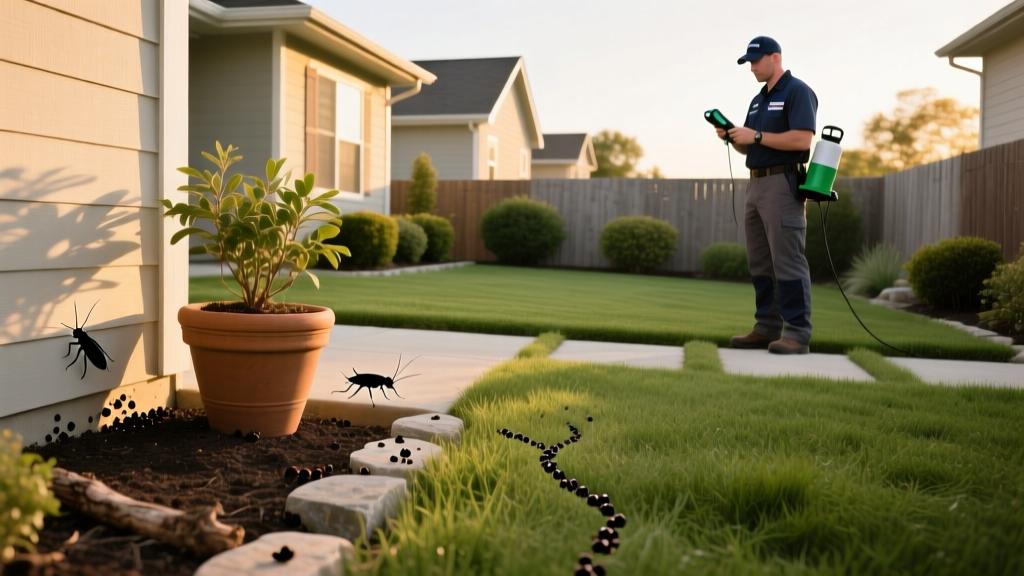
How to Get Rid of American Roaches: Yard & Perimeter Defense
The Outdoor Origin of Indoor Infestations
When homeowners spot a two-inch reddish-brown cockroach scurrying across the kitchen floor, the immediate reaction is to treat the interior. However, the American cockroach (Periplaneta americana) is fundamentally an outdoor pest that migrates indoors seeking moisture and shelter. To permanently solve the problem, you must establish a robust yard and perimeter defense. Learning how to get rid of American roaches requires shifting your focus from the kitchen baseboards to the mulch beds, sewer grates, and foundation perimeters of your property.
According to the University of Florida IFAS Entomology Department, American roaches thrive in warm, moist environments and can produce up to 15 egg capsules (oothecae) in their lifetime, each containing 14 to 16 eggs. Stopping the breeding cycle outdoors is the most cost-effective and long-lasting control method.
Identify the Invader: American Roach vs. Lookalikes
Accurate identification dictates your treatment strategy. Misidentifying a Smokybrown or Oriental cockroach can lead to ineffective bait placements, as their harborage preferences differ slightly. Use this comparison matrix to confirm you are dealing with Periplaneta americana.
| Species | Size & Color | Distinguishing Mark | Primary Outdoor Habitat |
|---|---|---|---|
| American Cockroach | 1.5 - 2.0 inches; Mahogany/Reddish-brown | Pale yellow figure-eight pattern on the back of the head | Mulch beds, sewer systems, woodpiles, palm trees |
| Smokybrown Cockroach | 1.25 - 1.5 inches; Uniform dark mahogany/black | Uniform coloration; long wings extending past abdomen | Tree holes, roof shingles, dense ivy, high moisture areas |
| Oriental Cockroach | 1.0 - 1.25 inches; Glossy dark brown to black | Short wings (males) or no wings (females); slow moving | Crawlspaces, damp soil, under porches, leaf litter |
The Yard-to-House Pipeline: Where They Hide Outdoors
American roaches do not wander aimlessly; they follow moisture gradients and structural edges. Before applying any chemical controls, you must locate their daytime harborage zones. Inspect these high-risk yard areas:
- Thick Mulch Beds: Pine straw and hardwood mulch retain moisture and provide ideal nesting. Keep mulch at least 12 inches away from the foundation.
- Sewer Grates and Cleanouts: Municipal sewer lines are primary breeding grounds. Roaches exit through cracked PVC pipes or loose-fitting iron grates.
- Woodpiles and Compost: Decomposing organic matter generates heat and moisture. Elevate firewood on concrete blocks at least 20 feet from the home.
- Overhanging Vegetation: Branches touching the roof or siding act as aerial highways, bypassing ground-level chemical barriers.
Step-by-Step Perimeter Defense Strategy
Effective eradication relies on an integrated pest management (IPM) approach combining habitat modification, granular baiting, and residual liquid barriers. The Texas A&M Agrilife Extension emphasizes that chemical sprays alone will fail if moisture and food sources remain unaddressed.
Phase 1: Environmental Modification (Days 1-3)
Roaches require high humidity to survive. Altering the microclimate of your yard makes it inhospitable.
- Correct Grading: Ensure soil slopes away from the foundation at a minimum rate of 1/4 inch per foot for the first 6 feet. This prevents water pooling against the concrete slab.
- Gutter and Downspout Management: Install corrugated downspout extenders to discharge roof runoff at least 5 feet away from the foundation. Clogged gutters drip continuously, creating permanent moisture zones.
- Vegetation Pruning: Trim shrubs so the bottom 6 inches of branches are clear of the soil, allowing UV light and airflow to dry the ground beneath.
Phase 2: Granular Baiting for Turf and Mulch (Day 4)
Liquid sprays kill on contact and repel, but granular baits exploit the roach's scavenging nature and coprophagy (eating feces) to trigger a colony-wide domino effect.
Pro Tip: Advion Insect Granular Bait
Use a product containing Indoxacarb (0.22%), such as Advion Insect Granular Bait. Apply at a rate of 1.15 to 4.6 lbs per 1,000 square feet. Broadcast the granules specifically into mulch beds, leaf litter, and around tree bases. The roaches consume the bait, return to the harborage, and die. Other roaches consume the toxic feces and carcasses, multiplying the kill rate. Expect a 70% reduction in outdoor populations within 14 days.
Use a product containing Indoxacarb (0.22%), such as Advion Insect Granular Bait. Apply at a rate of 1.15 to 4.6 lbs per 1,000 square feet. Broadcast the granules specifically into mulch beds, leaf litter, and around tree bases. The roaches consume the bait, return to the harborage, and die. Other roaches consume the toxic feces and carcasses, multiplying the kill rate. Expect a 70% reduction in outdoor populations within 14 days.
Phase 3: The Liquid Residual Barrier (Day 7)
Once the bait has begun working, establish a chemical fence to stop migrating scouts from crossing onto your foundation.
- Active Ingredient: Bifenthrin 7.9% (e.g., Talstar P Professional Insecticide).
- Mix Rate: 1.0 fluid ounce per gallon of water for severe infestations (0.5 fl oz for maintenance).
- Application Technique: Using a 1-gallon or 2-gallon pump sprayer, apply the solution in a continuous band 3 feet up the foundation wall and 3 feet out onto the soil/mulch. This creates a 6-foot treated zone.
- Drying Time: Keep pets and children off the treated area until the liquid is completely dry (typically 1 to 2 hours). Once dry, the bifenthrin binds to the soil and remains active for 60 to 90 days.
Product Comparison: Best Outdoor Roach Control Treatments
Selecting the right chemistry prevents resistance buildup. Rotate your active ingredients every 6 to 12 months. Below is a breakdown of professional-grade products available to homeowners for yard defense.
| Product Name | Active Ingredient | Formulation | Approx. Cost (2026) | Best Use Case |
|---|---|---|---|---|
| Talstar P | Bifenthrin (7.9%) | Liquid Concentrate | $55 / 3/4 Gallon | Perimeter barrier spraying; fast knockdown and long residual. |
| Advion Insect | Indoxacarb (0.22%) | Granular Bait | $38 / 25 lbs | Broadcasting in mulch and turf; colony elimination via domino effect. |
| Niban FG | Boric Acid (5%) | Fine Granular | $45 / 4 lbs | Targeted crack/crevice treatment in damp outdoor utility boxes. |
| Demand CS | Lambda-cyhalothrin (9.7%) | Microencapsulated Liquid | $65 / Pint | Harsh weather resistance; UV-stable for sun-exposed foundations. |
Exclusion: Sealing the Fortress
Chemical and bait treatments manage the population, but physical exclusion prevents the survivors from entering your home. The EPA's Safe Pest Control guidelines strongly advocate for sealing entry points as a primary defense mechanism.
- Foundation Cracks: Seal gaps larger than 1/16 inch using a high-quality polyurethane concrete sealant (e.g., Sikaflex Self-Leveling Sealant). Do not use standard silicone, which degrades under UV exposure and soil moisture.
- Pipe Penetrations: Where HVAC lines, plumbing, and gas lines enter the exterior walls, stuff the voids with coarse copper mesh (Stuf-Fit) before capping with expanding polyurethane foam (PurgeFoam). Roaches cannot chew through copper mesh, and it prevents the foam from being pulled out by temperature shifts.
- Door Sweeps: Install heavy-duty rubber or bristle door sweeps on all exterior doors. If you can see light under the door at night, an American roach can easily slip underneath.
Warning: Pollinator Protection
When applying liquid residual sprays like Bifenthrin, never spray directly onto blooming weeds, clover, or ornamental flowers in your yard beds. Bifenthrin is highly toxic to bees and other pollinators. Treat the foundation and soil, but avoid the blossoms. Apply treatments in the late evening when pollinators are inactive and the spray has time to dry before morning foraging begins.
When applying liquid residual sprays like Bifenthrin, never spray directly onto blooming weeds, clover, or ornamental flowers in your yard beds. Bifenthrin is highly toxic to bees and other pollinators. Treat the foundation and soil, but avoid the blossoms. Apply treatments in the late evening when pollinators are inactive and the spray has time to dry before morning foraging begins.
Frequently Asked Questions
Do American roaches fly?
Yes, but they are not agile fliers. Both male and female American cockroaches have fully developed wings. In hot, humid weather (typically above 85°F), they will glide or flutter short distances, usually from elevated positions like tree branches or gutters down to the ground or rooflines.
How long does it take to eliminate an outdoor colony?
With a combined approach of granular baiting (Indoxacarb) and perimeter spraying (Bifenthrin), you will see a massive die-off within 7 to 10 days. Complete colony collapse and elimination of the outdoor breeding population typically takes 3 to 4 weeks, depending on the severity of the infestation and the size of the property.
Can I use diatomaceous earth (DE) in the yard?
Diatomaceous earth is largely ineffective for outdoor yard defense. DE requires a completely dry environment to work; it destroys the waxy cuticle of the insect's exoskeleton, causing dehydration. In outdoor mulch beds, soil, and turf, ambient moisture, morning dew, and rain instantly neutralize DE, rendering it useless against moisture-loving American roaches. Stick to microencapsulated liquids and weather-resistant granular baits for exterior use.
Should I treat the municipal sewer grate near my driveway?
Never spray pesticides or dump granular baits directly into municipal sewer systems or storm drains. This is illegal and causes severe environmental contamination. Instead, treat the soil and concrete perimeter immediately surrounding the outside of the grate. If roaches are actively pouring out of a specific grate, contact your local public works department to inspect the mainline for structural breaches.

