
Pest Control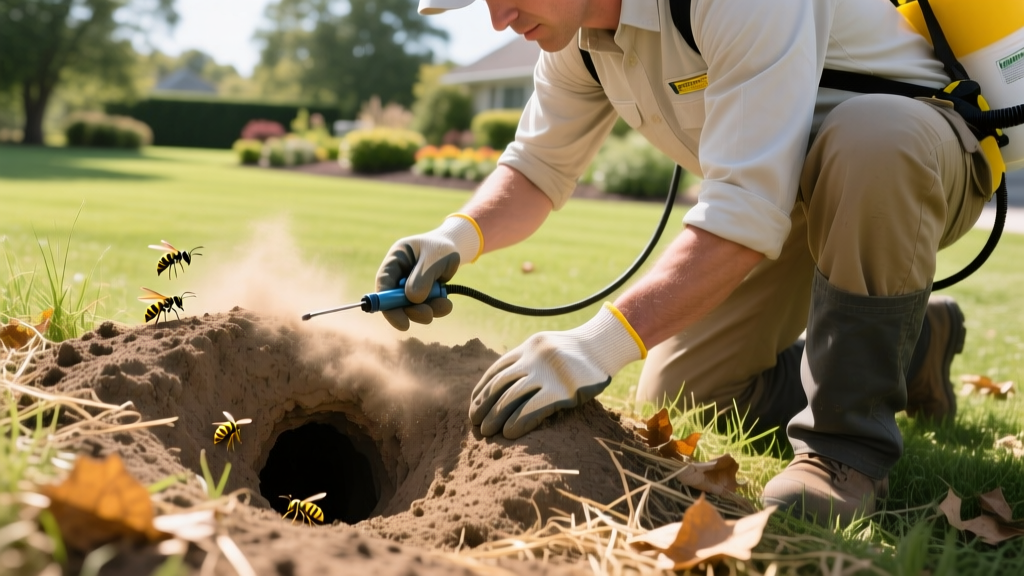
Yellow Jacket Extermination: Rescue Fixes for Active Ground Nests
Symptom Diagnosis: Confirming the Ground Nest Threat
Discovering a sudden swarm of aggressive insects erupting from a hole in your lawn requires immediate triage. Ground-nesting yellow jackets (primarily Vespula species) frequently colonize abandoned rodent burrows, hollow landscape timbers, and dense thatch layers. Unlike paper wasps that build visible aerial combs, ground nests remain hidden until a vibration—like a lawnmower or string trimmer—triggers a defensive swarm of 500 to 5,000 workers.
Before initiating any yellow jacket extermination protocol, you must confirm the insect species. Misidentifying beneficial ground-nesting bees or solitary cicada killers can lead to unnecessary chemical use and ecological harm.
Stinging Insect Diagnostic Matrix
| Insect Species | Nest Location | Aggression Level | Key Visual & Behavioral Traits |
|---|---|---|---|
| Yellow Jackets | Underground burrows, wall voids, dense thatch | Extreme (will pursue and sting repeatedly) | Stout bodies, bright black/yellow bands, rapid side-to-side flight, high traffic at single entrance hole. |
| Cicada Killers | Sandy soil, sparse lawn areas, flower beds | Very Low (females rarely sting; males cannot sting) | Massive size (up to 2 inches), solitary holes with U-shaped soil mounds, sluggish flight. |
| Digger Bees | Thin turf, dry soil, south-facing slopes | Low (docile, focused on foraging) | Fuzzy bodies, multiple small holes scattered across the lawn, active primarily in early spring. |
| Bumblebees | Abandoned mouse nests, under sheds, thick grass | Moderate (defensive but not aggressively pursuing) | Large, heavily pubescent (fuzzy), slow-flying, low traffic volume at the nest entrance. |
If your lawn exhibits a single, highly active hole with a steady stream of stout, fast-flying insects entering and exiting, you are dealing with a yellow jacket colony. According to the University of California Statewide IPM Program, ground nests reach peak population and maximum aggression in late summer and early autumn, making rescue extermination critical during these months.
⚠ Vibration Warning: Never attempt to diagnose or treat a ground nest while operating gas-powered lawn equipment. The low-frequency vibrations from mower engines travel through the soil and instantly trigger a mass defensive response. Always shut off equipment and retreat at least 50 feet before assessing the area.
Threat Triage: DIY Rescue vs. Professional Extermination
Not every nest should be treated by a homeowner. Yellow jacket venom contains acetylcholine and histamine, which causes intense pain, and a subset of the population carries a severe anaphylactic risk. Use the following decision framework to determine your extermination route:
- Call a Licensed Professional ($150–$350 in 2026) IF: The nest is located within a wall void or structural soffit (sealing the exterior hole will force them to chew through drywall into your living space); you or a family member has a known Hymenoptera venom allergy; the nest entrance is within 10 feet of a primary walkway or doorway; or the colony spans multiple entrance holes over a wide area.
- Execute DIY Rescue Fix IF: The nest is an isolated ground burrow in an open lawn area, you possess the proper PPE, and you can safely treat the entrance during optimal environmental conditions.
The Rescue Fix: Step-by-Step Ground Nest Extermination
Successful yellow jacket extermination relies on exploiting the colony's biology. You must eliminate the queen deep within the subterranean chambers. Surface-level treatments will only kill the guard wasps, leaving thousands of angry workers to dig secondary exit holes.
Step 1: Environmental and Gear Preparation
Timing is your most critical variable. Yellow jackets forage during daylight hours and return to the nest at dusk. Wait until at least one hour after sunset, or ideally just before dawn, when temperatures drop below 55°F. Cold temperatures significantly reduce their metabolic rate and flight ability.
Required PPE:
- Full-body bee suit or thick, light-colored canvas coveralls (dark colors trigger aggression).
- Leather gauntlet gloves tucked securely into sleeves.
- Veil or head net.
- Flashlight wrapped in red cellophane (yellow jackets cannot perceive the red light spectrum, preventing them from targeting the beam).
Step 2: Chemical Selection (The Transfer Effect)
The most common failure mode in DIY extermination is using the wrong chemical formulation. Do not use liquid sprays, boiling water, or gasoline. Liquids flood the upper tunnels and fail to reach the deep brood chambers, while flammable liquids are illegal, highly dangerous, and destroy your soil microbiome.
Instead, utilize an insecticidal dust. Dusts adhere to the wasps' bodies as they enter the tunnel. Through a process called the "transfer effect," the foraging workers carry the toxic dust deep into the nest, grooming it off and feeding it to the larvae and the queen.
Top Recommended Dust Formulations:
- Tempo 1% Dust (Cyfluthrin): Fast-acting, highly effective transfer kill. Priced around $20–$25 for a 1 lb shaker.
- Drione Dust (Silica Gel + Pyrethrins): Desiccates the exoskeleton while delivering a neurotoxin. Excellent for damp soil conditions where standard dusts might clump. Priced around $35 for a 1 lb container.
- Delta Dust (Deltamethrin): Waterproof formulation, ideal if rain is in the forecast or the soil is heavily irrigated.
Step 3: The "Puff and Retreat" Execution
- Approach the nest entrance slowly with your red-filtered light pointed at the ground, not directly at the hole.
- Using a hand duster (like the JT Eaton Duster), insert the nozzle tip within 1 to 2 inches of the entrance hole.
- Apply 3 to 4 gentle puffs of dust directly into the tunnel. Do not over-apply; a massive cloud of dust will block the entrance and deter wasps from entering.
- Immediately retreat along your original path. Do not turn your back until you are at least 30 feet away.
- Leave the hole completely open. The foragers must be able to enter and exit to transport the dust to the queen.
"Aerosol 'Wasp and Hornet' sprays with a 20-foot jet stream are highly effective for aerial paper nests, but they are largely ineffective for deep ground burrows. The spray coats the topsoil but fails to penetrate the 3-to-5-foot deep subterranean chambers where the queen resides." — Penn State Extension Entomology Department
Post-Extermination: Lawn Repair and Prevention
Wait a minimum of 48 to 72 hours before approaching the hole. Observe from a distance during peak daylight hours. If you see zero activity, the colony has been eradicated. If you still see scattered foragers, apply a second, lighter dusting at dusk.
Lawn Repair Protocol
Once the nest is confirmed dead, you must repair the turf to prevent future colonization and restore lawn aesthetics.
- Fill the Void: Mix native topsoil with a small amount of coarse sand. Tamp the mixture firmly into the burrow entrance to collapse the upper tunnels. Leaving voids in the soil invites future rodent or insect colonization.
- Overseed: Apply a high-quality grass seed matching your existing turf (e.g., Kentucky Bluegrass for cool-season zones, Bermudagrass for warm-season zones). Top with a 1/4-inch layer of peat moss or compost to retain moisture.
- Watering: Keep the patched area consistently moist (watering lightly twice daily) for 14 days until germination occurs.
Preventative Lawn Maintenance
Yellow jackets are opportunistic nesters. According to research published by Ohio State University Extension, they actively seek out pre-existing cavities. Implement these preventative measures:
- Rodent Control: Eliminate mice and voles from your property to remove the abandoned burrows yellow jackets rely on.
- Thatch Management: Core aerate and dethatch your lawn annually. Thick thatch layers provide insulated, hidden spaces for shallow nesting.
- Grub Control: Apply preventative grub treatments (like Chlorantraniliprole) in early summer. While yellow jackets are predators of grubs, a massive grub infestation will draw foraging yellow jackets into your lawn, increasing the likelihood of them establishing a local colony.
- Protein Baiting: In late summer, deploy commercial protein-based traps (containing heptyl butyrate or meat-based lures) at the perimeter of your property to intercept foraging queens and workers before they deplete local food sources and turn aggressive.
Troubleshooting Edge Cases
What if the nest is under a concrete slab or patio?
Do not attempt to seal the expansion joints or cracks. Apply the insecticidal dust directly into the crack at dusk. The wasps will track it under the slab. Once activity ceases after 72 hours, use a flexible polyurethane concrete caulk to permanently seal the entry point.
What if they are swarming my outdoor dining area?
Yellow jackets are highly attracted to sugary drinks and meat proteins in late summer. Remove open trash receptacles, keep soda cans covered, and avoid wearing sweet-smelling perfumes or floral-patterned clothing when dining outdoors. Use a oscillating fan on high speed pointed at the dining table; yellow jackets are weak fliers and cannot navigate wind speeds above 8 mph.

