
Pest Control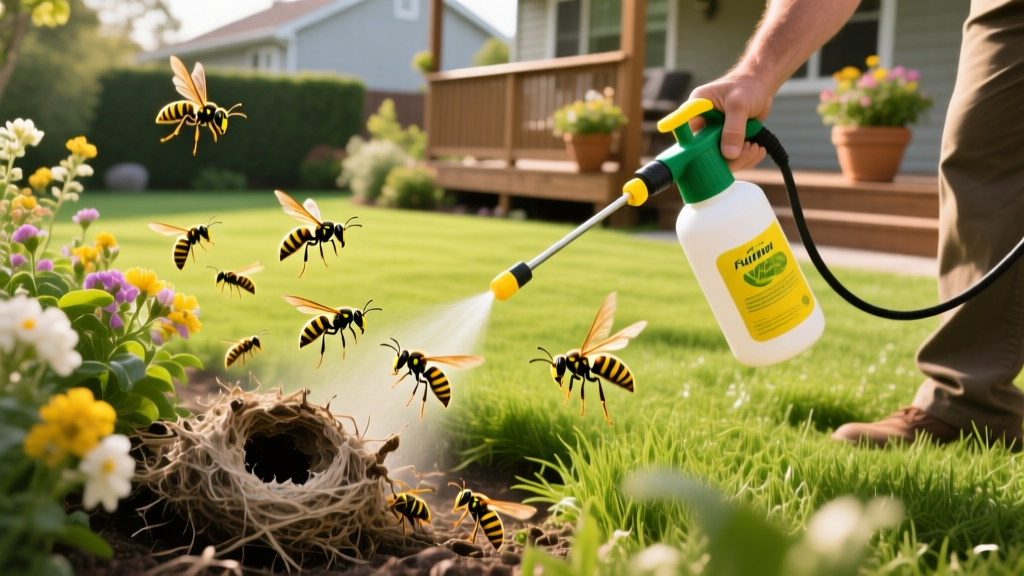
Fast Pest Control for Yellow Jackets: Diagnosis and Rescue Fixes
Symptom Diagnosis: Confirming the Threat
Before deploying pest control for yellow jackets, you must confirm the insect's identity. Misidentifying a docile paper wasp or a beneficial honeybee as an aggressive yellow jacket (Vespula and Dolichovespula species) leads to unnecessary pesticide use and ecological damage. Yellow jackets are distinct: they are 1/2 to 3/4 inch long, feature stark, hairless yellow and black banding, and fly with their legs tucked tightly against their bodies. Unlike honeybees, they can sting repeatedly without dying.
Colony aggression peaks in late summer and early fall. According to Penn State Extension, colonies reach maximum population (1,000 to 4,000 workers) in August and September. During this phase, foragers switch from hunting protein (insects) to scavenging sugars (fruit, soda, human food), bringing them into direct conflict with outdoor living spaces.
Stinging Insect Identification Matrix
| Species | Appearance & Body | Nest Type & Location | Aggression Level |
|---|---|---|---|
| Yellow Jackets | 1/2 - 3/4 inch; bright yellow/black; hairless; smooth | Papery; subterranean holes, wall voids, or small aerial shrubs | Extreme (especially late summer) |
| Bald-Faced Hornets | 5/8 inch; black and white; robust; hairless | Large aerial paper nests (football-shaped) in trees/shrubs | Moderate (defensive only) |
| Paper Wasps | 3/4 - 1 inch; brown/reddish; long dangling legs | Open, umbrella-shaped combs under eaves and overhangs | Low to Moderate |
| Honeybees | 1/2 - 5/8 inch; golden-brown; distinctly fuzzy/hairy | Hexagonal wax combs inside hollow trees or structural cavities | Low (sting is fatal to the bee) |
The Rescue Protocol: Emergency Eradication
When a nest is located in a high-traffic zone (near doorways, patios, or play areas), immediate rescue action is required. However, daytime eradication is highly dangerous. Foraging workers are active, and disturbing the nest triggers a mass defensive response. The CDC and NIOSH emphasize that severe allergic reactions (anaphylaxis) from mass stinging events are a primary cause of fatal occupational and residential pest encounters.
CRITICAL SAFETY DIRECTIVE: Never attempt DIY yellow jacket rescue if you have a known venom allergy, if the nest is located higher than 10 feet, or if the nest is deep inside a wall void where structural demolition might be required. In these scenarios, hire a licensed pest control operator equipped with pressurized micro-encapsulated dusts and structural void injection tools.
Product Arsenal: What Actually Works
Over-the-counter aerosol sprays often fail because they only kill the outer guards, leaving the queen and thousands of inner workers intact to rebuild and retaliate. Effective pest control for yellow jackets requires residual dusts or high-velocity knockdown aerosols. Below is the current professional-grade and consumer arsenal:
| Product / Brand | Active Ingredient | Format & Range | Estimated Cost | Best Use Case |
|---|---|---|---|---|
| Syngenta Tempo Dust | Cyfluthrin (1%) | Loose dust; applied via hand duster | $24 - $28 (1.25 lb) | Ground nests and deep wall voids |
| Bonide Wasp & Hornet Killer | Tetramethrin / Permethrin | Aerosol; 20-foot jet stream | $5 - $7 (16 oz) | Small, exposed aerial nests |
| Spectracide Pro Wasp Stop | Prallethrin / Lambda-cyhalothrin | Aerosol; 27-foot jet stream | $8 - $10 (14 oz) | High eaves and distant aerial nests |
| D-Fense Dust | Deltamethrin (0.05%) | Loose dust; applied via hand duster | $18 - $22 (1 lb) | Long-term residual void treatment |
Ground Nest Rescue: The Subterranean Edge Case
Eastern yellowjackets (Vespula maculifrons) predominantly build subterranean nests, often hijacking abandoned rodent burrows. Homeowners frequently mistake the entrance for a harmless mouse hole until they run a lawnmower over it. According to Ohio State University Extension, ground nests can house thousands of workers and extend several feet underground.
The 'Do Not Plug' Rule
The most common and catastrophic mistake homeowners make during ground nest rescue is plugging the entrance hole with dirt, steel wool, or expanding foam. Do not block the exit. Yellow jackets possess strong mandibles and will simply chew a new exit. If the nest is adjacent to your home's foundation or under a porch, blocking the primary exit will force the colony to chew upward through the subflooring and drywall, resulting in a massive indoor infestation.
Step-by-Step Ground Nest Eradication
- Time the Attack: Wait until 2 to 3 hours after sunset. Temperatures should ideally be below 65°F. At this time, all foragers have returned, and the cold makes them sluggish.
- Lighting Protocol: Do not use a standard white flashlight. Yellow jackets are attracted to the white/blue spectrum and will fly directly at the beam. Use a headlamp with a red light filter; insects cannot perceive the red spectrum well, allowing you to see the entrance without triggering an attack.
- PPE Requirements: Wear a full bee suit, a zipped veil, thick goatskin gloves, and tuck pant legs into heavy socks. Tape the glove-to-sleeve junction.
- Dust Application: Fill a bulb duster or bellows hand duster halfway with Tempo Dust (Cyfluthrin). Gently puff 3 to 4 clouds of dust directly into the entrance hole and along the immediate perimeter. The foragers will track the dust deep into the nest, contacting the queen and brood.
- Retreat and Wait: Leave the area immediately. Do not cover the hole. The colony will collapse within 24 to 48 hours as the dust spreads and the workers die.
Wall Void & Structural Rescues
When yellow jackets exploit gaps in siding, soffits, or attic vents, they build massive paper envelopes inside the wall cavity. You will hear a distinct, loud rustling or crackling sound from inside the drywall on quiet nights.
The Rescue Fix: Never use liquid aerosol sprays inside wall voids. Liquids soak into the drywall, cause staining, and fail to reach the deep nest. Furthermore, liquid sprays often agitate the colony, causing them to chew through the interior drywall into your living room. Instead, drill a 1/4-inch hole through the exterior siding directly adjacent to the nest activity (using a long masonry or wood bit), and inject D-Fense or Tempo Dust using a specialized void injector tube. Seal the exterior hole with caulk only after 72 hours, once all buzzing has completely ceased.
Post-Rescue Cleanup & Prevention
Once the colony is eradicated, the physical nest remains. For ground nests, the abandoned paper comb will naturally degrade in the soil over the winter; no excavation is necessary. For aerial or void nests, remove the dead comb once you are 100% certain the colony is dead. Leaving old nest material can attract carpet beetles and dermestid beetles, which will migrate into your home to feed on the dried insect carcasses.
To prevent future colonization, conduct a perimeter audit in early spring (April/May) when queen yellow jackets emerge from hibernation to scout for nesting sites. Seal all structural cracks wider than 1/8 inch with silicone caulk, install fine copper mesh over weep holes, and ensure attic vents are fitted with intact 1/16-inch hardware cloth. Eliminating early-season scouting queens is the most effective, low-toxicity pest control for yellow jackets available to homeowners.

