
Pest Control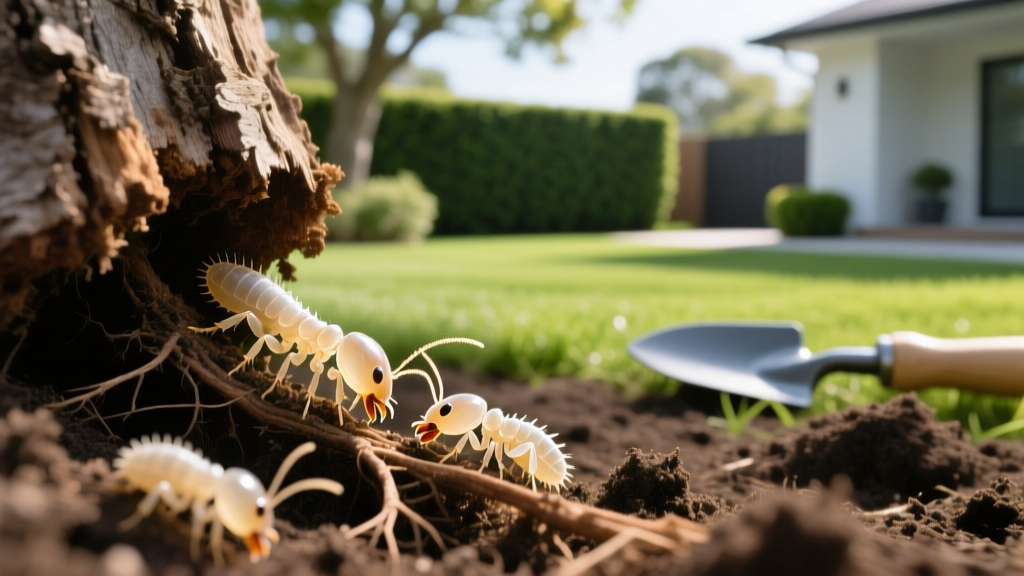
How to Identify and Eliminate Young Termites in Your Yard
Spotting a swarm of winged alates is the most obvious sign of a termite problem, but by the time swarmers appear, the colony has already been feeding on your property for years. The true indicator of an active, expanding threat is the presence of young termites—specifically nymphs and newly molted workers—foraging in your yard's soil, mulch, and perimeter wood. Identifying and eliminating these juvenile populations before they mature into wood-destroying adults is the cornerstone of proactive insect yard defense.
According to the National Pest Management Association (NPMA), termites cause over $5 billion in property damage annually in the United States. Because standard homeowner insurance rarely covers termite damage, establishing a yard perimeter defense is a critical financial safeguard. This guide details the biology of young termites, high-risk yard zones, and exact chemical and mechanical protocols to eradicate them.
The Biology of Young Termites: Nymphs vs. Workers
To effectively target young termites, you must understand their developmental stages. Termite colonies operate on a caste system. When eggs hatch, they produce nymphs—the youngest stage of the termite life cycle.
Identification Profile: Young Termite Nymphs
• Appearance: Translucent, pale white to cream-colored, soft-bodied, and entirely blind.
• Size: 1 to 3 millimeters in length (roughly the size of a grain of rice).
• Behavior: Nymphs cannot forage independently. They rely on older worker termites to feed them via trophallaxis (regurgitation of digested wood and gut flora).
• Location: Found deep within soil galleries, inside rotting stump cores, or clustered in the center of bait stations.
• Appearance: Translucent, pale white to cream-colored, soft-bodied, and entirely blind.
• Size: 1 to 3 millimeters in length (roughly the size of a grain of rice).
• Behavior: Nymphs cannot forage independently. They rely on older worker termites to feed them via trophallaxis (regurgitation of digested wood and gut flora).
• Location: Found deep within soil galleries, inside rotting stump cores, or clustered in the center of bait stations.
If you unearth young termites in your yard mulch, it indicates a mature subterranean colony nearby is utilizing your yard as a secondary foraging site. Nymphs eventually molt into workers, soldiers, or secondary reproductives. Eliminating the foraging workers starves the nymphs, collapsing the colony's growth cycle.
4 High-Risk Yard Zones for Termite Nurseries
Subterranean termites require constant contact with soil moisture to survive. Young termites are highly susceptible to desiccation, meaning they will only establish nursery zones in areas with high, consistent humidity.
- Wood-to-Soil Contact Points: Fence posts, deck supports, and retaining walls buried directly in the dirt provide both food and moisture. Termites use these as direct highways into your home's foundation.
- Over-Mulched Garden Beds: Bark mulch applied thicker than 3 inches traps soil moisture and creates an ideal microclimate for young termites. Pine bark and hardwood mulch are particularly attractive to foraging workers feeding nymphs.
- AC Condensation Lines: HVAC drip lines that discharge directly against the foundation create a perpetual moisture source, acting as a magnet for subterranean termite colonies.
- Stacked Firewood and Debris: Storing firewood directly on the lawn or against the siding provides a localized food source that allows young termite populations to explode without needing to travel back to the main colony.
Step-by-Step Yard Perimeter Treatment Protocol
Eradicating young termites requires breaking the trophallaxis cycle. You must use non-repellent termiticides or chitin synthesis inhibitors that allow older workers to carry the active ingredient back to the nursery and feed it to the nymphs.
Step 1: Trenching the Foundation
Using a trenching shovel, dig a continuous trench 6 inches wide and 6 inches deep around the entire perimeter of your home, including attached structures like patios. Where concrete slabs meet the foundation (driveways, walkways), you must drill 1/2-inch holes every 12 inches to inject the treatment beneath the slab.
Step 2: Applying Liquid Non-Repellent Termiticide
The industry standard for liquid yard defense is Fipronil (commonly sold as Termidor SC). Because it is non-repellent, termites do not know it is there. They tunnel through the treated soil, pick up the chemical, and groom it onto young termites in the colony.
- Mixing Ratio: 0.8 fluid ounces of Termidor SC per gallon of water (creating a 0.06% active ingredient suspension).
- Application Rate: 4 gallons of finished solution per 10 linear feet of trench.
- Cost Estimate: Approximately $120 to $150 for enough concentrate to treat an average 200-linear-foot home perimeter.
Step 3: Installing Chitin Synynthesis Bait Stations
For yards with high water tables or extensive hardscaping where trenching is impossible, use bait stations containing Noviflumuron or Hexaflumuron (e.g., Sentricon or Advance Termite Bait System). These chemicals inhibit chitin production. When worker termites feed the bait to young termites, the nymphs cannot molt and die, rapidly collapsing the colony's population.
- Placement: Install stations flush with the soil every 10 feet around the perimeter.
- Inspection: Check wooden monitors every 90 days. Once termite activity is confirmed, replace the monitor with the active bait matrix.
Chemical vs. Baiting Systems: Cost & Efficacy Matrix
Choosing between a liquid barrier and a baiting system depends on your yard's layout, soil type, and budget. The Environmental Protection Agency (EPA) regulates both methods, and both are highly effective when installed correctly.
| Feature | Liquid Barrier (Fipronil) | Bait Stations (Noviflumuron) |
|---|---|---|
| Initial Cost (Avg Home) | $800 - $1,500 | $1,200 - $2,000 |
| Annual Maintenance | $150 - $250 (Annual inspection) | $300 - $450 (Monitoring & bait replacement) |
| Time to Colony Elimination | 30 to 90 days | 60 to 180 days |
| Yard Disruption | High (Requires trenching & drilling) | Low (Small auger holes for stations) |
| Best For | Immediate protection, slab foundations | Eco-sensitive yards, wells, water features |
Moisture and Mulch Management: The Starvation Tactic
Chemical treatments will fail if your yard's environment continues to invite new colonies. Young termites require a soil moisture content of at least 20% to survive outside the primary nest. Modifying your yard's hydrology is a non-negotiable step in perimeter defense.
"Termites are essentially aquatic insects trapped in a terrestrial lifestyle. If you control the moisture gradient in your topsoil, you control the termite's ability to establish satellite nurseries near your foundation."
Actionable Moisture Corrections
- Grade Correction: Ensure the soil slopes away from your foundation at a minimum drop of 6 inches over the first 10 feet. This prevents pooling that saturates the trench zone and dilutes liquid termiticides.
- Downspout Extensions: Install rigid PVC extenders to carry roof runoff at least 4 feet away from the foundation. Flexible corrugated tubes often crush or disconnect, dumping water directly into the termite trench.
- Mulch Limits: Maintain a 12-inch bare-soil or gravel gap between your foundation and any organic mulch. Keep mulch depth strictly under 2 inches to allow the topsoil to dry out between rainfalls, creating a hostile environment for young termite nymphs.
Frequently Asked Questions
Can young termites fly or swarm?
No. Young termites (nymphs and young workers) are wingless and blind. Only mature alates (swarmers) develop wings to reproduce. If you see winged insects, they are adults, not young termites.
Will over-the-counter ant killers kill young termites?
No. Most retail ant sprays use pyrethroids (like bifenthrin or permethrin), which are repellents. These will kill the few workers on contact but will cause the rest of the colony to retreat deeper into the soil, avoiding the treated area and leaving the young termites unharmed. Always use non-repellent termiticides like Fipronil.
How deep do young termites live in the soil?
While the main royal chamber can be 10 to 20 feet underground, young termites and foraging workers typically occupy the top 6 to 18 inches of soil, tracking the moisture line and root systems of your yard's vegetation.

