
Tree Care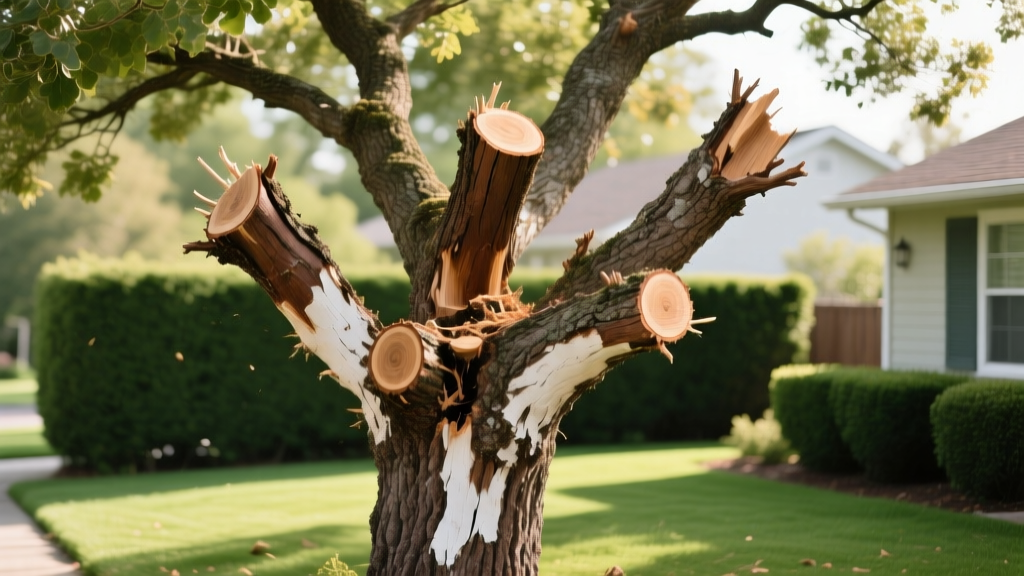
Bad Tree Trimming: 5 Signs of Hack Work and How to Fix It
The True Cost of Bad Tree Trimming
When an unlicensed worker takes a chainsaw to your canopy, the damage goes far beyond curb appeal. Bad tree trimming compromises the structural integrity, vascular system, and long-term viability of the tree. While a professional pruning service for a mature 60-foot oak might cost between $800 and $1,500, hiring a ‘hack-and-slash’ crew for $400 often results in severe decay, hazardous limb failure, and eventual removal costs exceeding $3,500. Understanding the anatomical consequences of improper cuts is the first step in diagnosing and rehabilitating a mangled tree.
Diagnostic Matrix: Identifying the 5 Fatal Pruning Errors
Before you can fix the damage, you must accurately identify what went wrong. Use this diagnostic matrix to evaluate your tree’s current state.
| Pruning Error | Visual Symptom | Long-Term Consequence |
|---|---|---|
| Tree Topping | Main central leader and large lateral branches severed arbitrarily. | Rapid, weakly attached epicormic sprout growth; massive internal decay. |
| Flush Cutting | Cut is perfectly flat against the trunk; branch collar is removed. | Destroys the tree’s natural chemical boundary; trunk rot initiates. |
| Lion’s Tailing | All inner foliage removed; leaves only at the very tips of branches. | Sunscald on exposed bark; extreme leverage on limbs causing windthrow. |
| Bark Ripping | Vertical strips of bark torn down the trunk below the cut site. | Exposes massive cambium wounds; invites wood-boring insects and fungi. |
| Stubbing | Branches cut 12 to 24 inches away from the trunk union. | Stubs die back to the trunk; prevents proper wound compartmentalization. |
The Science of Failure: Flush Cuts and the CODIT Model
The most insidious form of bad tree trimming is the flush cut. When a worker slices a branch perfectly flush with the trunk, they remove the branch collar (the swollen area at the base of the branch) and the branch bark ridge. These anatomical features are not just decorative; they are the tree’s primary defense mechanism.
According to the International Society of Arboriculture (ISA), trees do not ‘heal’ wounds like human skin; they compartmentalize them. Dr. Alex Shigo’s CODIT (Compartmentalization of Decay in Trees) model explains how a tree builds chemical and physical walls around an injury to stop rot from spreading into the main trunk. By removing the branch collar via a flush cut, the worker destroys Wall 4 of the CODIT system. The result is an open invitation for decay fungi to colonize the heartwood of the trunk, eventually hollowing out the tree from the inside while the canopy still looks green.
⚠️ Warning: The Pruning Sealer Myth
If a tree service paints your pruning cuts with black asphalt-based sealants or tar, fire them immediately. Research from the University of Florida IFAS Extension confirms that wound dressings trap moisture against the exposed wood, accelerating fungal decay and preventing the formation of protective callus tissue. Properly made cuts should always be left bare to the air.
If a tree service paints your pruning cuts with black asphalt-based sealants or tar, fire them immediately. Research from the University of Florida IFAS Extension confirms that wound dressings trap moisture against the exposed wood, accelerating fungal decay and preventing the formation of protective callus tissue. Properly made cuts should always be left bare to the air.
Lion’s Tailing: The Physics of Windthrow
Lion’s tailing occurs when a trimmer strips all the lateral, interior branches off a limb, leaving a tuft of foliage only at the extreme end. This creates a visual effect resembling a lion’s tail, but it introduces catastrophic physics into the tree’s structure.
Leaves and small twigs act as a natural wind-dampening system, distributing aerodynamic loads evenly across the branch. When interior foliage is removed, the center of gravity shifts entirely to the branch tip. During high-wind events or heavy ice storms, the excessive leverage placed on the stripped, unsupported limb frequently results in catastrophic failure at the trunk union. Furthermore, the sudden exposure of previously shaded inner bark to direct UV radiation causes severe sunscald, cracking the bark and exposing the cambium layer to pests.
The 3-Year Rehabilitation Framework for Mangled Trees
If your tree has suffered from bad tree trimming, do not attempt to fix it all in one season. Over-pruning a stressed tree to ‘correct’ previous mistakes will shock it into decline. Instead, follow this phased rehabilitation protocol using high-quality bypass tools like the Felco 2 for small sprouts and a Silky Zubat 270 pruning saw for larger corrections.
Year 1: Triage and Hazard Mitigation
- Remove Deadwood: Excise all dead, dying, or diseased wood. This prevents secondary pests like bark beetles from using the debris as a breeding ground.
- Address Bark Rips: Use a sharp sterilized knife to carefully trace around torn bark wounds, creating smooth, elliptical edges. This allows the cambium to roll callus tissue over the wound efficiently.
- Do Not Touch Sprouts: If the tree was topped, it will push out hundreds of epicormic water sprouts. Leave them alone for the first year. The tree desperately needs their leaf surface area to generate the carbohydrates required to fuel root recovery.
Year 2: Subordination and Thinning
- Select Scaffold Leaders: On topped branches, identify the single strongest, most vertically oriented water sprout to become the new terminal leader.
- Subordinate Competitors: Reduce the length of competing sprouts by 1/3 using reduction cuts (cutting back to a lateral branch that is at least 1/3 the diameter of the removed stem). This suppresses their apical dominance without removing their photosynthetic capacity.
- Restore Interior Foliage: If lion’s tailing occurred, allow any dormant buds along the stripped branches to push new growth. Do not prune these new interior shoots.
Year 3: Structural Training
- Finalize Leaders: Remove the subordinated competitor sprouts entirely, making clean cuts just outside the branch collar.
- Weight Reduction: If the newly established leaders are excessively long and whip-like, perform tip-weight reduction cuts to encourage lateral branching and taper.
How to Vet an Arborist and Avoid Future Hack Work
Preventing bad tree trimming starts with hiring the right professional. The Arbor Day Foundation strongly advises against hiring door-knockers or crews who advertise ‘topping’ as a service. Use this checklist to vet your next tree care provider:
- ISA Certification: Demand proof of current International Society of Arboriculture (ISA) Certified Arborist credentials. Verify their certification number on the ISA website.
- Insurance Specifics: Require certificates for both Commercial General Liability (minimum $1 million) and Workers’ Compensation. If they lack workers’ comp and a crew member falls on your property, you are liable.
- ANSI A300 Standards: Ask if their pruning practices comply with ANSI A300 standards. A true professional will know this refers to the industry-standard guidelines for tree care operations.
- The ‘No Spikes’ Rule: Ensure the contract explicitly states that climbing spikes will not be used on living trees being pruned. Spikes puncture the cambium and are only acceptable during complete tree removals.
Frequently Asked Questions
Can a topped tree ever regain its original natural form?
No. Once the primary central leader and mature scaffold branches are removed, the tree’s natural architectural form is permanently lost. Through careful subordination pruning over 5 to 7 years, you can establish new leaders and restore structural safety, but the tree will always bear the internal scars and altered silhouette of the topping event.
Is it illegal for a tree service to top my street tree?
In most municipalities, it is a direct violation of city ordinances to top or improperly prune a right-of-way or street tree. Unlicensed contractors caught performing bad tree trimming on public easements can face heavy fines, and the homeowner may be billed for the replacement cost of the ruined tree, which can exceed $2,000 for mature specimen caliper ratings.

