
Tree Care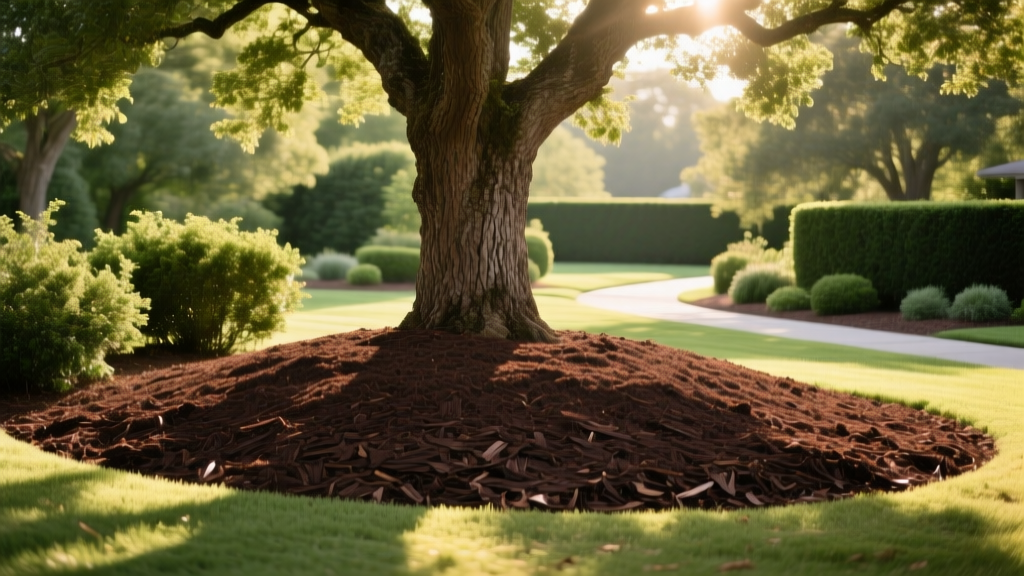
How Much Bark Mulch Do I Need? Coverage, Depth & Cost Guide
Determining the exact volume of bark mulch required for your trees prevents both material waste and severe root damage. Over-mulching suffocates root systems and invites fungal pathogens, while under-mulching fails to suppress weeds or retain soil moisture. This guide provides the precise mathematical formulas, depth requirements, and current material costs to help you calculate your exact bark mulch needs.
The Golden Rule of Mulch Depth for Trees
Before calculating volume, you must establish the target depth. According to the Morton Arboretum, the optimal mulch depth for established trees is between 2 and 4 inches.
WARNING: Avoid 'Mulch Volcanoes'
Never pile bark mulch against the trunk of a tree. The root flare (where the trunk expands at the base) must remain fully exposed. Piling mulch against the bark traps moisture, causing the cambium layer to rot, and creates a habitat for rodents that will girdle and kill the tree.
Never pile bark mulch against the trunk of a tree. The root flare (where the trunk expands at the base) must remain fully exposed. Piling mulch against the bark traps moisture, causing the cambium layer to rot, and creates a habitat for rodents that will girdle and kill the tree.
Adjusting Depth by Soil Type
- Clay Soils: Limit depth to 2 inches. Clay retains water naturally, and thick mulch layers will cause waterlogging and anaerobic soil conditions.
- Sandy Soils: Apply up to 4 inches. Sandy soils drain rapidly, requiring a thicker mulch layer to reduce evaporation and moderate soil temperature extremes.
- Poorly Drained Sites: Use a maximum of 2 inches, or consider a coarser mulch like large pine bark nuggets to allow for better gas exchange.
Step-by-Step Bark Mulch Calculator Formula
Landscape suppliers sell bulk mulch in cubic yards and bagged mulch in cubic feet. To find out how much bark mulch you need, use the standard landscape volume formula:
- Measure the Area: Measure the length and width of the mulch bed in feet. For circular tree rings, measure the radius (distance from the trunk to the outer edge) and use the formula: Area = 3.14 × (Radius × Radius).
- Determine Depth: Decide on your target depth in inches (typically 3 inches).
- Multiply: Multiply Length (ft) × Width (ft) × Depth (inches).
- Convert to Cubic Yards: Divide the total by 324. (There are 324 cubic inches in a cubic yard when factoring the 12-inch to 36-inch conversion).
Example Calculation: A rectangular bed measuring 20 feet long by 10 feet wide, mulched at a 3-inch depth.
(20 × 10 × 3) = 600.
600 ÷ 324 = 1.85 cubic yards.
Coverage Chart by Square Footage and Depth
Use this reference table to quickly estimate the cubic yards required for standard landscape beds. Remember to subtract the square footage of the tree trunk base and any large existing shrubs from your total area.
| Area (Sq. Ft.) | 2-Inch Depth | 3-Inch Depth | 4-Inch Depth |
|---|---|---|---|
| 100 | 0.62 cu. yds. | 0.93 cu. yds. | 1.23 cu. yds. |
| 250 | 1.54 cu. yds. | 2.31 cu. yds. | 3.09 cu. yds. |
| 500 | 3.09 cu. yds. | 4.63 cu. yds. | 6.17 cu. yds. |
| 1,000 | 6.17 cu. yds. | 9.26 cu. yds. | 12.35 cu. yds. |
Bulk vs. Bagged Bark Mulch: Cost Breakdown
Choosing between bulk delivery and bagged mulch depends entirely on the total volume required and your physical ability to transport it. Below is a comparative cost analysis based on current landscape supply pricing.
The Break-Even Point
One cubic yard equals exactly 13.5 standard 2-cubic-foot bags. If bagged mulch costs $5.50 per bag, the material cost per cubic yard is $74.25. If bulk mulch costs $45.00 per cubic yard plus an $85.00 delivery fee, the break-even point is typically around 2.5 to 3 cubic yards.
- Order Bagged If: You need less than 2.5 cubic yards, lack space for a dump truck to drop a bulk pile, or need to carry the mulch through narrow side yards where a wheelbarrow cannot fit.
- Order Bulk If: You need 3 or more cubic yards, have a flat driveway or designated drop zone, and possess the labor or equipment to spread it quickly before it dries out or blows away.
Pro Tip: Check for Hidden Bulk Fees
Many landscape supply yards charge a 'split load' fee (often $25–$50) if you order less than a full truckload (usually 10-15 cubic yards) and require them to stop the conveyor belt midway. Always ask about minimum delivery thresholds.
Many landscape supply yards charge a 'split load' fee (often $25–$50) if you order less than a full truckload (usually 10-15 cubic yards) and require them to stop the conveyor belt midway. Always ask about minimum delivery thresholds.
Species-Specific Mulching Adjustments
Not all trees respond identically to bark mulch. Adjust your material choice and application based on the specific species in your landscape.
Shallow-Rooted Species (Maples, Dogwoods, Spruces)
These species naturally develop roots close to the soil surface. Applying more than 2 inches of bark mulch can force these roots to grow upward into the mulch layer, making them highly susceptible to drought stress. Keep the layer strictly at 2 inches and extend the mulch ring to the drip line if possible.
Acid-Loving Conifers (Pines, Hemlocks)
Use aged pine bark specifically. As pine bark decomposes, it slightly lowers the soil pH, which benefits conifers. Avoid hardwood bark or mushroom compost blends around pines, as these can raise soil pH and induce nutrient lockout (specifically iron chlorosis).
Fruit and Orchard Trees
Maintain a strict 6-inch bare gap around the trunk of fruit trees. The Penn State University Extension notes that bark mulch piled against fruit tree trunks invites voles and mice during winter, which will chew through the bark and girdle the tree. Use a wire mesh guard if you must mulch closer to the trunk.
Pre-Mulch Preparation and Logistics
Calculating the volume is only half the process. Proper preparation ensures the mulch performs its intended function.
- Weed Eradication: Do not apply bark mulch directly over established perennial weeds like bindweed or bermudagrass. The weeds will penetrate 3 inches of bark within weeks. Apply a non-selective herbicide or use a thick layer of cardboard (sheet mulching) before adding bark.
- Edge the Bed: Cut a clean 4-inch deep trench along the border of the mulch bed. This physical barrier prevents the mulch from washing into the lawn during heavy rain and stops turfgrass stolons from invading the tree ring.
- Weight Considerations for Bulk: A cubic yard of dry shredded bark weighs approximately 400 to 500 pounds. However, if the supplier's pile was exposed to heavy rain, moisture content can push the weight to 800 pounds per cubic yard. A standard half-ton pickup truck can safely haul only 1 to 1.5 cubic yards of wet mulch. Do not overload your vehicle suspension.
By applying the 324-divisor formula, respecting the 2-to-4-inch depth limit, and choosing the correct purchasing format based on the 2.5 cubic yard break-even threshold, you will optimize tree health while minimizing material expenditures.

