Tree Care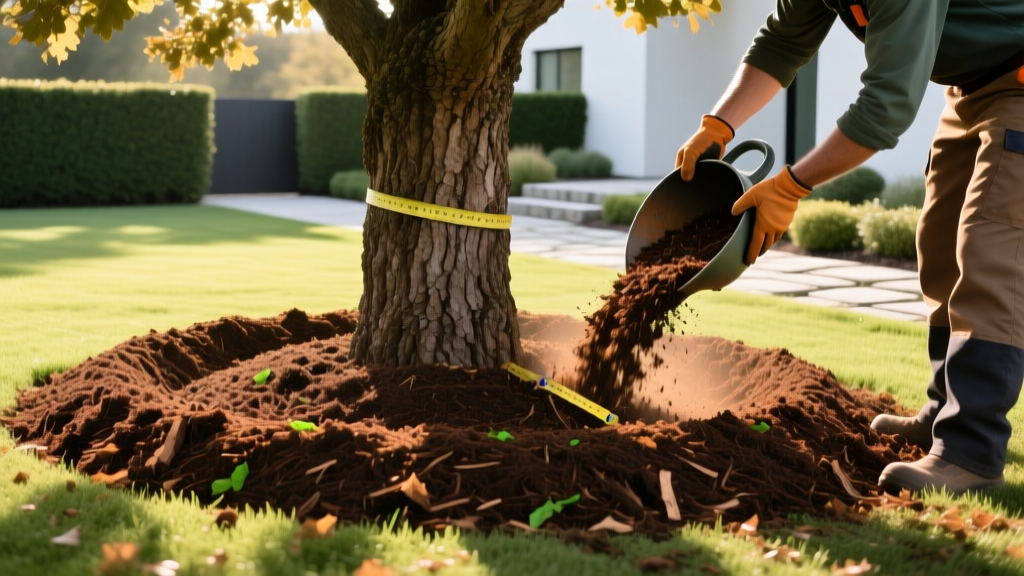
Bark Mulch Estimator: Calculate Exact Volume & Costs for Trees
Ordering too much bark mulch wastes money and creates disposal headaches; ordering too little leaves tree roots exposed to moisture loss and temperature fluctuations. Worse, applying it incorrectly—specifically piling it against the trunk—causes fatal cambium rot. A precise bark mulch estimator eliminates the guesswork, aligning your material orders with the exact biological needs of your trees and the physical dimensions of your landscape beds.
This guide provides the exact mathematical formulas, 2026 material pricing, and species-specific depth matrices required to calculate your bark mulch needs accurately, whether you are top-dressing a single sapling or mulching a half-acre estate.
The Core Math Behind Any Bark Mulch Estimator
Commercial mulch is sold by the cubic yard (bulk) or by the cubic foot (bagged). One cubic yard equals 27 cubic feet. To use a manual estimator or verify a digital calculator's output, you must convert your square footage and desired depth into cubic yards. The industry standard divisor is 324, which represents the number of square feet one cubic yard will cover at a depth of exactly one inch.
Formulas for Standard Bed Shapes
- Rectangular or Square Beds: (Length in feet × Width in feet × Depth in inches) ÷ 324 = Cubic Yards
- Circular Tree Rings: (3.14 × Radius in feet² × Depth in inches) ÷ 324 = Cubic Yards
- Irregular/Freeform Beds: Break the area into smaller rectangles and circles, calculate each individually, and sum the totals.
Calculation Example: You are mulching a circular ring around a mature oak tree. The ring extends 6 feet from the trunk (radius = 6). You want a 3-inch depth.
Step 1: 3.14 × (6 × 6) = 113.04 sq ft.
Step 2: 113.04 × 3 (inches) = 339.12.
Step 3: 339.12 ÷ 324 = 1.04 cubic yards.
Always round up to the nearest quarter-yard for bulk orders to account for settling and uneven terrain.
Step 1: 3.14 × (6 × 6) = 113.04 sq ft.
Step 2: 113.04 × 3 (inches) = 339.12.
Step 3: 339.12 ÷ 324 = 1.04 cubic yards.
Always round up to the nearest quarter-yard for bulk orders to account for settling and uneven terrain.
Bark Mulch Depth Matrix by Tree Species & Age
The most common error homeowners make is applying a uniform 4-inch layer across all plantings. According to research from the Morton Arboretum, excessive mulch depth restricts oxygen exchange in the soil profile, leading to root hypoxia and the development of secondary, girdling roots. Adjust your estimator inputs based on the specific tree profile.
| Tree Category | Target Depth (Inches) | Trunk Clearance Gap | Preferred Bark Texture |
|---|---|---|---|
| Newly Planted Saplings (1-3 years) | 2 to 3 inches | 3 inches from flare | Finely shredded pine or hardwood |
| Mature Deciduous (Oaks, Maples, Elms) | 3 to 4 inches | 4 to 6 inches from flare | Medium shredded cedar or hemlock |
| Conifers & Evergreens (Pines, Spruce) | 3 to 4 inches | 4 inches from flare | Large pine bark nuggets or shredded pine |
| Shallow-Rooted Species (Dogwoods, Magnolias) | 2 inches maximum | 4 inches from flare | Finely shredded, aged bark |
Critical Warning: Prevent Volcano Mulching
Never allow bark mulch to touch the tree trunk. The root flare (where the trunk widens at the base) must remain visible and exposed to air. Piling mulch against the bark traps moisture, inviting fungal pathogens like Phytophthora and encouraging rodents to gnaw on the cambium layer during winter. Maintain a strict 3-to-6-inch mulch-free halo around the trunk base.
Never allow bark mulch to touch the tree trunk. The root flare (where the trunk widens at the base) must remain visible and exposed to air. Piling mulch against the bark traps moisture, inviting fungal pathogens like Phytophthora and encouraging rodents to gnaw on the cambium layer during winter. Maintain a strict 3-to-6-inch mulch-free halo around the trunk base.
2026 Pricing Breakdown: Bulk vs. Bagged Bark Mulch
When your bark mulch estimator outputs the final volume, your next decision is purchasing format. The crossover point where bulk delivery becomes more cost-effective than bagged mulch is typically at 1.5 cubic yards. Below is the current 2026 pricing landscape for premium bark mulches.
Material Cost Comparison
- Bulk Pine Bark (Shredded): $38 to $48 per cubic yard.
- Bulk Cedar Bark (Shredded): $65 to $85 per cubic yard. (Cedar contains natural thujone, which deters carpenter ants and termites).
- Bulk Hemlock Bark: $55 to $70 per cubic yard. (Prized for its deep, rich color and slow decomposition rate).
- Bagged Mulch (2 cubic foot bags): $4.50 to $6.50 per bag. Note: It takes 13.5 bags to equal one cubic yard, making bagged mulch cost between $60 and $87 per cubic yard.
Hidden Costs: Delivery and Spreading Fees
Bulk mulch prices rarely include transport. Expect a local delivery fee (within a 10-to-15-mile radius of the landscape supply yard) ranging from $75 to $125 per dump truck load. Most standard dump trucks carry a maximum of 10 to 15 cubic yards. If your estimator calculates 22 cubic yards, you will incur two delivery fees. Furthermore, if you require professional spreading, landscape contractors typically charge $45 to $65 per cubic yard for labor, which includes wheelbarrowing, leveling, and edging the beds.
Choosing the Right Bark: Pine, Cedar, and Hemlock
Not all bark mulches decompose at the same rate or interact with soil biology identically. Use this decision matrix to select the right material for your specific soil amendment goals.
| Bark Type | Decomposition Rate | Soil pH Impact | Best Use Case |
|---|---|---|---|
| Pine Bark (Aged) | Moderate (12-18 months) | Slightly acidifies soil | Acid-loving trees (Azaleas, Dogwoods, Pines) |
| Cedar Bark | Slow (24-36 months) | Neutral | Pest-prone areas, termite mitigation, high-traffic beds |
| Hemlock Bark | Very Slow (36+ months) | Neutral to slightly acidic | Aesthetic focal points, steep slopes (resists washing) |
| Hardwood Bark | Fast (6-12 months) | Alkaline shift as it breaks down | Annual vegetable garden borders, rapid soil building |
According to soil science guidelines published by the University of Minnesota Extension, fresh, unaged wood chips can temporarily tie up soil nitrogen at the soil-mulch interface as microbes break down the high-carbon material. Always ensure your supplier provides aged or composted bark mulch (stockpiled for at least 6 months) to prevent nitrogen deficiency in your trees.
Pro Tips for Prepping the Soil Bed Before Mulching
A bark mulch estimator only calculates volume; it cannot account for poor site preparation. To maximize the moisture-retention and temperature-regulation benefits of your bark, execute these steps before the delivery truck arrives:
- Eliminate Competing Weeds: Do not lay bark over established Bermuda grass or bindweed. Apply a targeted glyphosate or horticultural vinegar treatment 14 days prior, or physically smother the area with overlapping layers of uncoated cardboard.
- De-compact the Soil Surface: Use a hand cultivator or a broadfork to gently scarify the top 1 inch of soil. This breaks up hydrophobic crusts and allows water to penetrate the soil profile rather than running off the top of the mulch layer.
- Install a Physical Edge: Trench a 4-inch deep, 4-inch wide V-trench around the perimeter of the bed. This prevents the bark mulch from migrating into the lawn during heavy rains and stops turfgrass stolons from invading the tree ring.
- Pre-Moisten the Bark: If applying bagged mulch during a dry spell, water the bags lightly before cutting them open. This reduces dust and helps the mulch settle immediately into place, preventing wind-blown loss.
Frequently Asked Questions
Does bark mulch attract termites?
Bark mulch itself is not a primary food source for subterranean termites, as they prefer the cellulose in solid wood structural timbers. However, the moist environment created by a thick mulch layer can provide a conducive foraging pathway to your home's foundation. Maintain a strict 12-inch mulch-free gap between any landscape beds and your home's siding, and opt for cedar bark, which contains natural termite-repelling oils.
How often should I recalculate and replenish my bark mulch?
Shredded pine and hardwood barks decompose significantly within 12 to 18 months. You should run your bark mulch estimator annually in early spring. Typically, a 1-inch to 1.5-inch "top-dressing" application is sufficient to restore the original 3-inch depth and refresh the aesthetic color without suffocating the soil profile.
Can I use a bark mulch estimator for rubber or stone mulch?
No. The 324-divisor formula calculates volume accurately for any material, but the depth requirements differ drastically. Stone and river rock require a 2-inch depth over a woven geotextile fabric, while rubber mulch requires a 1.5-inch depth. Furthermore, stone and rubber do not decompose, meaning you will only ever need to calculate the volume once for the initial installation.