
Tree Care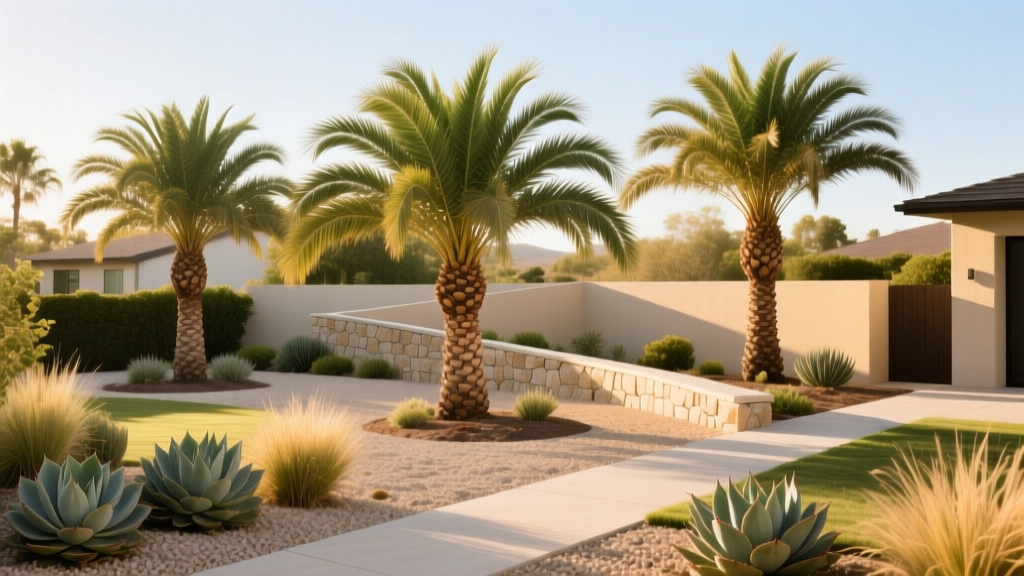
Beginner Guide to Designing Low-Maintenance Palm Tree Landscapes
The Monocot Advantage: Why Palms Require a Different Approach
Designing successful palm tree landscapes begins with understanding a fundamental botanical fact: palms are monocots, not true trees (dicots). Unlike oaks or maples, palms lack a vascular cambium layer. This means their trunks cannot expand in girth over time, and they cannot heal wounds. A single nick from a string trimmer or a climbing spike creates a permanent entry point for fatal pathogens like Ganoderma zonatum. For beginners, this dictates the golden rule of palm landscaping: protect the trunk at all costs and design your hardscaping to eliminate the need for mechanical trimming near the base.
Furthermore, palm root systems operate differently. They produce adventitious roots from a specialized area at the base of the trunk called the Root Initiation Zone (RIZ). If the RIZ is buried too deeply during planting, these roots will suffocate, leading to a slow, irreversible decline that often takes 12 to 18 months to manifest above ground.
Selecting Your Palms: Cold-Hardy vs. Tropical Frameworks
Choosing the right species prevents expensive replacements. Your landscape design must align with your USDA Hardiness Zone and the specific microclimates of your property. South-facing walls retain radiant heat, allowing for marginal tropical species, while open, wind-swept lawns require cold-hardy varieties.
| Species | Mature Height | USDA Zones | Canopy Spread | Landscape Use Case |
|---|---|---|---|---|
| Sabal Palmetto | 40-60 ft | 8-11 | 10-15 ft | Central focal point, street lining |
| Needle Palm | 5-8 ft | 6-11 | 4-6 ft | Shaded understory, foundation planting |
| Pindo Palm (Jelly) | 15-20 ft | 7-11 | 10-15 ft | Mid-story anchor, drought-tolerant beds |
| Pygmy Date Palm | 8-12 ft | 9-11 | 6-8 ft | Patio containers, entryway framing |
| Windmill Palm | 20-40 ft | 7-10 | 6-10 ft | Narrow spaces, cold-climate accents |
According to the Clemson University Home & Garden Information Center, matching the palm's mature canopy spread to your available overhead space is critical. Planting a Sabal Palmetto beneath a 20-foot power line will result in severe, disfiguring utility pruning within a decade.
Site Preparation and the Root Initiation Zone (RIZ)
Amateur landscapers often treat palms like broadleaf trees, digging deep holes and amending the backfill with rich, water-retentive potting soil. This is a fatal error. Palms require high drainage and oxygen exchange at the root level.
⚠️ Critical Planting Warning: Never bury the Root Initiation Zone. When planting, the top of the RIZ (the slight bulge at the very base of the trunk where roots emerge) must sit 1 to 2 inches above the surrounding grade. The soil will naturally settle over the first year. Planting too deep is the number one cause of transplant shock and mortality in new palm landscapes.
The Ideal Digging Protocol:
- Hole Width: Dig exactly 2 times the width of the root ball. Palms do not benefit from excessively wide holes filled with loose soil, which can cause the heavy root ball to sink post-planting.
- Hole Depth: Dig 2 inches shallower than the height of the root ball to ensure the RIZ remains elevated.
- Backfill: Use 100% native soil. If your native soil is heavy clay, mix in 30% coarse builder's sand (not play sand, which compacts) to improve percolation.
Underplanting and Companion Layering
A solitary palm in a sea of turfgrass is a missed design opportunity and a maintenance hazard, as mower blades frequently damage palm trunks. Instead, design a dedicated mulch bed extending at least 4 feet from the trunk in all directions.
For a cohesive, low-maintenance palm tree landscape, utilize the 'Rule of Thirds' for vertical layering. Your tallest tier is the palm canopy; the middle tier consists of structural shrubs; the ground tier features shade-tolerant, shallow-rooted epiphytes or groundcovers that won't compete with the palm's fibrous root mat.
Top Companion Plants for Palm Beds
- Coontie (Zamia pumila): A native, drought-tolerant cycad that thrives in the dappled shade beneath a palm canopy. Requires minimal irrigation once established.
- Bromeliads (Neoregelia species): Provide vibrant, year-round foliage color. Plant them in clusters of three or five at the base of the palm for a lush, tropical aesthetic.
- Soft Rush (Juncus effusus): Excellent for low-lying areas of the palm bed that tend to hold water after heavy rains.
- Asian Jasmine (Trachelospermum asiaticum): A dense, evergreen groundcover that suppresses weeds and eliminates the need to string-trim near the trunk.
Precision Nutrition: The 8-2-12-4Mg Formula
Palms are heavy feeders with specific micronutrient requirements that standard lawn fertilizers cannot meet. Applying high-nitrogen lawn fertilizer to a palm bed exacerbates potassium and magnesium deficiencies, leading to 'frizzle top' and fatal spear rot.
The University of Florida IFAS Extension recommends a specialized slow-release fertilizer with an N-P-K-Mg ratio of 8-2-12-4Mg. Crucially, this formulation must include a micronutrient package containing 1% to 2% Manganese (Mn), Iron (Fe), Zinc (Zn), Copper (Cu), and Boron (B). As detailed in their comprehensive guide on palm nutrient deficiencies, boron deficiency specifically causes 'hookleaf' and truncated, blunt-tipped new fronds.
Application Rates and 2026 Pricing
Apply the 8-2-12-4Mg fertilizer three times a year (early spring, early summer, and early fall). Broadcast the granules evenly under the entire canopy drip line, keeping it at least 6 inches away from the trunk itself.
- Rate: 1.5 pounds of actual nitrogen per 100 square feet of canopy area.
- Cost Expectation: In 2026, professional-grade 8-2-12-4Mg palm fertilizer (such as Sunniland or Lesco brands) costs between $65 and $85 per 50-pound bag. While more expensive upfront than generic 10-10-10, it prevents hundreds of dollars in corrective soil drenches and tree replacements.
The 'Clock-Face' Pruning Standard
Over-pruning is the most common aesthetic and physiological mistake in palm care. 'Hurricane cutting'—stripping a palm down to a few upright, vertical fronds—starves the tree of the potassium stored in older leaves and severely narrows the trunk, creating a weak point that can snap in high winds.
Adhere strictly to the International Society of Arboriculture (ISA) and UF/IFAS pruning guidelines: only remove fronds that are completely brown and dead, or those that hang below the horizontal plane.
The 9-to-3 Rule: Visualize the palm canopy as a clock face. The newest, upright frond is 12 o'clock. You should never remove any green or partially green frond that is positioned above the 9 o'clock and 3 o'clock horizontal lines. If a frond is pointing upward or straight out, it stays on the tree, regardless of minor yellowing on the tips.
By following this structural framework—protecting the RIZ during planting, utilizing specialized 8-2-12-4Mg nutrition, and enforcing strict 9-to-3 pruning—your palm tree landscapes will transition from high-maintenance liabilities to resilient, striking architectural features that appreciate in value alongside your property.

