
Tree Care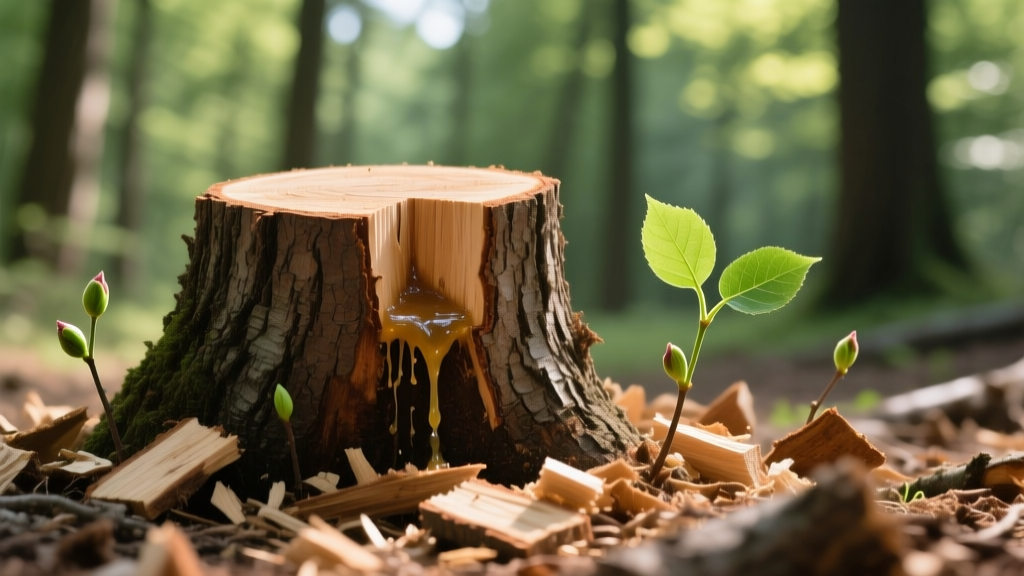
Can a Tree Stump Regrow? Species Guide & Sprout Prevention
The Biology of Stump Regrowth: Why It Happens
When you cut down a tree, the visible trunk is gone, but the root system remains fully intact and alive. The biological mechanism that allows a tree stump to regrow is driven by the cambium layer—the thin, living tissue located just inside the bark. This layer contains dormant buds that activate when the main canopy is removed, triggering a survival response known as epicormic sprouting or suckering.
The roots, suddenly deprived of the sugars produced by the leaves, panic and push stored carbohydrates upward to force new leaf growth. If left untreated, a single cut stump can produce dozens of vigorous, fast-growing shoots that eventually form a dense, multi-stemmed shrub. According to Penn State Extension, this regrowth is not merely a cosmetic nuisance; it actively drains energy from the root system, keeping the roots alive and expanding, which can threaten nearby infrastructure.
Which Tree Species Are Most Likely to Regrow?
Not all trees possess the same capacity for vegetative reproduction. Broadleaf deciduous trees are notorious for aggressive stump sprouting, while conifers generally lack this ability. Below is a breakdown of common yard trees and their regrowth vigor.
| Tree Species | Sprouting Vigor | Root Suckering Risk | Recommended Action |
|---|---|---|---|
| Willow (Salix) | Extreme | High (spreads rapidly) | Immediate chemical treatment or grinding |
| Poplar / Cottonwood | Extreme | Very High (colonial spread) | Grind and install root barrier |
| Elm (Ulmus) | High | Moderate | Chemical treatment to prevent Dutch Elm Disease vectoring |
| Red Oak (Quercus) | Moderate | Low | Monitor and treat sprouts with targeted herbicide |
| Maple (Acer) | Moderate to High | Low | Cut-stump herbicide application |
| Pine / Spruce / Fir | None | None | Leave to decay naturally or grind for aesthetics |
Identifying Stump Sprouts vs. Seedlings
Homeowners often confuse new seedlings blowing in from the wind with actual stump regrowth. Misidentifying the source leads to ineffective treatment. Here is how to tell them apart:
- Attachment Point: Stump sprouts emerge directly from the callus tissue (the ridged edge of the cut stump) or the root collar just below the soil line. Seedlings grow independently in the soil.
- Root Tracing: If you gently dig around the base of a sprout and it connects directly to the massive lateral root of the old stump, it is a sucker. A seedling will have a distinct, fragile taproot.
- Growth Rate: Sprouts grow explosively fast—often 3 to 5 feet in a single season—because they are fueled by an established, massive root system. Seedlings grow slowly.
⚠️ Warning: The Hidden Dangers of Ignoring Regrowth
Allowing hardwood stumps to continuously sprout and die back creates an entry point for wood-decay fungi and root rot pathogens. Furthermore, species like Elm and Oak can use the living root system as a bridge to transmit devastating diseases like Dutch Elm Disease or Oak Wilt to adjacent healthy trees via root grafts. Treating the stump is a critical biosecurity measure for your entire landscape.
Proven Methods to Stop a Tree Stump from Regrowing
To permanently kill a stump, you must destroy the cambium layer or desiccate the root system. Choose the method below that best fits your timeline, budget, and environmental preferences.
Method 1: Cut-Stump Herbicide Application (Fastest & Most Effective)
This method relies on systemic herbicides to travel down into the roots and kill them. Consumer-grade ready-to-use weed killers (typically 2% active ingredient) are entirely ineffective on mature stumps. You need a concentrated formulation.
- Select the Right Chemical: Use a concentrate containing Triclopyr (e.g., Ortho Poison Ivy & Brush Killer, Garlon 4) or Glyphosate (e.g., Roundup Pro). The active ingredient concentration must be between 20% and 40%.
- Timing is Critical: The most effective time to apply is late summer to early fall, when trees are actively translocating carbohydrates down to their roots for winter storage.
- The 15-Minute Rule: Herbicide must be applied within 15 minutes of cutting the tree. If the stump has dried, use a handsaw to slice off the top 1/2 inch to expose fresh, wet cambium.
- Targeted Application: Do not paint the entire stump. The dead heartwood in the center will not absorb the chemical. Use a foam brush to apply the herbicide strictly to the outer 2 inches of the stump (the cambium ring).
Method 2: Epsom Salt Desiccation (Chemical-Free Alternative)
If you prefer to avoid synthetic herbicides near water sources or vegetable gardens, 100% Magnesium Sulfate (Epsom salt) will draw moisture out of the wood, mummifying the roots. This process takes 6 to 12 months.
- Drill 8 to 12 holes into the top of the stump using a 1-inch spade bit. Drill as deep as possible (at least 10 inches).
- Drill additional holes at a 45-degree angle around the sides of the stump to intersect with the lateral roots.
- Fill each hole to the brim with pure Epsom salt. Do not use table salt (sodium chloride), which will permanently sterilize the surrounding soil.
- Pour a small amount of water into each hole to dissolve the salt, then seal the holes with melted candle wax or a waterproof tarp to prevent rain from washing the solution away.
Method 3: Professional Stump Grinding (Immediate Resolution)
Stump grinding physically shreds the stump and the upper root flare into woodchips. As of 2026, professional stump grinding costs average $4 to $7 per inch of diameter. A 24-inch stump will cost between $96 and $168.
Critical Depth Requirement: Ensure the arborist grinds to a depth of 12 to 18 inches below grade. Shallow grinding (only 4-6 inches) leaves the root collar intact, which is exactly where the most aggressive epicormic buds are located. According to the University of Minnesota Extension, removing the root collar is essential to prevent suckering in species like Poplar and Willow.
Decision Matrix: Should You Grind, Treat, or Leave It?
Use this framework to determine the most cost-effective and ecologically sound approach for your specific scenario.
| Scenario | Recommended Action | Why? |
|---|---|---|
| Conifer stump (Pine/Spruce) in a naturalized woodland area | Leave it | Conifers do not regrow. The stump will become a valuable "nurse log" for local wildlife and fungi. |
| Hardwood stump in the center of a manicured turf lawn | Grind to 12 inches | Prevents mower damage, eliminates tripping hazards, and allows immediate sod replacement. |
| Hardwood stump within 5 feet of a home foundation or retaining wall | Chemical treatment (Triclopyr) | Grinding large roots near foundations can cause soil subsidence and destabilize the structural base. Chemical treatment kills the roots while leaving the soil matrix intact. |
| Poplar/Willow stump near a septic system or water line | Grind + Install Copper Root Barrier | These species will aggressively seek water. Grinding removes the collar, and a physical barrier prevents remaining deep roots from infiltrating pipes. |
Expert FAQ on Stump Regrowth
Will covering the stump with dirt or mulch stop it from regrowing?
No. Piling soil or heavy mulch over a living stump will not suffocate it. In fact, the dark, moist environment will encourage the sprouts to grow etiolated (long and pale) as they search for sunlight, eventually pushing right through the mulch. Furthermore, piling soil against the bark of nearby living trees can cause collar rot.
Can I use diesel fuel or motor oil to kill a stump?
Absolutely not. While old internet myths suggest pouring diesel or motor oil on a stump, this is highly illegal in most municipalities, constitutes severe environmental contamination, and will poison the groundwater. It will also render the soil completely toxic, preventing you from ever planting grass or shrubs in that spot again. Stick to EPA-registered herbicides or Epsom salt.
How long does it take for a treated stump to fully decay?
Once the cambium is successfully killed via herbicide or desiccation, the decay process depends on the wood density. A softwood like Willow or Poplar will soften and decompose in 2 to 3 years. A dense hardwood like Oak or Hickory can take 5 to 7 years to fully break down into the soil profile, even after the roots are dead.

