
Tree Care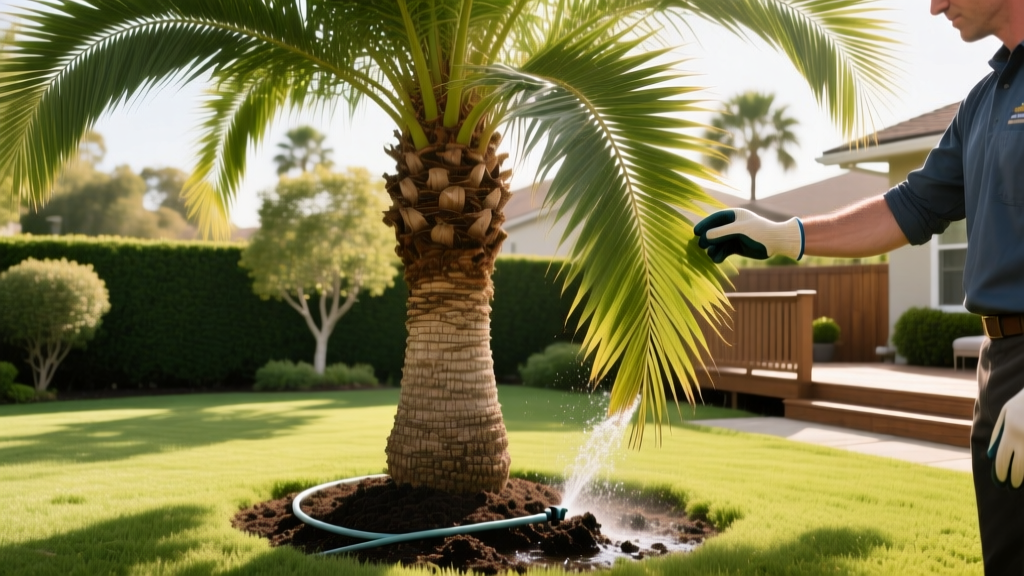
How to Care Palm Trees: Watering, Fertilizing, and Pruning
Palms are not true trees; they are monocots, sharing more physiological traits with grasses and corn than with oaks or maples. Because they lack a vascular cambium layer, palms cannot heal over wounds or secondary growth. If you want to properly care palm trees in your landscape, you must discard traditional broadleaf tree maintenance habits and adopt protocols tailored to their unique apical meristem growth structure.
This guide outlines the precise agronomic and arboricultural standards for palm maintenance, focusing on exact nutrient ratios, deep-watering volumetrics, and structural pruning rules that prevent fatal stress.
The 8-2-12-4Mg Fertilizer Framework
Applying standard 10-10-10 lawn fertilizer to a palm will induce severe nutrient antagonism. High phosphorus levels lock out iron and manganese in the soil profile, leading to fatal chlorosis. According to the University of Florida IFAS Extension, the only scientifically validated ratio for palm health is 8-2-12-4Mg (Nitrogen-Phosphorus-Potassium-Magnesium).
Agronomic Breakdown:
- Nitrogen (8%): Drives frond expansion and overall vigor.
- Phosphorus (2%): Kept intentionally low to prevent micronutrient lockout.
- Potassium (12%): Critical for trunk caliper strength, cold tolerance, and disease resistance.
- Magnesium (4%): Prevents 'frizzle top' and necrotic margin yellowing on older fronds.
Application Rates and 2026 Pricing
As of 2026, professional-grade sulfur-coated slow-release prills (such as Carl Pool Palm Food or Lesco Palm Special) cost between $45 and $65 per 50-pound bag. The exact application rate is 1.5 pounds of fertilizer per 100 square feet of canopy area, applied three times a year (early spring, early summer, and early fall).
Scatter the granules in a continuous ring starting one foot away from the trunk and extending to the drip line. Never pile fertilizer against the trunk base, as the high salt index of potassium sulfate will burn the adventitious roots and invite basal stem rot.
Precision Watering Schedules
Palms possess a dense, fibrous root ball that extends roughly 3 to 5 feet from the trunk in mature specimens. Shallow, frequent sprinkler cycles only wet the top two inches of soil, encouraging surface rooting and making the palm highly susceptible to windthrow during storms. You must deliver water directly to the 18-to-24-inch deep root zone.
| Trunk Caliper (Diameter) | Gallons Per Session | Summer Frequency | Winter Frequency |
|---|---|---|---|
| Under 6 inches | 5 - 8 gallons | 2x per week | 1x per week |
| 6 to 12 inches | 10 - 15 gallons | 2x per week | 1x per week |
| Over 12 inches | 20 - 30 gallons | 1x per week | Every 14 days |
Use a soil moisture probe, such as the Kenszer 24-inch Deep Soil Moisture Meter, to verify saturation at the 18-inch depth before initiating the next watering cycle. Overwatering in heavy clay soils causes hypoxia, rapidly leading to spear rot and fatal pythium infections.
The '9-to-3' Pruning Protocol
Over-pruning is the most common cause of premature palm death in residential landscapes. The practice of 'hurricane cutting'—stripping all but the topmost vertical fronds to reduce wind resistance—severely starves the palm of photosynthetic capacity and weakens the trunk. The UF/IFAS Pruning Guidelines mandate the 9-to-3 clock rule.
Step-by-Step Execution
- Visualize the Clock: Imagine the palm canopy as a clock face viewed from the side. The 12 o'clock position is straight up.
- Identify the Cut Line: Only remove fronds that hang below the horizontal plane (below the 9 o'clock and 3 o'clock positions).
- Assess Frond Color: Never remove green fronds, even if they are below the 9-to-3 line. The palm is actively drawing potassium and magnesium from those aging fronds to support new spear growth.
- Execute the Cut: Use a sterilized, curved carbon-steel saw (like the Felco 600 or Silky Hayauchi). Cut the petiole (stem) as close to the trunk as possible without gouging the trunk tissue. Trunk gouges do not heal and become permanent entry points for Ganoderma butt rot.
Critical Warning: Never use climbing spikes to ascend a palm trunk for pruning. Spikes puncture the vascular bundles, creating permanent wound columns that compromise the structural integrity of the trunk and invite fatal fungal pathogens.
Diagnosing Micronutrient Deficiencies
Visual symptoms on palm fronds act as a direct diagnostic map for soil chemistry. Because palms push all new growth from a single apical bud, deficiencies always manifest in specific patterns based on nutrient mobility.
- Magnesium Deficiency: Broad yellow bands along the outer margins of the oldest (lowest) fronds, with a green center. Fix: Apply the 8-2-12-4Mg fertilizer or supplement with magnesium sulfate (Epsom salt) at 1 lb per 100 sq ft.
- Potassium Deficiency: Translucent yellow-orange spots and necrotic tips on the oldest fronds. Fix: Increase potassium sulfate applications; ensure soil pH is below 7.0.
- Manganese Deficiency (Frizzle Top): Severely stunted, deformed, and frizzled newest fronds emerging from the central spear. Fix: Apply manganese sulfate as a foliar spray or soil drench immediately. This is common in highly alkaline soils (pH > 7.5).
- Boron Deficiency: Sharp, abrupt bends in the trunk or spear failure where the newest frond refuses to open. Fix: Apply Solubor (sodium borate) at a highly diluted rate of 1 ounce per 10 gallons of water as a soil drench. Boron is highly toxic to palms in excess; never exceed recommended dosages.
Managing Lethal Yellowing and Phytoplasma
Lethal Yellowing (LY) is a fatal phytoplasma disease vectored by the palm cixiid planthopper (Haplaxius crudus). It begins with the premature dropping of fruit, followed by the blackening of flower stalks, and a progressive yellowing that starts on the oldest fronds and moves up the canopy.
If your region is endemic to LY (such as South Florida, the Caribbean, or parts of Southern California), prophylactic trunk injections are mandatory for susceptible species like Coconut Palms and Queen Palms. The standard treatment is Oxytetracycline hydrochloride (e.g., Arborjet TREE-age). Professional arborists typically charge $15 to $25 per injection site, with treatments required every four months for the life of the tree. If a palm exhibits more than 25% canopy yellowing from LY, removal is the only viable option to prevent the vector from spreading the phytoplasma to adjacent healthy specimens.

