
Tree Care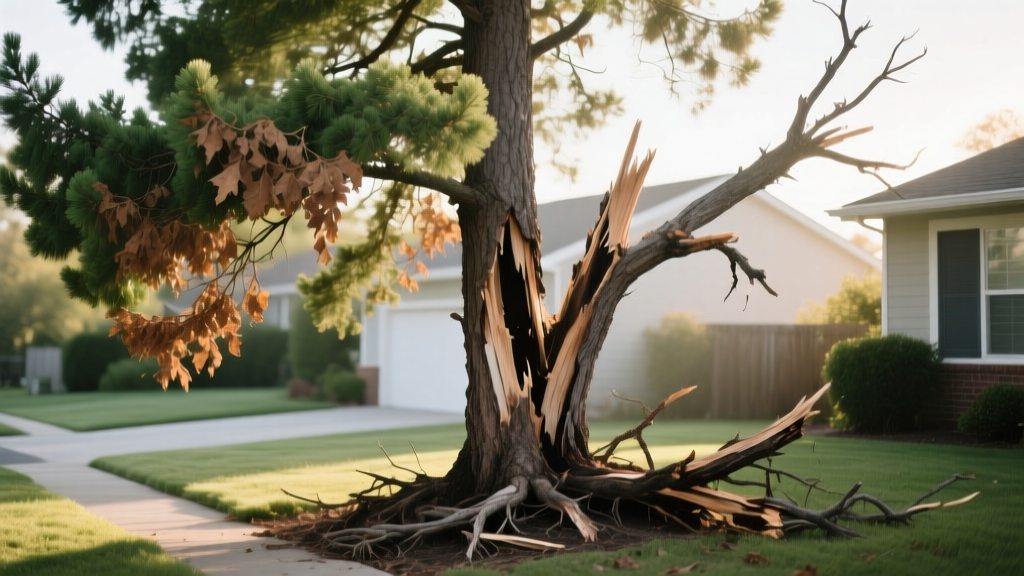
Cedar Park Tree Care: Fixing Drought and Storm Damage Symptoms
The Cedar Park Climate Paradox: Droughts and Microbursts
Trees in Cedar Park, Texas, endure one of the most punishing environmental cycles in the country. Situated on the Edwards Plateau, the region's shallow, alkaline caliche soils bake under extended flash droughts, only to be subjected to violent spring microbursts, high-shear winds, and severe hailstorms. When homeowners attempt standard landscaping maintenance, they often misdiagnose compounding stressors. A tree dropping leaves in August might not just be thirsty; it could be suffering from root asphyxiation caused by compacted soil from a May hailstorm. Effective Cedar Park tree care requires precise symptom differentiation and targeted rescue protocols.
Symptom Matrix: Drought Stress vs. Storm Trauma
Because drought and storm damage frequently occur within the same growing season, their symptoms often overlap. Use this diagnostic matrix to identify the primary stressor before applying rescue treatments.
| Symptom Category | Drought Stress Indicators | Storm / Hail Trauma Indicators |
|---|---|---|
| Leaf Canopy | Marginal scorch, crispy brown edges, uniform thinning across the outer crown. | Physical tearing, irregular shredding, asymmetrical dieback on the windward side. |
| Bark & Trunk | Longitudinal cracking (sunscald), premature shedding of outer bark plates. | Pockmarked scarring, stripped cambium layers, spiral wind-twist fissures. |
| Root Zone | Hydrophobic topsoil, fine feeder root death, soil pulling away from the trunk base. | Soil heaving, visible root plate shift, pooling water in newly formed depressions. |
| Secondary Pests | Hypoxylon canker, oak wilt vectors (nitidulid beetles) targeting stressed sap. | Flatheaded appletree borers, carpenterworms invading exposed hail wounds. |
Diagnosing and Rescuing Drought-Stressed Trees
Central Texas clay and caliche become virtually hydrophobic when completely desiccated. Sprinkler systems running for 15 minutes three times a week will only wet the top two inches of soil, encouraging shallow root growth that succumbs to the next heatwave.
The Deep-Watering Protocol for Edwards Plateau Soils
To rescue a drought-stressed Live Oak (Quercus virginiana) or Cedar Elm (Ulmus crassifolia), you must deliver water directly to the absorptive roots located 8 to 18 inches below the surface, primarily at and beyond the drip line.
- Calculate Volume: Mature trees require roughly 10 to 15 gallons of water per inch of trunk diameter (DBH) per week during peak drought. A 24-inch DBH Live Oak needs up to 360 gallons weekly.
- Equipment Setup: Use a soaker hose rated at 1 Gallon Per Hour (GPH) per foot. Coil the hose in concentric circles starting 2 feet from the trunk and extending 5 feet past the drip line.
- Application Timing: Run the soaker hose for 12 to 15 hours overnight to allow slow capillary action to penetrate the dense clay without triggering surface runoff.
Warning: The Hypoxylon Canker Threat
Prolonged drought weakens a tree's chemical defenses, inviting Hypoxylon canker. Look for sloughing bark revealing black or tan crusty stroma underneath. There is no chemical cure for this opportunistic pathogen. Rescue relies entirely on aggressive, deep-root hydration and the immediate removal of competing turfgrass within the drip line to eliminate water competition.
Prolonged drought weakens a tree's chemical defenses, inviting Hypoxylon canker. Look for sloughing bark revealing black or tan crusty stroma underneath. There is no chemical cure for this opportunistic pathogen. Rescue relies entirely on aggressive, deep-root hydration and the immediate removal of competing turfgrass within the drip line to eliminate water competition.
Triage and Repair for Storm and Hail Damage
Spring supercells in Williamson County frequently drop golf-ball-sized hail and generate 70 mph straight-line winds. The immediate instinct to 'clean up' a damaged tree with pruning shears often causes more long-term harm than the storm itself.
Crown Restoration Pruning (ANSI A300 Standards)
According to the International Society of Arboriculture (ISA), storm-damaged trees require crown restoration, not topping. Topping a wind-thrown or shattered tree stimulates weak, rapid watersprout growth that is highly susceptible to the next storm.
- Reduction Cuts: When removing a torn lateral branch, cut back to a side branch that is at least one-third the diameter of the removed limb. This ensures the remaining branch has enough vascular capacity to seal the wound.
- Stub Removal: Flush cuts that damage the branch collar destroy the tree's natural compartmentalization zone (CODIT). Always cut just outside the branch bark ridge.
- Wound Sealants: Never apply pruning paint, tar, or epoxy to storm wounds. Research from Texas A&M AgriLife Extension confirms that sealants trap moisture, accelerate decay fungi, and inhibit the formation of protective callus tissue.
Managing Hail Scarring and Borer Vulnerability
Hail impacts strip the protective outer bark, exposing the nutrient-rich phloem and cambium. In Cedar Park, these wounds act as beacons for the Flatheaded Appletree Borer and carpenterworms. Monitor hail-scarred trunks weekly from May through August. If you spot frass (sawdust-like excrement) or sap weeping from the impact craters, the tree requires targeted systemic insecticides containing emamectin benzoate, applied via trunk injection by a licensed applicator to bypass the alkaline soil binding issues common in the region.
The Caliche Factor: Post-Storm Root Zone Triage
The underlying geology of Cedar Park features a hardpan caliche layer (calcium carbonate) that sits just 12 to 24 inches below the topsoil. Heavy storm rains pool against this impermeable layer, drowning deep roots and causing hypoxia (oxygen starvation).
'If your Pecan or Texas Ash tree shows sudden canopy yellowing and leaf drop three weeks after a massive rain event, it is likely drowning in a perched water table sitting on the caliche shelf, not suffering from a nutrient deficiency.'
The Rescue Fix: Vertical mulching. Using a 2-inch soil auger, drill holes 18 inches deep in a grid pattern every 3 feet across the drip line. Fill these holes with a mix of expanded shale and coarse compost. This fractures the caliche tension, creates vertical drainage chimneys, and restores oxygen to the root zone without the massive expense of pneumatic air-spading.
Decision Framework: DIY Rescue vs. ISA Certified Arborist
Knowing when to deploy your own labor versus hiring a professional is critical for both tree survival and your 2026 landscaping budget.
| Intervention Task | DIY Feasibility | Estimated Professional Cost (2026) | When to Call a Pro |
|---|---|---|---|
| Deep Soaker Hydration | High | $85 - $150 / visit | If you lack overnight watering access or physical ability to move 100+ ft of hoses. |
| Small Limb Pruning (<2 in.) | High | Included in health assessments | Never required for small, reachable twigs; use sterilized bypass pruners. |
| Vertical Mulching / Augering | Moderate | $250 - $450 / tree | If the soil is heavily compacted with embedded limestone rocks that stall manual augers. |
| Dynamic Cabling & Bracing | Zero (Dangerous) | $500 - $950 / system | When a multi-trunk Live Oak has a V-shaped union with included bark and storm-split risk. |
| Pneumatic Air-Spading | Zero (Specialty Gear) | $350 - $600 / hour | For severe root girdling or removing soil fill graded over the root flare during construction. |
Long-Term Resilience Planning
Reactive fixes will only sustain your trees for a single season. True Cedar Park tree care demands proactive soil management. Apply a 3-inch layer of native hardwood mulch over the entire root zone, keeping it strictly 4 inches away from the root flare to prevent basal rot. This single practice buffers the soil against the 105°F August surface temperatures, reduces evaporation by up to 40%, and slowly introduces organic acids that help neutralize the highly alkaline caliche soil, unlocking bound micronutrients like iron and manganese for long-term canopy vigor.

