
Tree Care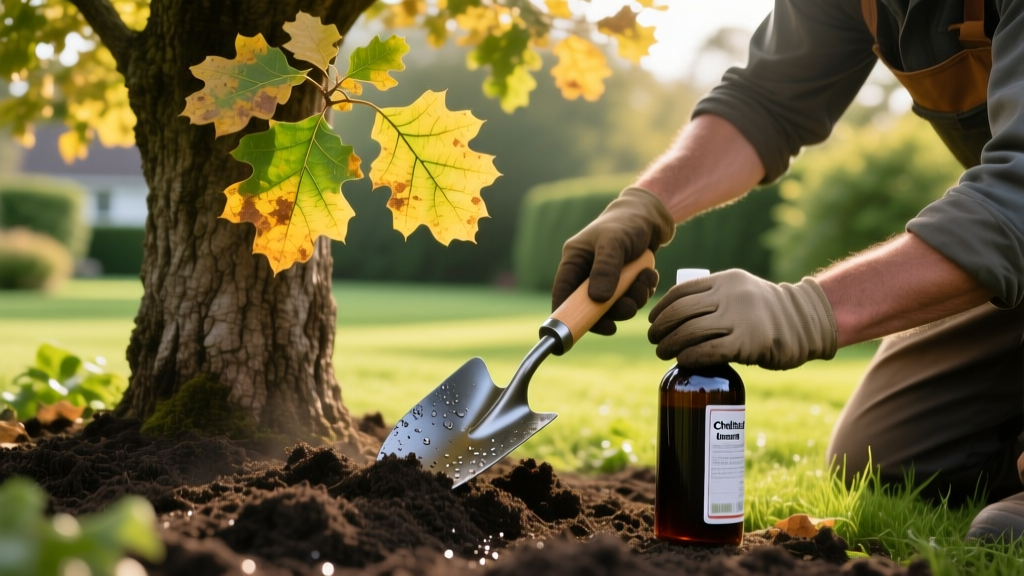
How to Apply Chelated Iron for Trees to Cure Leaf Chlorosis
The Chemistry of Iron Lockout in Alkaline Soils
When a tree’s newest leaves emerge pale yellow with distinct dark green veins, it is suffering from interveinal chlorosis. While the immediate assumption is an iron deficiency, the soil usually contains abundant iron. The problem is chemical unavailability. In soils with a pH above 7.0, soluble iron (Fe2+) rapidly oxidizes into insoluble iron (Fe3+), essentially turning into rust that roots cannot absorb. Standard iron sulfate fertilizers fail in these conditions because they lock up within days of application.
To bypass this soil chemistry trap, arborists use chelated iron. A chelate is a synthetic organic molecule that wraps around the iron ion, shielding it from oxidation and keeping it soluble in the soil solution long enough for root uptake. However, not all chelates are created equal. Selecting the wrong chelate for your specific soil pH is the primary reason treatments fail.
The Chelate Selection Matrix: EDDHA vs. DTPA vs. EDTA
Matching the chelating agent to your soil’s pH is non-negotiable. According to the University of Minnesota Extension, applying a weak chelate in highly alkaline soil results in the chelate breaking down, releasing the iron to oxidize immediately.
| Chelate Type | Effective Soil pH Range | Best Use Case | Average Cost (2026) |
|---|---|---|---|
| Fe-EDDHA | 4.0 to 9.0 | Highly alkaline soils, heavy clay, desert landscapes | $45 - $65 per lb |
| Fe-DTPA | 4.0 to 7.5 | Slightly alkaline to neutral soils, standard suburban lawns | $20 - $35 per lb |
| Fe-EDTA | 4.0 to 6.5 | Acidic soils, container trees, ericaceous plants | $12 - $18 per lb |
Expert Insight: The Ortho-Ortho Isomer
When purchasing Fe-EDDHA, check the label for the ortho-ortho isomer percentage. Cheap EDDHA products rely heavily on the ortho-para isomer, which degrades rapidly at pH levels above 7.5. For severely alkaline soils (pH 8.0+), you need a product with at least 40% to 50% ortho-ortho EDDHA to ensure the iron remains available to the tree throughout the growing season.
When purchasing Fe-EDDHA, check the label for the ortho-ortho isomer percentage. Cheap EDDHA products rely heavily on the ortho-para isomer, which degrades rapidly at pH levels above 7.5. For severely alkaline soils (pH 8.0+), you need a product with at least 40% to 50% ortho-ortho EDDHA to ensure the iron remains available to the tree throughout the growing season.
Step-by-Step Soil Drench Application Protocol
Soil drenching is the most effective and longest-lasting application method for established trees. Foliar sprays only offer a temporary cosmetic fix (lasting 3-4 weeks) and can burn leaf tissue if mixed improperly. Follow this protocol for lasting results.
- Measure the Trunk Caliper: Use a diameter tape or calipers to measure the trunk diameter at 4.5 feet above ground level (breast height). If the tree has multiple trunks, measure each and add the diameters together.
- Calculate the Dose: For Fe-EDDHA, the standard therapeutic rate is 1.5 to 2.0 ounces of product per inch of trunk caliper. A tree with a 10-inch caliper requires 15 to 20 ounces of chelate.
- Pre-Hydrate the Soil: Chelates require moisture to move through the soil profile. Deeply water the area under the tree’s drip line 24 hours before application.
- Mix and Apply: Dissolve the measured powder in 5 to 10 gallons of water. Apply the solution evenly across the soil surface within the drip line, concentrating heavily in the zone 3 to 6 feet away from the trunk where the highest density of feeder roots exists.
- Water In: Immediately apply an additional 0.5 inches of irrigation to wash the chelate off the surface and into the top 6-12 inches of the root zone, preventing UV degradation of the chelate molecule.
When Soil Drenches Fail: Trunk Injection Alternatives
In highly compacted urban soils, heavy caliche, or sites with extreme pH (above 8.5), soil-applied chelates may still bind up before reaching the roots. In these edge cases, bypassing the soil entirely via trunk injection is required.
Professional arborists use systems like the Arborjet QUIK-jet or the TREE I.V. system to inject liquid iron directly into the xylem. For homeowners, DIY macro-infusion capsules (such as Medicap) are available, though they require drilling 5/16-inch holes around the trunk flare. Trunk injections provide rapid greening within 14 to 21 days but carry a risk of introducing wood-decay pathogens if drill bits are not sterilized with 70% isopropyl alcohol between trees. The Colorado State University Extension recommends limiting trunk injections to once every two years to prevent cumulative cambial damage.
Top Commercial Chelated Iron Formulations (2026 Market Guide)
Do not waste money on generic hardware store liquid iron products for large landscape trees; they are typically dilute Fe-EDTA solutions meant for potted houseplants. Invest in professional-grade formulations.
- BASF Sequestrene 138 Fe: The industry gold standard. Contains 6% ortho-ortho EDDHA chelated iron. Highly effective in desert and high-pH clay soils. Pricing averages $55 for a 5-pound jug.
- Miller’s FerriPlus: A direct competitor to Sequestrene 138, featuring 5% EDDHA with a high ortho-ortho ratio. Slightly more soluble in cold water. Pricing averages $48 for a 5-pound jug.
- Southern Ag Chelated Liquid Iron: A 5% DTPA/EDTA blend. Excellent for slightly alkaline soils (pH 7.0-7.4) and preventative maintenance. Pricing averages $24 per gallon.
Troubleshooting: Why Your Treatment Isn’t Working
If you have applied the correct EDDHA chelate at the proper dosage and the tree remains chlorotic after 45 days, you are likely facing one of three specific failure modes:
1. Misdiagnosis: Manganese Deficiency
Manganese deficiency presents with interveinal chlorosis that is visually identical to iron deficiency, though it often affects older leaves first rather than new growth. Applying iron will not cure a manganese deficiency. You must submit a foliar tissue test to a university extension lab to confirm which micronutrient is actually lacking.
2. Bicarbonate Lockout from Irrigation Water
If you are irrigating with well water or municipal water high in dissolved bicarbonates (above 120 ppm), the bicarbonates will actively neutralize the chelating agent and raise the localized soil pH around the roots. Test your irrigation water alkalinity. If bicarbonates are high, you must acidify your irrigation water with sulfuric acid or use a reverse osmosis filter for the application zone.
3. Phosphorus Antagonism
Excessive soil phosphorus (often from years of heavy lawn fertilizer runoff) binds with iron inside the plant's vascular system, rendering it immobile even if the roots successfully absorbed it. If a soil test shows phosphorus levels above 100 ppm, halt all phosphorus-containing fertilizers and rely exclusively on trunk injections until soil P levels drop.

