
Tree Care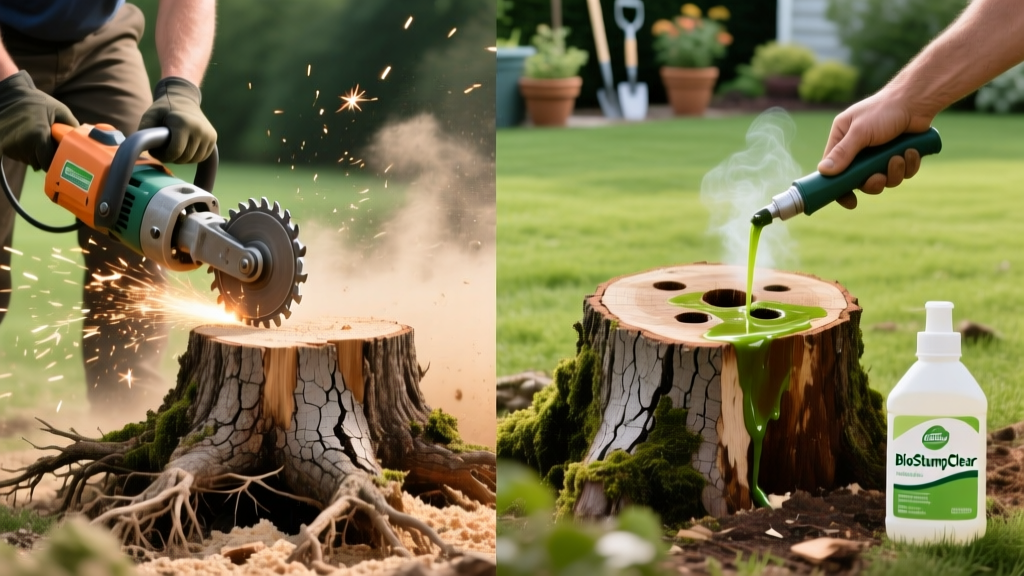
Chemical vs. Mechanical Tree Stump Remover: Which Method Works Best?
The Aftermath of Tree Removal: Dealing With the Stump
Removing a hazardous or dead tree is only half the battle. The remaining stump poses tripping hazards, attracts wood-boring pests like carpenter ants and termites, and complicates lawn mowing. Homeowners generally face a critical decision: use a chemical tree stump remover to accelerate decay, or rent mechanical equipment to grind it out immediately. Both methods have distinct cost profiles, labor requirements, and long-term impacts on your soil ecology.
This guide breaks down the exact science, costs, and step-by-step execution for chemical and mechanical stump removal, helping you choose the right approach based on your stump's diameter, species, and your timeline.
The Decision Matrix: Quick Guide to Stump Removal
Before purchasing supplies or renting heavy machinery, evaluate your specific scenario using this framework:
- Choose Chemical Removers If: The stump is under 24 inches in diameter, you have 4 to 8 weeks to wait, your budget is under $20, and the stump is not located near desirable garden beds (to avoid chemical leaching).
- Choose Mechanical Grinding If: The stump is over 24 inches, you need the area cleared immediately for sod or hardscaping, you have a budget of $150 to $400, and you are physically capable of handling a 100+ lb vibrating machine.
- Choose Manual Extraction If: The tree was recently cut, the stump is under 12 inches in diameter, and the root ball is shallow (common in softwood species like pine or spruce).
Chemical Tree Stump Remover: Potassium Nitrate Breakdown
Commercial chemical stump removers rely almost exclusively on Potassium Nitrate (KNO3), typically in a 100% concentration. Unlike herbicides that kill living tissue, KNO3 acts as a powerful nitrogen source that hyper-accelerates the natural fungal and bacterial decay process. It essentially feeds the microbes that digest lignin and cellulose, turning solid wood into a spongy, easily removable mass.
Warning: Do not use potassium nitrate near vegetable gardens, water features, or the drip line of desirable trees. High nitrogen concentrations can cause severe root burn and alter local soil pH.
Step-by-Step Chemical Application
- Cut Low: Use a chainsaw to cut the stump as close to the ground as possible (1-2 inches above grade). Fresh cuts absorb chemicals better than weathered, sealed wood.
- Drill the Pattern: Using a 1-inch spade bit and a high-torque drill, bore holes 10 to 12 inches deep into the top of the stump. Space the holes 3 inches apart in concentric circles, staying 2 inches away from the outer bark edge to prevent the granules from spilling onto the soil.
- Angle the Outer Edge: Drill additional holes at a 45-degree angle from the sides of the stump, intersecting with the vertical holes to create internal channels.
- Fill and Hydrate: Pour KNO3 granules (such as Spectracide or Bonide formulations, costing roughly $10 to $15 per 16oz bottle) into the holes until they are nearly full. Top off each hole with warm water to dissolve the granules and carry the solution deep into the root system.
- Seal and Wait: Cover the stump with a dark, heavy-duty tarp and weigh down the edges with bricks. This traps moisture and heat, creating an ideal environment for decay-causing fungi. Reapply water and granules every two weeks.
Timeline: Softwoods (pine, fir) will become spongy in 4 to 6 weeks. Dense hardwoods (oak, hickory, maple) may take 8 to 12 weeks. Once the wood is spongy, you can chop it out with a mattock or carefully burn it out (check local fire ordinances first).
Mechanical Stump Grinding: The Heavy-Duty Alternative
For immediate results, mechanical stump grinding is the industry standard. A stump grinder uses a high-torque, rotating cutting wheel equipped with carbide-tipped teeth to chip away the wood 4 to 6 inches below ground level. According to the Arbor Day Foundation, grinding is the most efficient way to remove stumps without disturbing the surrounding soil structure as severely as manual excavation.
Renting vs. Hiring a Professional
You can rent a walk-behind stump grinder from equipment rental yards for approximately $150 to $250 for a four-hour window, or $300 to $400 for a full day. However, these machines weigh between 150 and 300 pounds and possess violent lateral torque. If the cutting wheel catches a buried rock or thick lateral root, the machine can jerk dangerously.
Hiring a certified arborist or landscaping professional typically costs $2.50 to $5.00 per inch of stump diameter. For a 30-inch oak stump, expect to pay between $75 and $150 for a professional to grind it out, which often includes hauling away the woodchips and backfilling the hole.
Execution and Safety Protocols
If you choose the DIY rental route, strict safety protocols are non-negotiable:
- Clear the Zone: Remove all rocks, mulch, and soil from the base of the stump. Dirt and stones will instantly dull the carbide grinding teeth, rendering the machine ineffective and requiring expensive replacement parts.
- PPE Requirements: Wear ANSI Z87.1-rated safety goggles (not just glasses), heavy-duty hearing protection (grinders operate at 95+ decibels), steel-toe boots, and close-fitting clothing.
- The Sweeping Motion: Never plunge the wheel straight down. Start at the outer edge of the stump and use a side-to-side sweeping motion, grinding away 2 to 3 inches of depth per pass until you reach 6 inches below grade.
Head-to-Head Comparison Matrix
| Feature | Chemical (KNO3) | Mechanical Grinding | Manual Digging |
|---|---|---|---|
| Time Required | 4 to 12 weeks | 1 to 3 hours | 4 to 8 hours |
| Average Cost | $10 - $20 | $150 - $400 | $0 (Labor only) |
| Physical Labor | Low (Drilling) | Moderate (Machine handling) | Extreme (Digging/Chopping) |
| Soil Disruption | Minimal | Low (Leaves woodchips) | Severe (Large crater) |
| Best Stump Size | Under 24 inches | Any size | Under 12 inches |
Debunking the Epsom Salt Internet Myth
A pervasive DIY myth suggests using Epsom salt (Magnesium Sulfate) as a natural tree stump remover. While high concentrations of Epsom salt will eventually desiccate and kill living root tissue through osmotic shock, it does not accelerate the decay of dead wood. Furthermore, dumping pounds of magnesium sulfate into your yard severely alters the soil's cation exchange capacity, leading to magnesium toxicity that locks out calcium and potassium, effectively sterilizing the soil for future planting. Stick to Potassium Nitrate for chemical acceleration, or use mechanical force.
Post-Removal Soil Rehabilitation
Regardless of the removal method, you will be left with a hole filled with wood debris. The University of Minnesota Extension warns against simply covering ground woodchips with topsoil and planting grass or shrubs immediately.
As the remaining woodchips decompose, soil microbes consume massive amounts of nitrogen to break down the high-carbon material. This process, known as nitrogen immobilization, will starve any new grass or plants of essential nutrients, resulting in yellow, stunted growth.
Pro-Tip for Replanting: Shovel out as much of the woodchip and sawdust mixture as possible. Backfill the cavity with a 50/50 mix of native soil and high-quality compost. If you must plant grass over the site immediately, apply a high-nitrogen fertilizer (such as a 30-0-0 formulation) at double the standard rate to compensate for the microbial nitrogen tie-up occurring beneath the surface.
Final Verdict
There is no universal 'best' tree stump remover; the right choice depends entirely on your timeline and budget. If you are preparing a site for a new patio or need an immediate aesthetic fix, the upfront cost of mechanical grinding is justified by the instant results and labor savings. However, if you are managing a large property with multiple stumps and have a season to wait, the chemical application of Potassium Nitrate offers a highly effective, low-labor alternative that respects your budget and your back.

