
Tree Care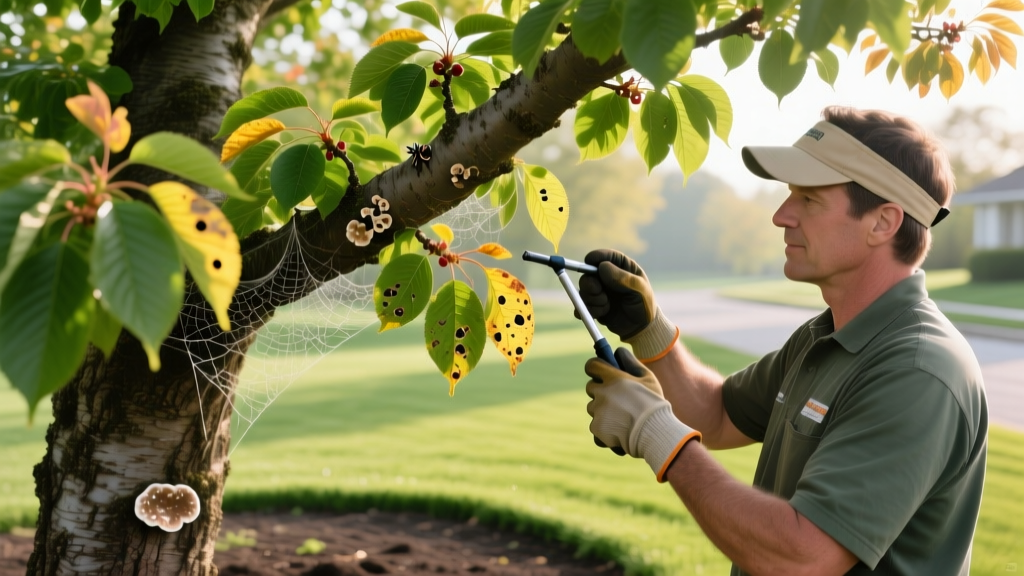
Cherry Tree Drooping Leaves: 5 Causes and Fast Rescue Fixes
When a cherry tree (Prunus spp.) develops drooping leaves, it is signaling a hydraulic failure within its vascular system or root zone. Unlike hardy shade trees that can tolerate weeks of stress, cherry trees have shallow, highly sensitive root systems and thin bark that make them exceptionally vulnerable to moisture fluctuations, soil-borne pathogens, and transplant trauma. Ignoring the initial wilt can lead to irreversible cambial death within 7 to 10 days during peak summer heat.
This diagnostic guide bypasses generic watering advice to provide a precise, symptom-based framework for identifying the exact cause of your cherry tree drooping leaves and executing targeted rescue protocols using current 2026 arboricultural standards.
The Diagnostic Matrix: Pinpointing the Wilt
Before applying any treatments, cross-reference your tree's specific symptoms with this diagnostic matrix to avoid misdiagnosis. Applying water to a tree suffering from root rot will accelerate its death.
| Visual Symptom | Soil Condition | Time of Day | Probable Culprit |
|---|---|---|---|
| Uniform drooping, leaves crisp at edges | Dry below 4 inches | Afternoon / Evening | Environmental Drought Stress |
| Limp, dull green leaves, no crisping | Soggy, smells anaerobic | Morning through Night | Phytophthora Root Rot |
| One-sided wilt (single branch or scaffold) | Normal moisture | Constant | Verticillium Wilt |
| Overall wilting shortly after planting | Variable / Compacted | Mid-day peak heat | Transplant Shock |
| Drooping with yellowing, sawdust at base | Normal | Constant | Peachtree Borer Infestation |
The 5 Primary Culprits Behind Cherry Tree Drooping Leaves
1. Transplant Shock & Root Desiccation
Newly planted cherry trees, particularly bare-root or balled-and-burlapped (B&B) specimens, lose up to 90% of their absorbing root network during harvest and transport. The remaining roots cannot pull enough water to support the existing canopy, resulting in drooping leaves even in moist soil.
The Fix: Apply an anti-transpirant like Bonide Wilt-Pruf (retailing around $18/quart in 2026) to the foliage. This polymer coating reduces leaf transpiration by up to 40%, buying the root system 3 to 4 weeks to regenerate. Water the root ball directly with 10 gallons per inch of trunk caliper every 3 days for the first month. Do not fertilize; high nitrogen salts will burn compromised roots.
2. Overwatering & Phytophthora Root Rot
Cherry trees require well-draining soil. When planted in heavy clay or depressed yard areas, water pools around the root crown, suffocating the roots and inviting Phytophthora cinnamomi, a devastating water mold. The leaves will droop, turn a dull yellow-green, and eventually drop while still pliable.
⚠️ The Percolation Test: Dig a 12-inch deep hole near the drip line. Fill it with water and time the drainage. If it takes longer than 4 hours to drain, your soil is perched and highly conducive to Phytophthora. You must aerate or install a French drain immediately.
The Fix: Halt all irrigation. Pull mulch away from the trunk flare to allow the crown to dry. For active infections, professional arborists use Subdue MAXX (mefenoxam). Homeowners can apply a systemic phosphorous acid drench like Agri-Fos (approx. $38/pint), mixed at 2 oz per gallon of water, poured directly over the root zone to halt pathogen spread.
3. Verticillium Wilt (The Fatal Vascular Blockage)
Caused by the soil-borne fungus Verticillium dahliae, this disease physically plugs the tree's xylem (water-conducting tissue). The hallmark symptom is asymmetric wilting—one side or a single scaffold branch will droop and die back while the rest of the tree appears healthy. According to the University of Maryland Extension, maples and cherries are highly susceptible.
The Diagnostic Scratch Test: Sterilize a pocket knife and scrape the bark on the wilting branch. If the underlying cambium shows olive-green or blackish streaks, Verticillium is confirmed.
The Fix: There is no chemical cure for Verticillium wilt. Prune out infected branches 12 inches below the visible streaking, sterilizing your saw with 70% isopropyl alcohol between every single cut. If the main trunk is streaked, the tree must be removed and replaced with a resistant species like Prunus maackii (Amur chokecherry).
4. Environmental Stress & Summer Drought
Mature cherry trees can suffer from hydraulic cavitation during prolonged dry spells where temperatures exceed 85°F. The tree sacrifices its leaves to preserve core trunk moisture. Drooping is usually accompanied by marginal leaf scorch (brown, crispy edges).
The Fix: Surface watering is ineffective due to shallow turf roots competing for moisture. Use a deep-root watering spike (such as the Dramm Deep Root Waterer, ~$25) attached to your hose. Insert it 8 inches into the soil at the drip line and let it run at a trickle for 45 minutes per zone. Apply a 3-inch layer of arborist wood chips to retain soil moisture.
5. Pest Pressure: Peachtree Borer
The peachtree borer (Synanthedon exitiosa) tunnels into the lower trunk and root crown, severing the flow of water and nutrients. Look for drooping leaves combined with masses of hardened, gummy sap and frass (sawdust-like excrement) at the soil line. The Clemson University Extension notes that stressed trees emit volatile compounds that actively attract these borers.
The Fix: For active larvae, carefully probe the entry holes with a flexible wire to crush them. To prevent future generations, apply a systemic soil drench of Imidacloprid (e.g., Bayer Advanced 12 Month Tree & Shrub) in early spring before adult moths emerge in June. Cost is roughly $20 for a 32oz concentrate, which treats multiple trees.
Your 48-Hour Rescue Protocol
If your cherry tree's leaves are actively drooping today, execute this timeline to maximize the chance of recovery.
- Hour 0-2 (Audit): Perform the soil percolation test and the cambial scratch test. Determine if the issue is moisture-related (too wet/too dry) or vascular (pathogen).
- Hour 2-4 (Correct Moisture): If dry, deploy the deep-root watering spike. If waterlogged, rake back all mulch and use a garden fork to vertically pierce the soil 10 inches deep in 10 spots around the drip line to introduce oxygen to the roots.
- Hour 24 (Protect Foliage): If the roots are compromised (transplant shock or rot), spray the canopy with an anti-transpirant (Wilt-Pruf) at dusk to prevent the leaves from desiccating while the roots recover.
- Hour 48 (Monitor): Check the cambium again. If the tissue remains pale green, the tree is surviving. If it turns brown, prepare for removal.
"Cherry trees do not recover from prolonged vascular wilt. If a homeowner waits until more than 30% of the canopy has drooped and defoliated, the tree's carbohydrate reserves are usually too depleted to push new growth, even with aggressive fungicide and hydration therapies."
— Best Practices for Stone Fruit Ornamentals, The Morton Arboretum
Summary: Quick-Reference Rescue Actions
- Transplant Shock: Wilt-Pruf spray + 10 gal/inch caliper watering.
- Root Rot: Stop watering, expose trunk flare, apply Agri-Fos drench.
- Verticillium Wilt: Sterilize tools, prune 12" below streaks, or remove tree.
- Drought: Deep root spike watering + 3" wood chip mulch ring.
- Borers: Wire-probe holes, apply Imidacloprid soil drench in spring.

