
Tree Care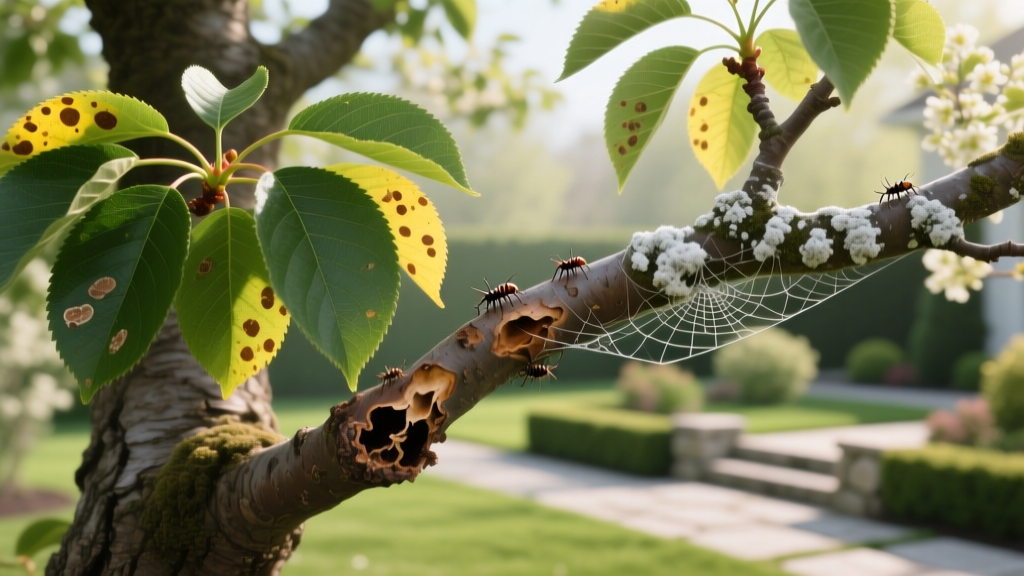
Cherry Tree Illness Diagnosis: Spot & Treat 5 Common Diseases
The Diagnostic Framework: Reading Your Cherry Tree's Symptoms
Diagnosing a cherry tree illness requires moving beyond generic assumptions of 'tree sickness.' Cherry trees (both sweet Prunus avium and tart Prunus cerasus varieties) are highly susceptible to specific fungal and bacterial pathogens that thrive in humid, stagnant microclimates. The most critical mistake homeowners make is applying broad-spectrum fungicides without identifying the pathogen's life cycle. Bacterial infections require entirely different management timelines than fungal spores, and applying the wrong treatment can exacerbate the decline.
⚠ Arborist Warning: Never prune a diseased cherry tree during or immediately after rainfall. Moisture activates fungal spores and bacterial ooze, turning your pruning tools into vectors that will spread the cherry tree illness to healthy tissue.
Top 5 Cherry Tree Illnesses and Targeted Treatments
1. Black Knot (Apiosporina morbosa)
Black knot is a devastating fungal disease that manifests as rough, elongated, blackish-brown swellings (galls) on twigs and branches. Initially velvety and olive-green in spring, these galls harden and turn coal-black by late summer. If left untreated, the galls girdle the branch, cutting off nutrient flow and eventually killing the entire limb.
- Failure Mode: Homeowners often prune directly at the base of the visible gall. The fungal mycelium extends internally far beyond the visible swelling.
- Solution: Prune at least 6 to 8 inches below the lowest visible edge of the gall. Remove and burn or bury the clippings immediately; do not compost them. According to the University of Minnesota Extension, destroying the pruned material is mandatory, as the fungus will continue to release spores from dead wood for months.
2. Cherry Leaf Spot (Blumeriella jaapii)
This fungus targets the foliage, appearing as small, circular, purple-to-brown spots on the upper leaf surface. As the illness progresses, the centers of these spots drop out, creating a characteristic 'shot-hole' appearance. Severe infections cause premature defoliation, weakening the tree's winter hardiness and reducing next year's fruit yield.
- Failure Mode: Waiting until the leaves are visibly spotted to apply fungicide. By the time symptoms appear, the infection is already systemic within the leaf tissue.
- Solution: Apply a preventive fungicide like Bonide Liquid Copper Fungicide (approx. $16 per 32oz concentrate) or a Chlorothalonil-based product at petal fall, and repeat every 10 to 14 days during wet spring weather. The Royal Horticultural Society emphasizes that rigorous autumn leaf cleanup is just as critical as chemical control to eliminate overwintering spores.
3. Brown Rot (Monilinia fructicola)
Brown rot attacks blossoms, twigs, and fruit. Infected blossoms turn brown and collapse (blossom blight), while infected fruit develops soft brown lesions covered in concentric rings of gray, powdery spores. The fruit eventually shrivels into hard 'mummies' that cling to the branches.
- Failure Mode: Leaving mummified fruit on the tree or the ground. These mummies act as primary inoculum sources for the following spring.
- Solution: Hand-pick all mummified fruit during winter dormancy. Apply a dormant spray of Monterey Liqui-Cop Copper Fungicidal Garden Spray ($18 for 32oz) just before bud swell. During the growing season, use a Myclobutanil-based fungicide like Spectracide Immunox ($15) if fruit is developing.
4. Bacterial Canker (Pseudomonas syringae)
This bacterial cherry tree illness is notoriously difficult to manage. Symptoms include dead buds, dieback of shoots, and the exudation of sour-smelling, amber-colored gum from bark lesions (gummosis). The bacteria enter through pruning wounds, frost cracks, or leaf scars.
- Failure Mode: Applying copper sprays in the spring. Sweet cherry foliage is highly sensitive to copper during the growing season; spring applications will cause severe phytotoxicity (leaf burn) and premature defoliation, worsening the tree's stress.
- Solution: Copper sprays (like Bordeaux mixture) must ONLY be applied in late autumn after leaf drop and in late winter before bud break. Prune out infected branches during dry summer weather when bacterial populations on the bark are lowest.
5. Powdery Mildew (Podosphaera clandestina)
Powdery mildew presents as white, powdery fungal mats on new shoots, suckers, and the undersides of lower leaves. While rarely fatal to mature trees, it stunts new growth and severely impacts the aesthetic value and fruit quality of ornamental and orchard cherries.
- Failure Mode: Relying solely on chemical treatments without addressing the microclimate. Powdery mildew thrives in high humidity but does not require free water to germinate.
- Solution: Improve canopy airflow by selectively thinning interior branches and removing all root suckers. Apply a horticultural oil (like Neem oil) or a potassium bicarbonate spray at the first sign of white mycelium.
Fungicide Active Ingredients & Application Matrix
| Active Ingredient | Brand Example | Target Illness | Application Window | Est. Cost |
|---|---|---|---|---|
| Copper (Metallic) | Monterey Liqui-Cop | Bacterial Canker, Brown Rot | Dormant (Fall/Winter) | $18 / 32oz |
| Chlorothalonil | Daconil Ultimate | Cherry Leaf Spot | Petal Fall & Spring | $22 / 32oz |
| Myclobutanil | Spectracide Immunox | Brown Rot, Powdery Mildew | Pink Bud to Harvest | $15 / 16oz |
| Potassium Bicarbonate | GreenCure | Powdery Mildew | First Sign of Symptoms | $25 / 1lb |
Step-by-Step Sanitation and Pruning Protocol
When surgically removing diseased wood, your sanitation protocol is just as important as the cut itself. Penn State Extension notes that poor tool hygiene is the leading cause of secondary infections in stone fruit orchards.
- Select the Right Tool: Use high-quality bypass pruners (e.g., Felco 2 Classic, approx. $60) for branches under 3/4 inch, and a bypass lopper or pruning saw for larger limbs. Never use anvil pruners, as they crush the vascular tissue, delaying callus formation.
- Sterilize Between Cuts: Wipe the blades with 70% isopropyl alcohol. Do not use a 10% bleach solution. While bleach kills pathogens, the chloride ions cause micro-pitting in high-carbon steel blades. These microscopic pits harbor bacteria and ruin the blade edge.
- Execute the 3-Cut Method: For branches larger than 1.5 inches, make an undercut 6 inches from the trunk to prevent bark tearing, followed by a top cut slightly further out, and finish with a clean collar cut just outside the branch bark ridge.
- Seal Large Wounds (Optional): While modern arboriculture generally advises against pruning sealants for small cuts, applying a breathable, asphalt-based tree wound dressing to cuts larger than 3 inches can deter wood-boring insects during peak summer flight seasons.
'Healthy cherry trees compartmentalize decay rapidly. Your goal when pruning out a cherry tree illness is not to paint the wound, but to make a surgically clean cut that allows the tree's natural CODIT (Compartmentalization of Decay in Trees) process to seal the vascular tissue before autumn moisture sets in.'
Preventative Care Calendar
Managing cherry tree diseases requires a proactive, year-round approach rather than reactive panic. Implement this seasonal framework to maintain canopy health:
- Dormant Season (Late Winter): Prune out all dead wood, black knot galls, and cankered branches. Apply dormant horticultural oil to smother overwintering scale insects that create entry wounds for bacterial canker.
- Early Spring (Bud Swell to Petal Fall): Rake and destroy all fallen debris from the previous year. Begin preventive fungicide applications for Cherry Leaf Spot and Brown Rot as soon as flower buds open.
- Summer (Fruit Development): Monitor for powdery mildew on water sprouts (vigorous vertical shoots). Thin the fruit clusters to one cherry every 4 inches to improve air circulation and prevent brown rot transmission between touching fruits.
- Autumn (Post-Harvest): Rake all fallen leaves immediately to break the cherry leaf spot life cycle. Apply a fixed copper spray to the bare branches and trunk to protect leaf scars from bacterial canker infiltration during winter rains.

