
Tree Care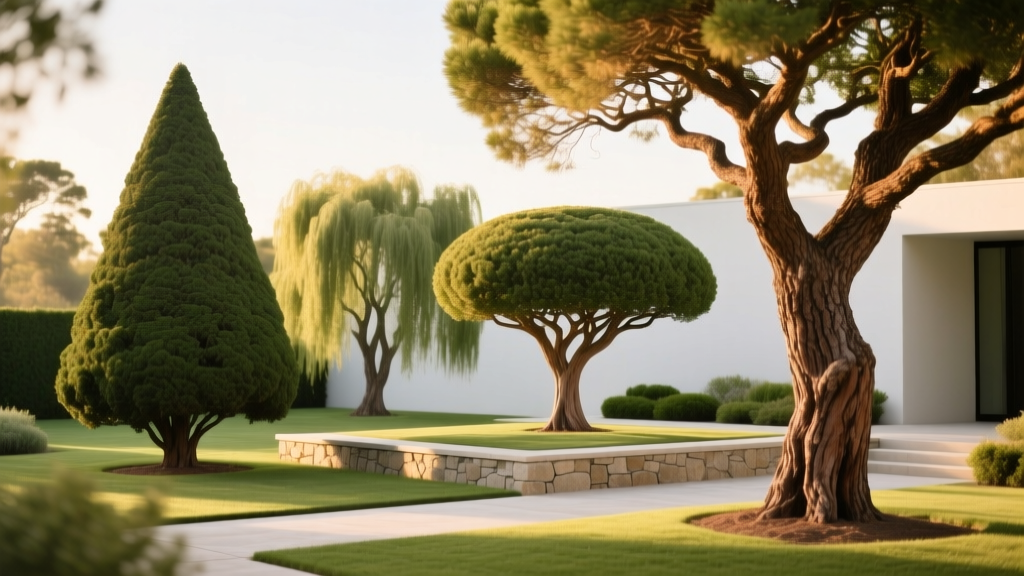
A Beginner's Guide to Tree Shapes for Landscape Design
The architectural form of a tree—commonly referred to as its shape or habit—dictates how it interacts with your home, hardscaping, and surrounding microclimate. Selecting the correct tree shapes for your specific yard zones prevents costly root damage to foundations, eliminates annual pruning battles with power lines, and ensures proper sunlight penetration to your lawn. As urban and suburban lot sizes continue to shrink in 2026, understanding mature tree form is no longer optional; it is the foundational step of sustainable landscape design.
The 6 Primary Tree Shapes Explained
Nurseries and arborists classify tree habits into six primary categories. Knowing these terms will help you read plant tags and communicate effectively with landscape professionals.
- Columnar (Fastigiate): These trees grow almost straight up with very narrow lateral branching. Their width is typically less than 20% of their height. They are ideal for narrow side yards, privacy screens, and lining driveways without casting excessive shade on adjacent lawns.
- Pyramidal (Conical): Characterized by a wide base that tapers to a distinct point at the top. This shape is predominantly found in evergreen conifers. The wide base intercepts snow load efficiently, while the tapered top allows sunlight to reach lower branches.
- Rounded (Globose): These trees have a mature canopy width that roughly equals their height, forming a circular or oval silhouette. They are the classic 'shade trees' used to cool patios and south-facing windows.
- Vase (Urn): Narrow at the trunk base and widening significantly toward the top. This shape creates a high canopy clearance, making it the premier choice for planting over pedestrian walkways, streets, and low seating areas.
- Weeping (Pendulous): Branches grow outward and then droop heavily toward the ground due to a lack of structural lignin rigidity. These are strictly specimen trees used as focal points, as their dense lower canopy suppresses turfgrass growth beneath them.
- Flat-Topped (Spreading): The canopy spreads horizontally, often growing wider than the tree is tall. These mimic the natural understory trees found in forest edges and are excellent for wide, open lawn areas where low, broad shade is desired.
Matching Tree Forms to Yard Zones
Placing the wrong shape in the wrong zone is the leading cause of premature tree removal. Use this decision matrix to align tree forms with your property's functional areas.
| Tree Shape | Best Yard Zone | Required Hardscape Clearance | Lawn Impact |
|---|---|---|---|
| Columnar | Property lines, narrow side yards | 3 to 5 feet from fences/walls | Minimal shade; turf thrives nearby |
| Pyramidal | Backyard corners, windbreaks | 10 to 15 feet from structures | Heavy needle drop; acidic soil |
| Rounded | Center of large lawns, south windows | 15 to 20 feet from foundations | Dense shade; requires shade-tolerant grass |
| Vase | Over walkways, driveways, patios | 8 to 12 feet from paving edges | Moderate dappled shade; good for turf |
| Weeping | Front yard focal points, water features | Equal to mature canopy radius | Complete shade; turf will not grow beneath |
| Flat-Topped | Large open estates, park-like settings | 20+ feet from all structures | Wide shade footprint; limits planting below |
Top Cultivar Recommendations by Shape
When purchasing trees, always look for specific cultivars rather than the straight species. Straight species exhibit high genetic variability in form, whereas cultivars are cloned to guarantee a specific mature shape and size.
Columnar & Fastigiate Picks
For tight spaces, the Liquidambar styraciflua 'Slender Silhouette' (Sweetgum) is a top-tier choice. It reaches 50 feet in height but stays remarkably narrow at 4 to 6 feet wide. Another excellent option is the Carpinus betulus 'Fastigiata' (European Hornbeam), which matures at 40 feet tall and 20 feet wide, offering a dense, formal screen. Spacing rule: Plant columnar trees 4 to 6 feet apart for a continuous privacy hedge.
Vase-Shaped Picks
The Zelkova serrata 'Green Vase' is highly resistant to Dutch Elm Disease and provides a striking, upright arching form, maturing at 50 feet tall and 40 feet wide. For smaller yards, the Lagerstroemia indica 'Natchez' (Crape Myrtle) offers a multi-stemmed vase shape, topping out at 25 feet with brilliant white summer blooms and exfoliating bark. Spacing rule: Allow at least 15 feet from the trunk to any overhead obstruction to accommodate the flaring canopy.
Rounded & Spreading Picks
The Acer rubrum 'Red Sunset' (Red Maple) provides a dense, oval-to-rounded canopy (45 feet tall, 35 feet wide) with exceptional fall color. If you need a wider, flat-topped shade provider, the Gymnocladus dioicus (Kentucky Coffeetree) offers a broad, spreading habit that casts dappled, rather than solid, shade, allowing grass to grow beneath it.
💡 Pro Tip: The 1/3 Canopy Rule
When calculating spacing for rounded and spreading trees, measure the expected mature canopy width, divide it by three, and add that number to your trunk-to-structure clearance. This accounts for asymmetric growth toward sunlight and prevents future siding damage from branch abrasion.
When calculating spacing for rounded and spreading trees, measure the expected mature canopy width, divide it by three, and add that number to your trunk-to-structure clearance. This accounts for asymmetric growth toward sunlight and prevents future siding damage from branch abrasion.
Pruning Strategies to Maintain Form
A tree's genetic predisposition dictates its shape, but early structural pruning locks that form in place. According to the Clemson University Home & Garden Information Center, the first three years of a tree's life are critical for establishing a permanent branching structure.
Training Pyramidal and Columnar Trees
These forms require a central leader training system. Identify the most vigorous, upright terminal shoot and ensure it remains the highest point. If competing lateral branches (codominant stems) attempt to overtake the leader, prune them back by one-third or remove them entirely. Never 'top' a pyramidal tree; this destroys the apical dominance and results in a bushy, deformed, and structurally weak canopy.
Training Vase and Rounded Trees
These deciduous forms benefit from an open-center or modified central leader system. Once the tree reaches the desired height for trunk clearance (usually 6 to 8 feet for vase shapes over walkways), the central leader is pruned back to a lateral branch. This forces the tree to push energy into 3 to 5 main scaffold branches that grow outward and upward. Ensure these scaffold branches have wide crotch angles (45 to 60 degrees) to prevent splitting under snow or wind loads.
⚠️ Utility Line Warning: Never plant rounded or vase-shaped trees exceeding 25 feet in mature height within 15 feet of overhead distribution power lines. The Arbor Day Foundation strongly recommends planting only low-growing, spreading shrubs or small ornamental trees (under 20 feet mature height) in the 'utility zone' directly beneath wires to prevent hazardous arcing and mandatory utility pruning.
Frequently Asked Questions
Can I change a tree's shape after it matures?
You can alter the density and minor outline of a canopy, but you cannot fundamentally change a tree's genetic habit. Attempting to prune a naturally rounded, 40-foot Red Maple into a narrow columnar shape will result in massive watersprout growth, structural decay from large pruning wounds, and eventual tree failure. Always select the correct shape at the time of planting.
Why is my vase-shaped tree growing straight up?
Young vase-shaped trees often exhibit a strong central leader before their lateral scaffold branches thicken and take over. This is normal. If the central leader is not subordinated (pruned back to slow its growth) by year three, the tree will adopt a rounded or oval habit rather than the desired wide-spreading vase form.
Do weeping trees require special pruning?
Weeping cultivars, like the Weeping Cherry (Prunus subhirtella 'Pendula'), should generally be left alone to develop their natural cascading form. The only required pruning is removing 'suckers' that grow straight up from the rootstock below the graft union, and occasionally trimming the very tips of branches that are dragging on the soil to prevent fungal pathogens from entering the bark.

