
Tree Care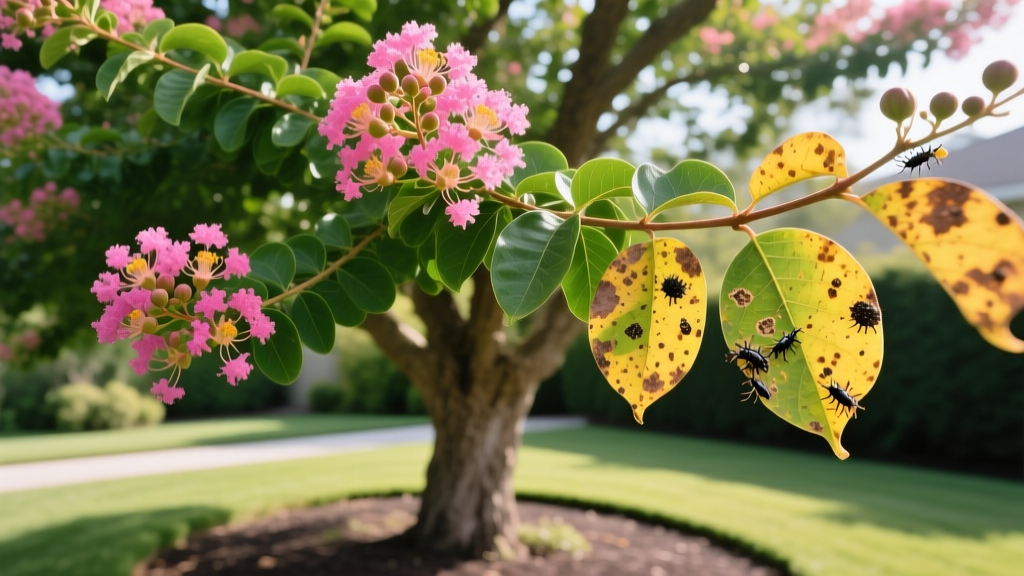
How to Fix Spotted, Yellow, or Dropping Crape Myrtle Leaves
Crape myrtles (Lagerstroemia indica) are prized for their vibrant summer blooms and striking winter bark, but their foliage is highly susceptible to specific fungal pathogens and sap-sucking insects. When crape myrtle leaves begin turning yellow, developing brown spots, or dropping prematurely in mid-summer, it is rarely a watering issue. It is almost always a biological threat that requires immediate, targeted intervention. According to the NC State Extension Plant Toolbox, improper diagnosis often leads homeowners to apply the wrong chemical controls, wasting money and damaging the tree's long-term vigor.
This guide provides exact diagnostic criteria, chemical dosages, and cultural protocols to restore your crape myrtle's canopy.
Diagnostic Matrix: Identifying the Leaf Threat
Before purchasing any treatment, you must correctly identify the pathogen. Crape myrtles face three primary foliage threats, each requiring a completely different chemical approach. Use this matrix to match your tree's symptoms.
| Visual Symptom | Primary Culprit | Pathogen / Pest | Peak Activity |
|---|---|---|---|
| Angular brown spots, yellowing margins, premature leaf drop starting at the bottom of the canopy. | Cercospora Leaf Spot | Cercospora lythracearum (Fungus) | Late Spring to Early Fall (wet periods) |
| White, powdery dusting on new growth, stunted shoots, curled leaf edges. | Powdery Mildew | Erysiphe lagerstroemiae (Fungus) | Spring and Fall (high humidity, dry leaves) |
| Sticky residue on leaves, black soot-like coating, leaf curling, presence of tiny yellow-green insects. | Crape Myrtle Aphid & Sooty Mold | Tinocallis kahawaluokalani & Capnodium | Mid-Summer (June through August) |
Step-by-Step Treatment Protocols
Protocol 1: Eradicating Cercospora Leaf Spot
Cercospora is the most destructive foliar disease for crape myrtles in the Southeastern United States. The spores overwinter in fallen leaf litter and splash onto the lower canopy during spring rains. Once the fungus penetrates the leaf tissue, curative treatment is largely ineffective; the goal is preventative protection of new growth.
- Active Ingredient: Chlorothalonil or Myclobutanil.
- Recommended Product: Bonide Fung-onil (Chlorothalonil 29.6%), typically priced around $14 for a 16 oz concentrate.
- Application Rate: Mix 1.5 fluid ounces of concentrate per 1 gallon of water.
- Schedule: Begin spraying when leaves are half-expanded in early spring (usually April). Reapply every 10 to 14 days until early summer. A mature 15-foot tree requires roughly 3 to 4 gallons of mixed solution for full canopy coverage.
- Pro Tip: Alternate Chlorothalonil with a systemic fungicide like Spectracide Immunox (Myclobutanil) every third application to prevent pathogen resistance.
Protocol 2: Clearing Powdery Mildew
Unlike Cercospora, which requires wet leaf surfaces to infect, powdery mildew thrives in high humidity but requires dry leaf surfaces. It attacks tender new growth, preventing flower buds from opening. The University of Georgia Extension notes that while older cultivars like 'Carolina Beauty' are highly susceptible, modern introductions like 'Natchez' and 'Muskogee' possess strong genetic resistance.
- Active Ingredient: Potassium Bicarbonate or Propiconazole.
- Recommended Product: GreenCure Fungicide (Potassium Bicarbonate) for organic approaches, or Bayer Advanced Disease Control (Propiconazole) for severe infections.
- Application Rate: For Potassium Bicarbonate, mix 1 tablespoon per gallon of water. Add 1 teaspoon of horticultural oil to act as a surfactant.
- Schedule: Apply at the first sign of white dusting on new shoots. Repeat every 7 to 10 days during humid spring weeks.
Protocol 3: Eliminating Aphids and Sooty Mold
The crape myrtle aphid is a host-specific pest that feeds exclusively on Lagerstroemia species. As they feed, they excrete honeydew, which rapidly colonizes black sooty mold. The mold blocks photosynthesis, causing leaves to yellow and drop. Spraying contact insecticides is ineffective for large trees because you cannot reach the upper canopy.
The Soil Drench Solution:
Use a systemic neonicotinoid soil drench. The roots absorb the chemical and translocate it to the leaves, killing aphids when they feed.
Use a systemic neonicotinoid soil drench. The roots absorb the chemical and translocate it to the leaves, killing aphids when they feed.
- Product: BioAdvanced 12 Month Tree & Shrub Protect & Feed (Imidacloprid 1.47%). Cost: ~$22 for 32 oz.
- Dosage: Apply 1 fluid ounce of concentrate per inch of trunk circumference (measured at chest height). Mix with 1 gallon of water for every 10 inches of trunk diameter.
- Timing: Apply as a soil drench in early spring (March/April) before aphid populations explode. It takes 2 to 4 weeks for the chemical to reach the upper canopy.
The Airflow Imperative: Corrective Pruning
Chemical controls will fail if the tree's microclimate remains overly humid. The Clemson University HGIC emphasizes that poor air circulation is the primary catalyst for both Cercospora and Powdery Mildew.
Never top your crape myrtle (a practice derogatorily known as 'crape murder'). Topping forces dense, weak, whip-like growth that traps moisture and blocks UV light from penetrating the inner canopy.
- Remove Suckers: Cut all basal suckers flush with the trunk or ground level.
- Thin the Interior: Remove crossing branches, inward-growing twigs, and secondary trunks that rub against each other.
- Elevate the Canopy: Prune lower lateral branches up to 4 to 6 feet off the ground to prevent soil-borne fungal spores from splashing onto the lowest leaves.
- The 20% Rule: Aim for a canopy density where roughly 20% of the sky is visible through the branches when standing directly beneath the tree.
Seasonal Maintenance Calendar
Consistency is the difference between a thriving specimen and a defoliated stick. Follow this annual timeline:
- February (Dormancy): Prune for structure and airflow. Rake and destroy all fallen leaf litter from the previous year to eliminate overwintering Cercospora spores. Apply a dormant rate of horticultural oil to smother overwintering aphid eggs.
- March/April (Bud Break): Apply Imidacloprid soil drench for aphid prevention. Begin preventative Chlorothalonil fungicide sprays as leaves expand.
- May/June (Active Growth): Continue 14-day fungicide intervals if spring rainfall is heavy. Monitor new growth for powdery mildew.
- July/August (Peak Heat): Ensure the tree receives 1 to 1.5 inches of water per week via drip irrigation. Avoid overhead watering entirely, as wet foliage at night guarantees fungal infection.
- November (Leaf Drop): Rake and bag all fallen leaves. Do not compost diseased crape myrtle leaves, as home compost piles rarely reach the 140°F required to kill Cercospora spores.
When to Replace vs. Treat: A Cost-Benefit Framework
Homeowners often ask when a diseased crape myrtle is too far gone. Use this framework to decide whether to invest in chemical rehabilitation or replace the tree.
| Factor | Treat the Existing Tree | Remove and Replace |
|---|---|---|
| Trunk Health | Bark is intact; no deep cankers or wood rot at the base. | Trunk has severe mechanical damage, deep fungal cankers, or is hollow. |
| Cost (15ft Tree) | $30 - $50 annually for chemicals and soil drenches. | $400 - $900 for stump grinding, new 7-gallon tree, and labor. |
| Time to Maturity | Immediate canopy recovery within one growing season. | 5 to 8 years for a new planting to reach equivalent size and bloom density. |
| Genetic Resistance | Tree is a susceptible older cultivar (e.g., 'Carolina Beauty'). | Opportunity to plant a highly resistant cultivar like 'Natchez' or 'Tuscarora'. |
Verdict: If the trunk is structurally sound, treating the tree is vastly more cost-effective and provides immediate landscape value. Only remove the tree if it is a highly susceptible cultivar located in a chronically damp, shaded microclimate where fungal pressure will remain unmanageable.
Frequently Asked Questions
Why are my crape myrtle leaves turning red in summer?
Red or purple pigmentation on crape myrtle leaves in mid-summer is usually a stress response, not a disease. It indicates a phosphorus deficiency or severe drought stress. Conduct a soil test; if phosphorus is low, apply a bone meal supplement or a balanced 10-10-10 granular fertilizer at a rate of 1 lb per 100 square feet of root zone.
Can I use neem oil for crape myrtle leaf spot?
Neem oil is marginally effective against powdery mildew and aphids, but it is entirely ineffective against Cercospora leaf spot. Furthermore, applying neem oil when daytime temperatures exceed 85°F will cause phytotoxicity, burning the leaves and causing them to drop prematurely. Stick to synthetic fungicides like Chlorothalonil for Cercospora.
Is sooty mold killing my tree?
No. Sooty mold is a surface fungus that feeds exclusively on the sugary honeydew excreted by aphids; it does not infect the plant tissue. However, a thick layer of black soot blocks sunlight, reducing photosynthesis by up to 30%, which weakens the tree over time. Eliminate the aphids with a systemic soil drench, and the sooty mold will dry up and flake off naturally within a few weeks.

