
Tree Care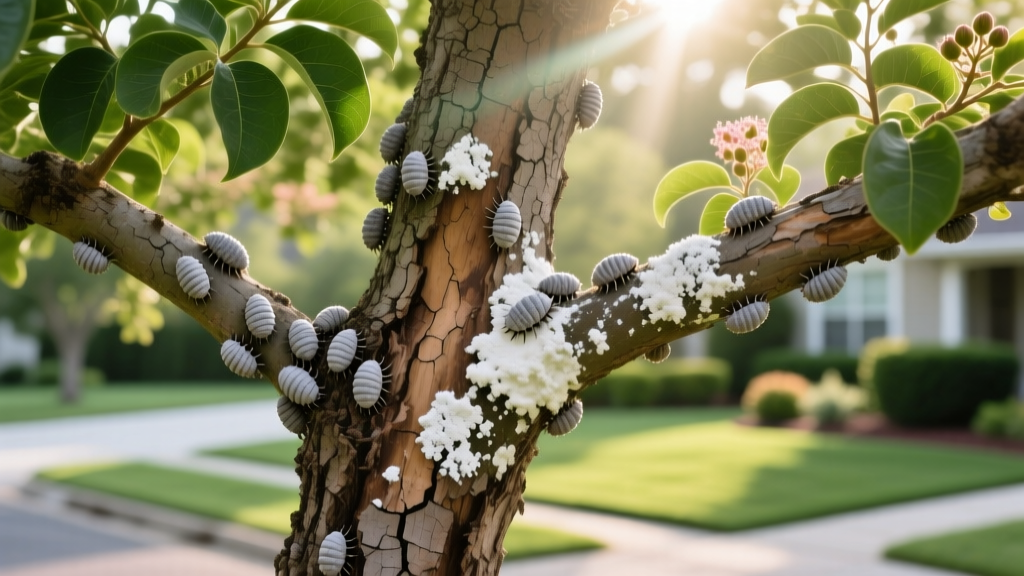
Crepe Mertle Tree Diagnosis: Fixing Bark Scale and Mildew
The Diagnostic Matrix: Identifying Your Crepe Myrtle's Decline
Whether you spell it crepe myrtle, crape myrtle, or the highly searched crepe mertle, Lagerstroemia indica remains a staple in Southern and transitional zone landscapes. However, these resilient trees are increasingly falling victim to a specific triad of pests and pathogens. Before reaching for a generic pesticide, you must accurately diagnose the visual symptoms. Misdiagnosis leads to wasted chemicals and further tree decline.
The following diagnostic matrix isolates the three most common failure modes for crepe myrtles in 2026, mapping visual symptoms to their underlying biological causes and immediate interventions.
| Visual Symptom | Primary Culprit | Immediate Action | Long-Term Fix |
|---|---|---|---|
| White, felt-like spots on bark; black sooty mold on lower branches | Crepe Myrtle Bark Scale (CMBS) | Scrub heavily infested bark with a stiff brush and horticultural oil | Trunk spray application of Dinotefuran (Safari 20SG) |
| White powdery dust on new shoots and flower buds; bud drop | Powdery Mildew (Erysiphe lagerstroemiae) | Prune and destroy infected terminal shoots immediately | Preventative Propiconazole spray at bud break |
| Sticky residue on leaves; black fungal coating on lower canopy | Crape Myrtle Aphids (Tinocallis kahawaluokalani) | Blast foliage with high-pressure water to dislodge nymphs | Soil drench of Imidacloprid in early spring |
Deep Dive 1: Eradicating Crepe Myrtle Bark Scale (CMBS)
First identified in the US in 2010, CMBS (Eriococcus lagerstroemiae) has become the most destructive pest for these trees. Unlike typical soft scales, CMBS hides beneath the bark crevices, secreting a protective white, felt-like ovisac that shields it from contact insecticides.
Spotting the White Felt
Inspect the older, darker bark on the main trunks and lower scaffolding branches. You are looking for stark white, oval-shaped patches ranging from 1/16 to 1/8 inch in length. If you crush one, it will exude a pinkish fluid. As the scale feeds on phloem sap, it excretes honeydew, which rapidly cultivates black sooty mold on the bark and surrounding understory plants.
Chemical vs. Biological Control Protocols
While ladybugs and lacewings are natural predators, they cannot outpace a severe CMBS outbreak. Chemical intervention is mandatory for heavy infestations. According to Clemson University's Home & Garden Information Center, systemic neonicotinoids are the only reliable cure.
Expert Application Tip: Do not use soil drenches if your tree is experiencing drought stress or if the soil temperature is below 50°F. The roots will not translocate the chemical to the canopy. Instead, use a trunk spray method.
The Trunk Spray Method (Dinotefuran):
Product: Safari 20SG (Dinotefuran).
Mixing Rate: 0.2 to 0.4 ounces of Safari per gallon of water.
Application: Spray the lower 3 to 4 feet of the main trunks until the bark is thoroughly wet but not dripping. The chemical penetrates the bark and moves systemically upward. Expect to see scale death within 2 to 3 weeks. A single 12oz bottle costs approximately $140-$160 but will treat dozens of mature trees.
The Soil Drench Method (Imidacloprid):
Product: Bayer Advanced 12 Month Tree and Shrub Protect & Feed.
Dosage: 1 fluid ounce per inch of trunk circumference (measured at chest height).
Application: Mix with 1 gallon of water and pour in a 12-inch band around the drip line. This is cheaper (approx. $25 per bottle) but takes 4 to 6 weeks to reach the upper canopy.
Deep Dive 2: Powdery Mildew and Black Sooty Mold
The Aphid-Mold Connection
Many homeowners mistake black sooty mold for a primary disease. It is not. Sooty mold is a secondary fungus that grows exclusively on the sugar-rich honeydew excreted by crape myrtle aphids. If you treat the mold with fungicides but ignore the aphids, the mold will return in weeks. You must break the cycle by eliminating the sap-sucking insects.
For active aphid outbreaks in summer, use a contact insecticide like Safer Brand Insecticidal Soap. Mix 2.5 fluid ounces per gallon of water and spray the undersides of the leaves at dusk to avoid harming foraging bees and to prevent leaf burn from the sun.
Fungicide Protocols for Powdery Mildew
Powdery mildew thrives in humid, stagnant conditions, specifically targeting the soft, new growth of spring and early summer. If your tree is a susceptible older cultivar (like 'Carolina Beauty' or 'Catawba'), preventative fungicide is required.
- Propiconazole (Bonide Infuse): Apply at 2.5 fl oz per 3 gallons of water. This systemic fungicide halts spore germination. Apply at bud break and repeat every 14 days until the new leaves mature and develop their natural waxy cuticle.
- Myclobutanil (Spectracide Immunox): A highly effective, widely available alternative. Apply at 2.5 fl oz per 2 gallons of water.
"The most effective long-term solution for powdery mildew is not chemical, but genetic. When planting new specimens, select modern, mildew-resistant cultivars such as 'Natchez', 'Muskogee', 'Tuscarora', or the 'Infinitini' series." — University of Florida IFAS Extension
Corrective Pruning: Reversing 'Crape Murder'
Topping a crepe myrtle—colloquially known as 'crape murder'—destroys the tree's natural vascular flow, forcing it to push out weak, whippy, highly susceptible lateral shoots. These weak shoots are prime targets for both aphids and powdery mildew. If you have inherited a brutally topped tree, follow this 3-year corrective pruning framework:
- Year 1 (Dormant Season): Identify the large, knobby 'fists' where the tree was previously cut. Do not cut below the knob yet. Instead, select the 3 strongest, most upright shoots emerging from each knob and remove all other whippy growth flush with the knob.
- Year 2 (Dormant Season): The selected shoots will have thickened. Cut the original knob off entirely, making a clean, angled cut (45 degrees) just above the branch collar where the knob meets the main trunk. Seal the wound is not recommended; let the tree compartmentalize the cut naturally.
- Year 3 and Beyond: Transition to standard maintenance. Only remove crossing branches, inward-growing shoots, and suckers at the base. Always make cuts 1/4 inch above an outward-facing lateral bud.
Soil Nutrition and pH Lockout
Even pest-free crepe myrtles will fail to bloom if soil chemistry is ignored. These trees require a soil pH between 5.0 and 6.5. In areas with alkaline soils (pH > 7.0), the tree suffers from iron chlorosis, presenting as yellowing leaves with dark green veins. Standard iron sulfate will not work in high-pH soils because it instantly oxidizes and locks up. You must use chelated iron (Fe-EDDHA), which remains bioavailable in alkaline conditions. Apply 2 ounces of Fe-EDDHA per inch of trunk diameter in early spring, watering it deeply into the root zone.

