
Tree Care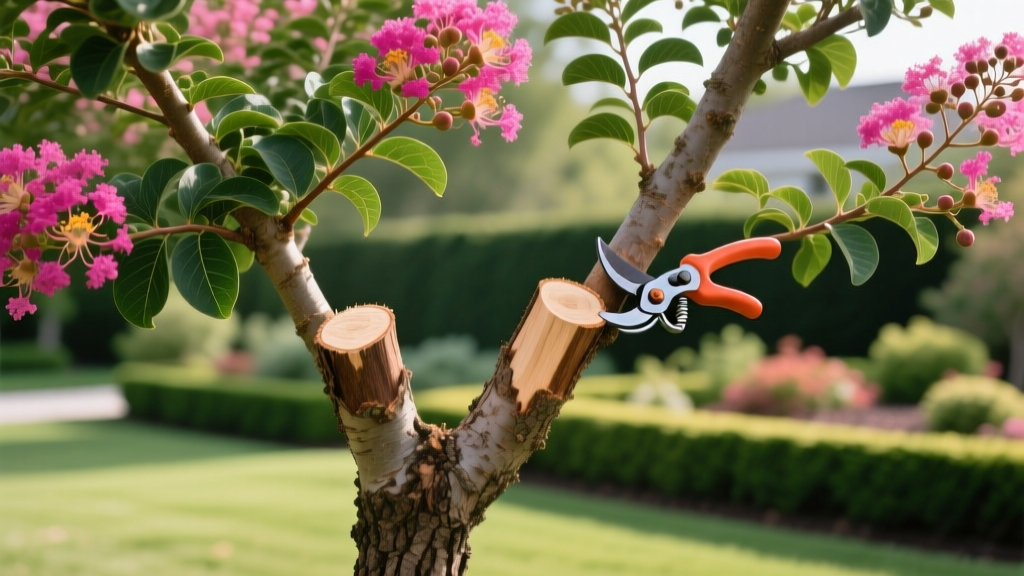
Crepe Myrtle Bush Pruning: How to Avoid Crape Murder
The Physiology of 'Crape Murder' and Why Topping Fails
Crepe myrtles (Lagerstroemia indica and its hybrids) are prized for their extended summer bloom periods and striking exfoliating bark. However, a pervasive landscaping malpractice known as 'crape murder'—the severe topping or pollarding of main trunks—continues to ruin the structural integrity of these shrubs. Understanding the physiological response of the tree is the first step toward proper crepe myrtle bush pruning.
When you decapitate a main stem, you remove the apical meristem, the tissue responsible for vertical growth and apical dominance. This triggers a panic response in the plant, forcing the latent buds below the cut to push out a dense cluster of epicormic shoots (watersprouts). According to research published by the Clemson University Home & Garden Information Center, these new shoots are structurally weak. They lack the deep vascular connections of primary branches and are highly susceptible to wind breakage, especially when weighed down by heavy summer bloom panicles.
Over time, repeated topping creates a swollen, disfigured 'knuckle' at the cut site. This knuckle restricts nutrient flow, traps moisture, and becomes a primary entry point for wood-decaying fungi like Ganoderma, ultimately hollowing out the trunk from the inside.
Regional Timing Matrix: When to Prune
Crepe myrtles bloom on new wood. This means the flower panicles develop on the current season's growth, allowing you to prune heavily in late winter without sacrificing summer color. Pruning too early in the fall can stimulate new growth that will be killed by the first hard freeze, while pruning too late in the spring removes the wood that has already begun setting flower buds.
| USDA Hardiness Zone | Optimal Pruning Window | Visual Cue for Readiness |
|---|---|---|
| Zones 7a - 7b | Mid-February to Early March | Buds are swollen but have not broken open; bark is fully dormant. |
| Zones 8a - 8b | Early February to Mid-February | Leaves have completely dropped; no signs of green at the branch tips. |
| Zones 9a - 10b | Mid-January to Early February | Shrub is in peak winter dormancy before the late-winter warm snaps. |
Professional-Grade Tool Loadout for 2026
Using dull or inappropriate tools crushes the cambium layer, leading to dieback that extends inches below the cut. To execute precise crepe myrtle bush pruning, invest in high-carbon steel bypass tools. Anvil pruners should be strictly avoided on live wood, as they crush the stem rather than slicing it.
- Hand Pruners (Up to 3/4 inch cuts): The Felco F-2 Classic (retailing around $68 in 2026) remains the industry standard. Its hardened steel blade and sap groove prevent sticking, while the replaceable parts ensure a lifetime of use.
- Hand Saws (1 to 3 inch cuts): The Silky Gomboy 210 with a medium teeth configuration (approx. $55) pulls through dense crepe myrtle wood effortlessly. Its impulse-hardened teeth stay sharp three times longer than standard carbon steel saws.
- Pole Pruners (High Canopy): For branches up to 1.25 inches thick that are out of reach, the Fiskars 6201 Telescoping Pruning Stik ($75) provides a 12-foot reach with a compound action pulley system that multiplies cutting leverage.
The 5-Step Structural Pruning Framework
Proper pruning focuses on thinning the canopy to improve airflow and light penetration, rather than reducing the overall height of the shrub. Follow this sequential framework to maintain a natural, vase-shaped architecture.
Step 1: Eradicate Base Suckers
Crepe myrtles are notorious for pushing root suckers from the base, especially if the root flare is buried under thick mulch. Do not just clip these flush with the soil; this encourages a hydra-like response where one sucker becomes three. Instead, pull the soil back, identify the exact origin point on the main trunk or root, and make a flush cut directly at the collar. Applying a localized, ready-to-use triclopyr herbicide to the fresh sucker cut can prevent regrowth without harming the mother plant.
Step 2: Remove the 'Three Ds'
Systematically remove all Dead, Damaged, and Diseased wood. When cutting dead wood, trace the branch back to the first sign of green, healthy cambium under the bark, and make your cut just above that transition point.
Step 3: Eliminate Crossing and Rubbing Branches
Branches that cross the center of the canopy or rub against one another create open wounds that invite pests like the crepe myrtle bark scale (Eriococcus lagerstroemiae). Evaluate which branch contributes most to the outward, vase-like shape and remove the offending competitor entirely back to its point of origin.
Step 4: Thin Inward-Facing and Vertical Shoots
Any branch growing directly toward the center of the shrub should be removed. Additionally, aggressively prune out vertical watersprouts that shoot straight up from lateral branches. These vertical shoots sap energy from the primary scaffolding branches and rarely produce high-quality blooms.
Step 5: Execute Proper Reduction Cuts
If you must reduce the height or length of a branch to clear a walkway or roofline, never cut it midway through the internode. Locate a lateral side branch that is at least one-third the diameter of the branch being removed. Make your cut just above this lateral branch. This 'drop-crotch' pruning method directs the plant's growth hormones into the remaining lateral branch, preserving the natural flow of the canopy.
Critical Warning: The Branch Collar and Wound Paint
Always identify the branch collar—the swollen, wrinkled area where the branch meets the trunk. Your cut must be made exactly 1/4 inch outside this collar. Never make a 'flush cut' directly against the trunk, as this removes the tree's natural chemical defense zone (CODIT). Furthermore, never apply pruning sealant, tar, or wound paint to the cut. Studies cited by NC State Extension confirm that sealants trap moisture against the exposed wood, accelerating internal decay rather than preventing it.
Always identify the branch collar—the swollen, wrinkled area where the branch meets the trunk. Your cut must be made exactly 1/4 inch outside this collar. Never make a 'flush cut' directly against the trunk, as this removes the tree's natural chemical defense zone (CODIT). Furthermore, never apply pruning sealant, tar, or wound paint to the cut. Studies cited by NC State Extension confirm that sealants trap moisture against the exposed wood, accelerating internal decay rather than preventing it.
Managing the Aftermath: Fertilization and Mulching
Following a proper pruning session, the shrub's energy requirements will shift. Avoid the common mistake of applying high-nitrogen synthetic fertilizers (like a 28-3-9 lawn fertilizer) to the base of the crepe myrtle. Excess nitrogen promotes rapid, sappy vegetative growth that is highly attractive to crepe myrtle aphids and delays the transition from leaf production to flower bud initiation.
Instead, apply a 2-inch layer of organic hardwood mulch in a wide ring around the drip line, keeping it strictly 3 inches away from the main trunks to prevent basal rot. If a soil test indicates a phosphorus or potassium deficiency, use a balanced, slow-release granular fertilizer (such as a 10-10-10 or 8-8-8 formulation) at a rate of 1 pound per 100 square feet of root zone in early April.
Troubleshooting Common Pruning Failures
Even with careful technique, homeowners may encounter specific physiological hurdles. Here is how to address the most frequent issues observed in the field:
- Failure to Bloom After Pruning: If your shrub produces lush green foliage but zero flower panicles, you likely pruned too late in the spring (removing the current season's flower buds) or the plant is receiving less than six hours of direct, unfiltered sunlight. Crepe myrtles require full sun to trigger the hormonal shift toward reproduction.
- Bark Peeling and Dieback: While exfoliating bark is a natural trait of mature Lagerstroemia, sudden dieback of entire branches accompanied by blackened, non-exfoliating bark indicates an infestation of crepe myrtle bark scale or a severe case of sooty mold blocking photosynthesis. Prune out the heavily infested branches and treat the remaining canopy with a systemic dinotefuran drench applied to the root zone in May.
- The 'Knuckled' Trunk Recovery: If you have inherited a severely topped crepe myrtle with massive, ugly knuckles, do not attempt to cut below the knuckle into the main trunk all at once. Over a three-year period, selectively thin the epicormic shoots growing from the knuckle, leaving the strongest, most vertically aligned shoot to eventually become the new dominant leader, gradually restoring the natural form.
For deeper insights into cultivar-specific growth habits and disease resistance, particularly regarding powdery mildew-resistant hybrids like 'Natchez' and 'Tuscarora', consult the comprehensive cultivar trials maintained by the University of Florida IFAS Extension. Proper crepe myrtle bush pruning is not about controlling the plant's size through brute force; it is about guiding its natural architecture to showcase the stunning bark and vibrant blooms that make it a cornerstone of southern landscapes.

