
Tree Care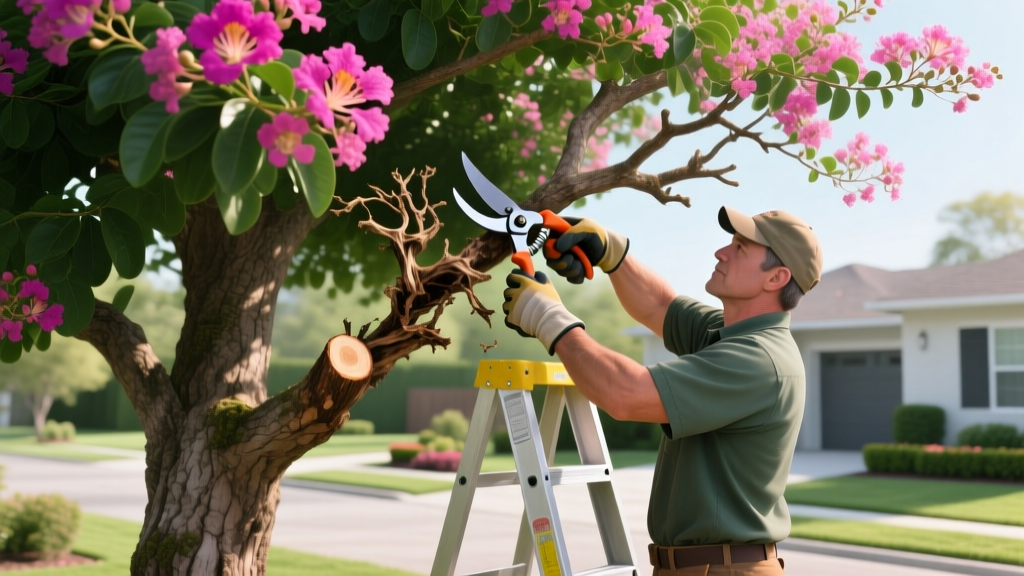
Expert Crepe Myrtle Care and Pruning to Prevent Crape Murder
The True Cost of 'Crape Murder' and How to Fix It
The crepe myrtle (Lagerstroemia indica) is a staple of southern landscapes, prized for its vibrant summer blooms, exfoliating bark, and elegant multi-trunk architecture. Yet, it remains one of the most abused trees in residential yards. The pervasive practice of severely topping these trees—colloquially known as 'crape murder'—destroys their natural form and compromises their structural integrity.
⚠️ WARNING: The Physiology of Topping Damage
When you chop a crepe myrtle off at a uniform height (usually 5 to 6 feet), you remove the apical meristem. This forces latent buds below the cut to push out rapid, vertical epicormic shoots. These new shoots are attached only to the outer bark and woundwood, lacking the deep structural integration of naturally grown branches. By mid-summer, when the heavy flower panicles develop, these weakly attached limbs frequently snap under the weight of summer thunderstorms, creating hazardous falling debris.
Proper crepe myrtle care and pruning focuses on enhancing the tree's natural vase-like shape, improving airflow to prevent fungal diseases, and directing energy into robust wood and prolific blooms. According to the Clemson University Cooperative Extension, a well-pruned crepe myrtle requires significantly less maintenance and lives decades longer than a repeatedly topped specimen.
Seasonal Crepe Myrtle Maintenance Matrix
Timing is critical. Because crepe myrtles bloom on new wood (growth produced in the current season), pruning must be completed before the spring growth flush begins. Use the following matrix to plan your annual care schedule.
| Season | Primary Action | Tools & Inputs | Estimated Cost |
|---|---|---|---|
| Late Winter (Feb - Early Mar) |
Structural pruning, removing crossing branches, basal suckers, and deadwood. | Felco 2 bypass pruners, Fiskars 32" loppers, Silky Hayauchi pole saw. | $0 (DIY) or $150-$300 (Pro) |
| Early Spring (April) |
Soil testing, applying slow-release fertilizer, and fresh mulching. | 10-10-10 granular fertilizer, pine bark mulch, soil test kit. | $25-$50 |
| Summer (June - Aug) |
Deadheading spent blooms (optional), monitoring for aphids and sooty mold. | Hand pruners, insecticidal soap or Neem oil. | $15-$30 |
| Fall (Nov) |
Raking fallen leaves to remove powdery mildew spores, reducing irrigation. | Leaf rake, yard waste bags. | $0 |
The 3-Cut Method for Proper Branch Removal
When removing branches larger than 1.5 inches in diameter, never make a single cut from the top down. The weight of the branch will cause the bark to tear down the trunk, stripping the cambium layer and inviting wood-decay fungi. Instead, use the industry-standard 3-cut method recommended by the University of Florida IFAS Extension.
- The Undercut: Position your saw about 6 to 12 inches away from the trunk. Cut upward from the underside of the branch, going about one-third of the way through the wood. This severs the bark fibers and prevents tearing.
- The Top Cut (Weight Removal): Move an inch or two further out on the branch (away from the trunk). Cut downward from the top. The branch will snap off cleanly between the two cuts, removing the heavy weight.
- The Collar Cut (Final Pruning): Remove the remaining stub by cutting just outside the branch bark ridge (the raised line where the branch meets the trunk) and the branch collar (the swollen area at the base of the branch). Never make a flush cut against the trunk; this removes the tree's natural chemical defense zone (CODIT) and prevents proper wound compartmentalization.
💡 Pro Tip: Restoring a 'Murdered' Crepe Myrtle
If you have inherited a severely topped tree with massive, swollen 'knuckles' at the cut sites, do not try to fix it in one year. Select 3 to 5 of the strongest, most vertically oriented shoots emerging from the knuckle and prune the rest flush to the bark. Over the next 3 to 4 years, gradually prune these selected shoots just above lateral buds to encourage branching and slowly rebuild a natural canopy.
Soil Chemistry, Fertilization, and Mildew Management
Crepe myrtles are highly adaptable, but they perform best in slightly acidic soil with a pH between 5.0 and 6.5. If your soil pH creeps above 7.0, the tree will struggle to absorb iron and manganese, resulting in interveinal chlorosis (yellowing leaves with green veins). If a soil test confirms high pH, apply elemental sulfur at a rate of 1 to 2 pounds per 100 square feet to gradually lower it.
Fertilizer Specifics
Avoid high-nitrogen lawn fertilizers near the root zone. Excess nitrogen promotes rapid, succulent leafy growth that is highly susceptible to aphid infestations and powdery mildew, while simultaneously suppressing flower production. Apply a balanced, slow-release granular fertilizer (such as 8-8-8 or 10-10-10) in early spring at a rate of 0.5 pounds per 100 square feet of canopy drip line.
Combating Powdery Mildew
Powdery mildew (Erysiphe lagerstroemiae) is the most common fungal pathogen affecting these trees, appearing as a white, powdery coating on new leaves and flower buds. It thrives in high humidity and poor air circulation.
- Cultural Control: Prune interior crossing branches to open the canopy to sunlight and wind. Always plant in full sun (minimum 8 hours of direct light).
- Chemical Control: If an outbreak occurs, apply a fungicide containing chlorothalonil or myclobutanil at the first sign of bud break. Alternatively, use horticultural neem oil as an organic preventative.
- Genetic Resistance: The ultimate solution is selecting resistant cultivars. The Texas A&M AgriLife Extension highly recommends 'Natchez' (white), 'Tuscarora' (coral), and 'Dynamite' (red) for their exceptional mildew resistance.
When to Remove Instead of Prune
While pruning can solve many aesthetic and health issues, certain scenarios dictate complete removal. If a multi-trunk crepe myrtle has suffered severe structural failure, or if the main trunks are hollowed out by heart rot (often indicated by fungal conks or mushrooms growing directly on the bark), the tree is a hazard.
Professional removal of a mature, 20-foot crepe myrtle typically costs between $450 and $850, depending on proximity to structures and power lines. Stump grinding will add an additional $150 to $300. Always hire an ISA-Certified Arborist who carries both liability and workers' compensation insurance, as improper removal of heavy, multi-trunked hardwoods carries significant risk of property damage.
Frequently Asked Questions
Should I deadhead crepe myrtles to get more blooms?
Deadheading (removing spent flower clusters) can encourage a second, lighter flush of blooms in late summer. However, it is labor-intensive on large trees and must be done before the tree sets seed. If you deadhead, cut just below the flower panicle, taking care not to remove the adjacent vegetative buds that will produce next year's growth.
Why is my crepe myrtle bark peeling off?
Do not panic; this is a natural and highly desirable trait. As the tree matures, the smooth outer bark exfoliates in patches, revealing beautiful under-layers of cinnamon, pink, gray, or cream. Never pull or pick at the peeling bark, as this can damage the sensitive cambium layer beneath.
Can I plant groundcover directly under the canopy?
It is not recommended to plant aggressive groundcovers like English ivy or Asiatic jasmine directly against the trunk. These plants compete for water and nutrients, and they trap moisture against the bark, increasing the risk of root crown rot. Maintain a 3-foot ring of mulch around the base, keeping the mulch 2 inches away from the trunk itself to prevent 'volcano mulching' decay.

