
Tree Care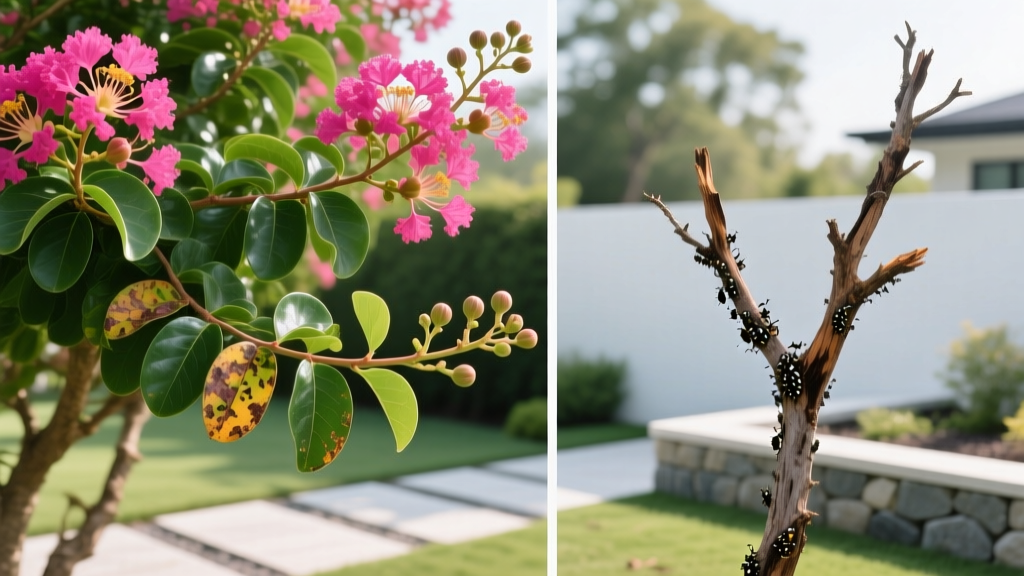
Crepe Myrtle Problem Diagnosis: Fixing Common Crape Myrtle Issues
Whether you refer to it as a crepe myrtle or crape myrtle (Lagerstroemia indica and its hybrids), this staple of Southern and transitional zone landscaping is prized for its exfoliating bark, drought tolerance, and vibrant summer blooms. However, environmental stress, aggressive pruning, and specific pathogens can quickly degrade their health. Accurate problem diagnosis is the first step toward restoring your tree's vigor.
The "Crepe Murder" Epidemic: Correcting Improper Pruning
The most pervasive issue affecting crape myrtles is not a disease, but a cultural malpractice known as "crepe murder." This involves severely topping or pollarding the tree in late winter, leaving blunt, ugly stubs. This practice destroys the tree's natural architectural form and forces the growth of weak, spindly shoots that cannot support the weight of heavy flower panicles.
Warning: Topping your crepe myrtle creates large, flat wounds that are highly susceptible to rot and fungal cankers. It also stimulates the formation of "knuckles"—swollen, knobby growths at the cut sites that permanently disfigure the trunk.
Step-by-Step Restoration Pruning
If your tree has been topped, you can restore its natural form over a two-to-three-year period using selective thinning:
- Remove the Knuckles: Using a sharp, bypass pruning saw, make clean cuts just below the swollen knuckles. Do not cut flush with the main trunk; leave the branch collar intact to promote compartmentalization.
- Select Primary Leaders: Choose 3 to 5 strong, well-spaced vertical shoots emerging from the new growth. These will become your new main trunks.
- Erase the Competition: Prune away all other weak, crossing, or inward-growing shoots at their point of origin.
- Elevate the Canopy: Gradually remove lower lateral branches over the next few seasons to expose the beautiful lower bark, but never remove more than 20% of the live canopy in a single year.
Fungal Threats: Powdery Mildew and Cercospora Leaf Spot
Fungal pathogens thrive in the humid, stagnant air conditions common in late spring and early summer. The two primary culprits are powdery mildew (Erysiphe lagerstroemiae) and Cercospora leaf spot (Cercospora lythracearum).
Powdery mildew manifests as a white, talcum-powder-like coating on new shoots and flower buds, often causing the buds to abort before opening. Cercospora leaf spot appears as dark brown, angular lesions on older leaves, leading to premature defoliation by late summer. According to Clemson University HGIC, planting resistant cultivars like 'Natchez', 'Muskogee', or 'Tuscarora' is the most effective long-term defense.
Fungicide Application Matrix
When cultural controls fail, targeted chemical intervention is required. Apply fungicides at the first sign of disease or just prior to bud break in early spring.
| Active Ingredient | Common Trade Names | Target Pathogen | Application Rate & Timing |
|---|---|---|---|
| Propiconazole 14.3% | Banner MAXX, Fertilome F-Stop | Powdery Mildew, Leaf Spot | 2-4 fl oz per gallon; apply every 14-21 days during humid periods. |
| Myclobutanil | Spectracide Immunox | Powdery Mildew | Follow label rates; begin at bud break, repeat every 10-14 days. |
| Copper Octanoate | Bonide Liquid Copper | Cercospora Leaf Spot | 2 tbsp per gallon; apply as a preventative before summer rains. |
Insect Pests: Crape Myrtle Bark Scale and Aphids
Insect pressure can severely stunt growth and ruin the aesthetic appeal of your trees. The two most destructive pests require entirely different management strategies.
Crape Myrtle Bark Scale (CMBS)
First identified in the US in the early 2000s, CMBS (Eriococcus lagerstroemiae) has become a devastating pest. It presents as a white, waxy, crusty coating on the bark of trunks and branches. As the scale feeds on the phloem, it excretes honeydew, which fosters the growth of black sooty mold. Heavy infestations cause branch dieback and significantly reduce flowering.
"Contact sprays are largely ineffective against CMBS once the waxy test forms. The gold standard for eradication is a systemic neonicotinoid applied as a basal trunk spray or soil drench, allowing the tree to translocate the chemical to the feeding sites." — Entomology Extension Guidelines
The Fix: Use Dinotefuran (e.g., Safari 20SG). For basal trunk sprays, mix 1.5 ounces of Safari per inch of trunk diameter at breast height (DBH) in enough water to wet the lower 12-18 inches of the trunk without runoff. Alternatively, Pyriproxyfen (Distance) can be used as an insect growth regulator to break the reproductive cycle.
Crape Myrtle Aphids
Unlike the bark-dwelling scale, crape myrtle aphids (Sarucallis kahawaluokalani) are soft-bodied, yellow-green insects that cluster on the undersides of new leaves. They cause leaf curling and drop sticky honeydew on patios and cars below.
The Fix: For light infestations, a strong jet of water or insecticidal soap (potassium salts of fatty acids at 2.5 fl oz per gallon) is sufficient. For severe outbreaks, a systemic soil drench of Imidacloprid (e.g., Bayer Advanced 12 Month Tree & Shrub Insect Control, applied at 1.5 oz per inch of trunk circumference) applied in early spring before bud break provides season-long control. Always consult local extension guidelines regarding pollinator safety when using systemic insecticides on flowering trees.
Nutritional Deficiencies and Soil pH Lockout
Crape myrtles are relatively light feeders, but they are highly sensitive to soil pH. They require a slightly acidic soil environment, ideally between 5.0 and 6.5. When soil pH creeps above 7.0 (alkaline), essential micronutrients like iron and manganese become chemically locked out, regardless of how much fertilizer you apply.
Diagnosing Iron Chlorosis
If your crepe myrtle's new leaves are turning pale yellow while the leaf veins remain distinctly green, you are looking at interveinal chlorosis caused by iron deficiency. This is incredibly common in areas with heavy clay or limestone-based soils.
Pro Tip: Do not just apply standard iron sulfate to alkaline soil; it will quickly oxidize and become unavailable to the roots. Instead, use chelated iron (Fe-EDDHA), which remains stable and plant-available even in soils with a pH up to 9.0. Apply 1 to 2 ounces of Fe-EDDHA per inch of trunk diameter in early spring.
For long-term correction, incorporate elemental sulfur into the root zone at a rate of 1 pound per 100 square feet to gradually lower the soil pH, and verify your progress with a professional soil test every two years. For comprehensive regional planting and care data, the Texas A&M AgriLife Extension provides excellent localized cultivar recommendations.
Frequently Asked Questions
Why is my crepe myrtle not blooming this year?
Failure to bloom is usually caused by one of three factors: insufficient sunlight (they require a minimum of 8 hours of direct, unfiltered sun), severe late-spring pruning that removed the flowering wood, or excessive nitrogen fertilization that promotes vegetative leaf growth at the expense of flower buds. Ensure your tree is in full sun and switch to a low-nitrogen, high-phosphorus fertilizer (like a 5-10-10 NPK ratio) if blooming is poor.
Can I plant a crape myrtle near my house foundation?
While their roots are not considered highly invasive or destructive to concrete, standard *Lagerstroemia indica* cultivars can reach 20 to 30 feet in height and width. Plant them at least 10 to 15 feet away from foundations, driveways, and overhead power lines. If you need a tree closer to the house, select a true dwarf cultivar like 'Chickasaw' or 'Pocomoke', which max out at 3 to 5 feet tall.
Is the black sooty mold on the bark killing my tree?
Sooty mold itself is a superficial fungus that feeds on the sugary honeydew excreted by sap-sucking insects like aphids or bark scale. It does not directly infect the tree's tissue, but a thick layer can block sunlight from reaching the bark and underlying leaves, reducing photosynthesis. The mold will naturally flake off and disappear once you successfully eliminate the underlying insect pest with systemic treatments.

