
Tree Care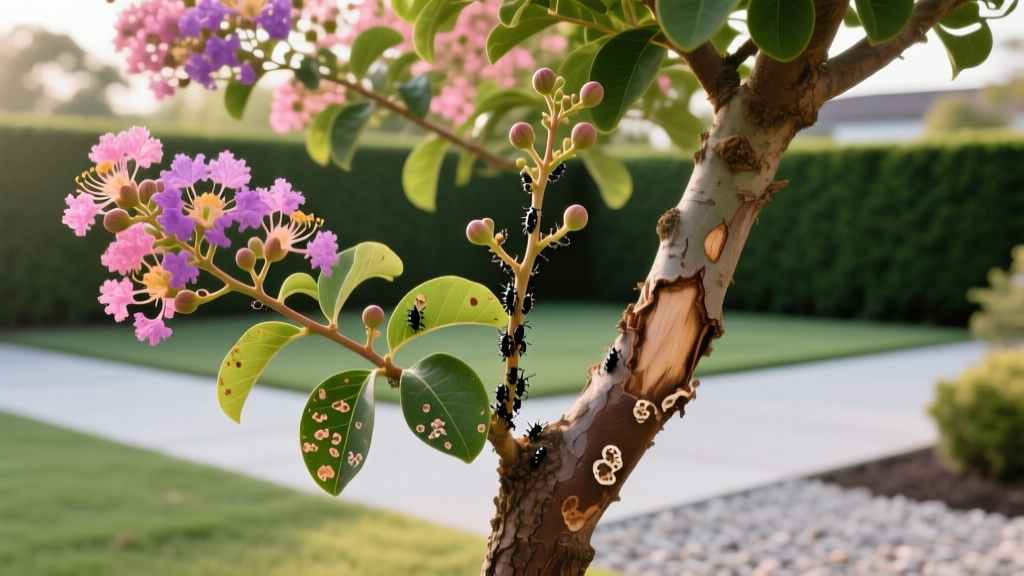
Crepe Myrtle Plants: Diagnosing Pests, Fungi, and Pruning Errors
The Crepe Myrtle Bark Scale (CMBS) Epidemic
First detected in the United States in 2013, the Crepe Myrtle Bark Scale (Eriococcus lagerstroemiae) has rapidly become the most destructive pest threatening Lagerstroemia species. Unlike aphids that cluster on new foliage, CMBS embeds directly into the bark, feeding on phloem sap and excreting a sticky honeydew that coats trunks and branches in black sooty mold. Left untreated, the scale causes severe dieback, stunted flowering, and eventual tree death.
⚠️ Diagnostic Warning: Do not confuse the natural exfoliating bark of a healthy crepe myrtle with scale damage. CMBS presents as distinct, crusty white or gray waxy patches that feel rough to the touch and do not peel away in smooth sheets like healthy bark.
Targeted Treatment Protocols
Eradicating CMBS requires a dual-phase chemical approach, as the waxy armor protects the insects from contact sprays. According to NC State Extension, the most effective strategy combines dormant oils with systemic neonicotinoids:
- Dormant Season (Late Winter): Apply a horticultural oil (such as Bonide All Seasons Horticultural Oil) at a 2% to 4% concentration rate. This suffocates overwintering nymphs. Ensure thorough coverage until the bark is dripping.
- Early Spring (Soil Drench): Apply a systemic insecticide when spring leaves are the size of a squirrel's ear. Imidacloprid (e.g., Bayer Advanced 12 Month Tree and Shrub Insect Control) is highly effective but takes 4 to 8 weeks to translocate to the canopy. For faster results, use Dinotefuran (e.g., Safari 20SG), which moves through the xylem in just 10 to 14 days.
Powdery Mildew vs. Sooty Mold: Fungal Identification
Homeowners frequently misidentify foliar issues on crepe myrtle plants. While both powdery mildew and sooty mold result in discolored leaves, their underlying causes and treatments are entirely different. Powdery mildew (Erysiphe lagerstroemiae) is a primary fungal pathogen, whereas sooty mold is a secondary fungus that grows exclusively on the sugary honeydew excreted by sap-sucking insects like aphids and CMBS.
| Feature | Powdery Mildew | Sooty Mold |
|---|---|---|
| Visual Symptom | White/gray powdery dusting on leaf surfaces and flower buds. | Black, charcoal-like film coating leaves, branches, and underlying surfaces. |
| Primary Cause | Fungal spores thriving in high humidity and poor air circulation (60-80°F). | Fungus growing on insect honeydew (Aphids, Bark Scale, Whiteflies). |
| Direct Treatment | Fungicides containing Myclobutanil, Propiconazole, or Thiophanate-methyl. | Treat the underlying insect pest; wash leaves with insecticidal soap. |
| Prevention | Plant resistant cultivars (e.g., 'Natchez', 'Muskogee', 'Tuscarora'). | Routine monitoring for scale and aphids; dormant oil applications. |
For long-term powdery mildew management, avoid relying solely on chemical fungicides. Clemson University HGIC recommends replacing highly susceptible older varieties with modern Lagerstroemia fauriei hybrids, which possess genetic resistance to both mildew and many scale variants.
Reversing "Crepe Murder": A 3-Year Pruning Restoration
The colloquial term "crepe murder" refers to the severe, indiscriminate topping of crepe myrtle plants, usually performed in late winter. Topping destroys the tree's natural architectural form, stimulates the growth of weak, whippy epicormic sprouts, and creates massive, unsightly knuckles at the cut sites. These knuckles are highly susceptible to rot and bark scale infestations.
Restoring a topped crepe myrtle requires patience and precise drop-crotch pruning. According to University of Florida IFAS, you must never cut a branch flush to the trunk; instead, cut just outside the branch collar.
The 3-Year Restoration Framework
- Year 1 (Structural Reduction): Identify the thickest, most dominant knuckles. Using sharp bypass loppers or a pruning saw, cut back to a lateral branch that is at least one-third the diameter of the branch being removed. This 1/3 rule ensures the lateral branch can assume apical dominance and suppress further water-sprout growth.
- Year 2 (Thinning and Directional Training): The tree will likely produce a flush of new vertical water sprouts from the previous year's cuts. Do not top them again. Instead, thin out the crowded sprouts, leaving only 1 to 3 outward-facing branches per knuckle. Remove any branches rubbing against each other or growing inward toward the canopy center.
- Year 3 (Refinement and Collar Cuts): By year three, the lateral branches will have thickened and established a natural weeping habit. Perform standard maintenance pruning: remove dead wood, crossing branches, and root suckers at the base. Avoid any further heading cuts.
Nutritional Deficiencies: Iron Chlorosis in Alkaline Soils
Crepe myrtle plants prefer a slightly acidic soil pH between 5.5 and 6.5. When planted in heavy clay or alkaline soils (pH > 7.0), the roots cannot absorb iron, leading to interveinal chlorosis—where new leaves emerge pale yellow with distinct dark green veins. If left uncorrected, the foliage will turn stark white, scorch, and drop prematurely.
The EDDHA Advantage: Most garden centers sell standard EDTA-chelated iron. However, EDTA becomes chemically unstable and unavailable to plant roots in soils with a pH above 6.5. If your soil test confirms a pH over 7.0, you must purchase EDDHA-chelated iron (often sold as Fe-EDDHA 6%). EDDHA remains stable and bioavailable to the roots in soils with a pH up to 9.0. Apply as a soil drench at a rate of 1 to 2 ounces per inch of trunk diameter in early spring.
Quick-Reference Troubleshooting Matrix
| Symptom Observed | Probable Diagnosis | Immediate Action Required |
|---|---|---|
| White crusty patches on trunk | Crepe Myrtle Bark Scale | Dormant oil (winter) + Dinotefuran soil drench (spring) |
| White powder on leaves/buds | Powdery Mildew | Improve airflow; apply Myclobutanil fungicide |
| Black film on leaves/patio | Sooty Mold (Secondary) | Identify and treat the primary insect pest |
| Massive knobby growth points | Topping / Crepe Murder | Begin 3-year drop-crotch restoration pruning |
| Yellow leaves, green veins | Iron Chlorosis (High pH) | Soil test; apply EDDHA-chelated iron drench |

