Tree Care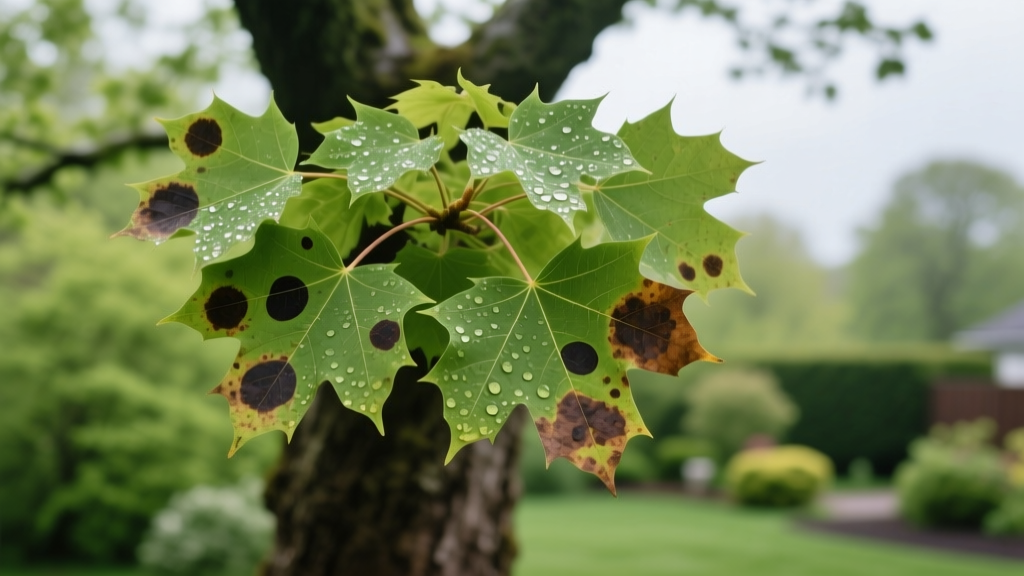
Why Are There Dark Spots on Maple Leaves? (Diagnosis & Fixes)
The Diagnostic Matrix: Identifying the Culprit
Dark spots on maple leaves (Acer spp.) are rarely a singular issue. The visual signature of the spot—its texture, margin, and location on the leaf blade—dictates the exact pathogen or pest involved. Misdiagnosing a cosmetic fungal issue as a vascular disease leads to unnecessary chemical treatments, while ignoring vascular symptoms guarantees tree loss. Use the diagnostic matrix below to identify the specific cause before initiating any rescue protocol.
| Pathogen / Pest | Visual Signature | Spot Location & Texture | Severity & Threat Level |
|---|---|---|---|
| Tar Spot (Rhytisma acerinum) | Shiny, raised black lesions (0.5 to 1 inch) resembling wet tar. | Randomly scattered across the upper leaf surface; raised texture. | Cosmetic. Rarely causes significant defoliation or structural damage. |
| Anthracnose (Discula / Kabatiella) | Irregular brown to black blotches with distinct yellow halos. | Often follows leaf veins; concentrated at leaf margins and tips. | Moderate. Causes premature defoliation and twig dieback in wet springs. |
| Maple Bladder Gall (Vasates quadripedes) | Starts as small red spots, maturing into black/brown raised blisters. | Upper leaf surface; forms distinct 0.1-inch hollow galls. | Cosmetic. Caused by eriophyid mites, not a fungus. |
| Verticillium Wilt (Verticillium dahliae) | Dark marginal scorch spots; accompanied by olive-green sapwood streaking. | Leaf margins; systemic vascular plugging causes uneven spotting. | Fatal. Soil-borne fungus that blocks the xylem; no chemical cure exists. |
Tar Spot: The Cosmetic Nuisance
Tar spot is the most common cause of dark spots on maple leaves, particularly on Norway (Acer platanoides) and Silver (Acer saccharinum) maples. According to the University of Minnesota Extension, the fungus overwinters in fallen leaf litter. In early spring, ascospores are released during wet weather and infect expanding leaves. By mid-to-late summer, the initial yellow-green spots mature into the characteristic raised black stromata.
Rescue Fixes for Tar Spot
Because tar spot is strictly cosmetic, aggressive chemical control is rarely justified for residential trees. The most effective rescue fix is cultural sanitation:
- Fall Raking: You must remove and destroy (bag and trash, or burn where permitted) all fallen leaves. Do not compost infected leaves, as home compost piles rarely reach the 140°F required to kill Rhytisma spores.
- Mulch Management: If you use a mulching mower, the shredded infected leaves will still harbor the fungus. Switch to a bagging attachment for the final two mows of autumn.
- Chemical Intervention: Only recommended for highly visible specimen trees with a history of severe premature defoliation. Apply a preventive fungicide containing Chlorothalonil (e.g., Daconil) or Propiconazole (e.g., Bonide Infuse) at bud break, followed by a second application 10 to 14 days later.
Anthracnose: The Defoliator
Unlike the perfectly round lesions of tar spot, anthracnose creates irregular, necrotic dark blotches that often track along the leaf veins. This disease thrives in cool, wet spring conditions. The Penn State Extension notes that while anthracnose rarely kills mature maples, repeated annual infections weaken the tree, making it susceptible to secondary borers and Armillaria root rot.
Rescue Fixes for Anthracnose
Managing anthracnose requires a combination of canopy management and targeted chemical application.
- Canopy Thinning: Prune the maple during late winter dormancy to remove crossing branches and water sprouts. The goal is to increase UV penetration and air circulation, reducing the leaf wetness duration that triggers spore germination.
- Systemic Trunk Injection: For maples over 15 feet tall where canopy spraying is impractical, utilize trunk injections of Propiconazole 14.3% (Arborjet Alamo). The standard dosage is 0.2 to 0.4 fluid ounces per inch of Diameter at Breast Height (DBH). Calculate DBH by measuring the trunk circumference at 4.5 feet high and dividing by 3.14.
- Foliar Sprays: For smaller maples, apply Mancozeb or Chlorothalonil as a protective barrier just as the buds begin to swell and break. Timing is critical; spraying after the dark spots have already formed is entirely ineffective, as these contact fungicides cannot cure existing necrotic tissue.
Maple Bladder Gall: The Mite Deception
If the dark spots on your maple leaves look like small, raised black or brown blisters (about the size of a pinhead), you are not dealing with a fungus. Maple bladder galls are caused by the eriophyid mite Vasates quadripedes. The mites feed on the developing leaf tissue in spring, causing the tree to grow a protective gall around them. The galls turn from green to red, and eventually to dark black/brown by late summer.
Rescue Fixes for Bladder Galls
Once the galls form, the mites are protected inside, rendering summer fungicide or insecticide sprays useless. The only effective rescue fix is a dormant application:
Expert Tip: Dormant Oil Timing
Apply a horticultural oil (such as Bonide All Seasons Spray Oil at a 2% to 3% solution rate) in late winter or very early spring, before the maple buds swell. The oil suffocates the overwintering adult mites hiding in the bark crevices. Do not apply dormant oil once the buds break, or you will severely burn the emerging maple foliage.
Apply a horticultural oil (such as Bonide All Seasons Spray Oil at a 2% to 3% solution rate) in late winter or very early spring, before the maple buds swell. The oil suffocates the overwintering adult mites hiding in the bark crevices. Do not apply dormant oil once the buds break, or you will severely burn the emerging maple foliage.
Verticillium Wilt: The Fatal Edge Case
If dark spots on the leaf margins are accompanied by sudden branch wilting, undersized leaves, and olive-green to black streaking in the sapwood (visible when you peel back the bark on an affected twig), your tree is infected with Verticillium wilt. This soil-borne fungus enters through the roots and physically plugs the xylem, preventing water transport.
Rescue Protocol for Verticillium Wilt
There is no chemical cure for Verticillium wilt. Fungicides cannot reach the inner vascular tissue in high enough concentrations to eradicate the pathogen. Your rescue protocol shifts from saving the tree to managing the site:
- Confirm Diagnosis: Cut a 1-inch diameter branch from a wilting section. Peel the bark and look for the characteristic dark streaking in the cambium layer.
- Remove and Destroy: If more than 20% of the canopy is affected, the tree must be removed to prevent the fungus from spreading to nearby susceptible plants via root grafts.
- Site Replanting: Do not replant another maple in the same location. The microsclerotia of Verticillium dahliae can survive in the soil for over 15 years. Replant with highly resistant species such as Oak (Quercus), Birch (Betula), or Ginkgo (Ginkgo biloba).
Chemical Control & Cost Breakdown (2026 Pricing)
When cultural controls are insufficient for Tar Spot or Anthracnose, chemical intervention requires precise product selection. Below is a breakdown of professional and consumer-grade options, including current estimated costs and application rates.
| Active Ingredient | Brand Example | Application Method | Rate / Dosage | Est. Cost |
|---|---|---|---|---|
| Propiconazole 14.3% | Bonide Infuse Systemic | Foliar Spray (Small Trees) | 3 tbsp per gallon of water | $25.00 / pint |
| Propiconazole 4.4% | Arborjet Alamo | Trunk Injection (Large Trees) | 0.2 - 0.4 oz per inch DBH | $15 - $25 / DBH inch (Pro service) |
| Chlorothalonil 29.6% | Fertilome Broad Spectrum | Foliar Spray (Protectant) | 3 tsp per gallon of water | $22.00 / quart |
| Horticultural Oil | Bonide All Seasons Oil | Dormant Bark Spray (Mites) | 2.5 oz per gallon (dormant rate) | $18.00 / quart |
Application Safety and Environmental Rules
Never apply foliar fungicides to maples when temperatures exceed 85°F, as the combination of heat and chemical surfactants will cause severe phytotoxicity (leaf burn). Furthermore, avoid spraying any product containing Chlorothalonil or Mancozeb if the tree is currently flowering and bees are actively foraging, as these compounds are highly toxic to aquatic invertebrates and can harm pollinators through drift. Always apply trunk injections during the early morning when transpiration rates are highest, ensuring the active ingredient is rapidly pulled into the canopy.