
Tree Care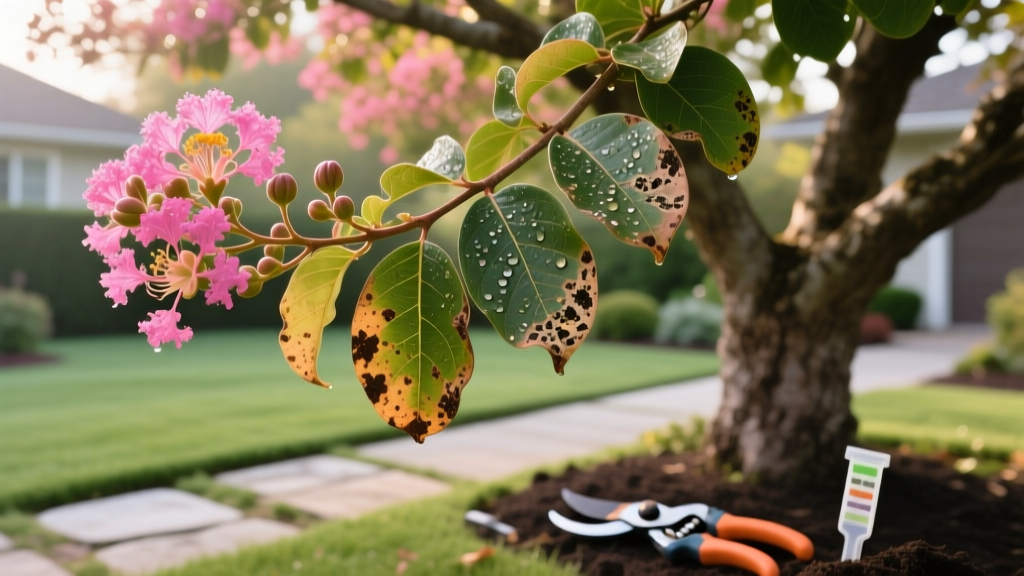
Crepe Myrtle Tree Leaves Turning Brown, Spotted, or Curling: Fixes
Diagnostic Triage: Identifying the Leaf Symptom
When crepe myrtle tree leaves exhibit distress, the visual symptoms dictate the treatment protocol. Misidentifying a fungal pathogen as an insect issue leads to wasted chemicals and progressive canopy decline. Use this rapid diagnostic framework to isolate the primary stressor before selecting a chemical or cultural intervention.
Symptom-to-Cause Decision Matrix
- White, powdery coating on new growth + curled leaf edges: Powdery Mildew (Erysiphe lagerstroemiae). Thrives in humid, shaded conditions with poor air circulation.
- Angular brown/black spots starting on lower canopy + premature defoliation: Cercospora Leaf Spot (Cercospora lythracearum). Spreads rapidly during extended summer rain events.
- Sticky residue on leaves + black sooty mold + curled foliage: Crepe Myrtle Aphid (Tinocallis kahawaluokalani) infestation. The mold feeds on aphid honeydew, blocking photosynthesis.
- Interveinal yellowing (chlorosis) on new leaves while veins remain green: Iron deficiency, typically induced by alkaline soils (pH > 7.2) locking up micronutrients.
Fungal Pathogens: Powdery Mildew and Cercospora Leaf Spot
Fungal diseases are the most common reason homeowners notice deformed or discolored crepe myrtle tree leaves. While both fungi cause defoliation, their environmental triggers and chemical controls differ significantly.
Powdery Mildew Management
Powdery mildew attacks expanding buds and young leaves, causing them to curl, stunt, and develop a white fungal mycelium. According to Clemson University Extension, this pathogen does not require free water to infect, meaning it thrives in dry, humid climates with warm days and cool nights.
Chemical Control: Apply a systemic fungicide containing Myclobutanil (e.g., Spectracide Immunox Multi-Purpose Fungicide) or Propiconazole 14.3% (e.g., Bonide Infuse Systemic Disease Control). Mix Propiconazole at a rate of 0.5 fluid ounces per gallon of water. Spray at 14-day intervals starting when leaf buds break in early spring. Expect to spend $18 to $24 per 16 oz bottle, which treats roughly 10 to 15 mature trees per season.
Cercospora Leaf Spot Eradication
Cercospora manifests as dark brown, angular spots that merge into large necrotic blotches. It begins in the lower, shaded canopy and moves upward. By late August, heavily infected trees may drop 50% of their foliage.
Chemical Control: Copper-based fungicides (like Bonide Liquid Copper) offer moderate protection but can cause phytotoxicity (leaf burn) if applied during high heat (>85°F). For severe outbreaks, rotate Tebuconazole (Bayer Advanced Disease Control) with Chlorothalonil (Daconil) to prevent fungal resistance. Apply strictly to the lower canopy first, ensuring thorough coverage of the leaf undersides where spores germinate.
Insect Pests: Aphids and Sooty Mold
Crepe myrtle aphids are host-specific pests that reproduce rapidly in early summer. As they feed on the phloem of crepe myrtle tree leaves, they excrete honeydew. This sugar-rich waste becomes a breeding ground for Capnodium fungi, resulting in a thick, black sooty mold that coats the leaves and severely restricts photosynthesis.
The 2026 Regulatory Shift on Neonicotinoids
Historically, homeowners relied on Imidacloprid soil drenches (e.g., Bayer 12-Month Tree & Shrub Protect & Feed) applied in March to prevent aphid outbreaks. However, as of 2026, several states have restricted residential use of neonicotinoids due to pollinator toxicity concerns. Before purchasing, verify your local state regulations regarding Imidacloprid.
Alternative Treatment Protocols
- Systemic Alternative: Chlorantraniliprole (Acelepryn) is a highly effective, pollinator-friendly diamide insecticide. Apply as a soil drench at a rate of 1.5 ml per inch of trunk diameter in early April. Cost is approximately $45 for a commercial concentrate, but it provides season-long control.
- Contact Foliar Spray: For active, visible infestations, use Bifenthrin (Ortho Max Insect Killer) or insecticidal soap. Spray at dusk to minimize bee exposure. A single application costs under $12 but requires reapplication every 7-10 days during peak summer heat.
- Sooty Mold Removal: Once the aphids are eliminated, the sooty mold will starve and flake off. To accelerate this, spray the canopy with a 2% horticultural oil solution (Neem oil or dormant oil) in late fall after leaf drop to smother overwintering eggs and loosen residual mold.
Nutritional Deficiencies: Iron Chlorosis in Alkaline Soils
If your crepe myrtle tree leaves are turning pale yellow while the veins remain distinctly green, the tree is suffering from iron chlorosis. This is rarely a lack of iron in the soil; rather, it is a pH issue. Crepe myrtles prefer a soil pH between 5.0 and 6.5. In soils with a pH above 7.2, iron becomes chemically bound and unavailable to the roots.
Critical Product Selection: Do not waste money on standard Iron EDTA chelates if your soil pH is above 7.0. EDTA breaks down in alkaline conditions. You must purchase Iron EDDHA (e.g., Sequestrene 138 or Miller's FerriPlus), which remains stable and bioavailable in soils with a pH up to 9.0. Expect to pay $30 to $40 for a 5-pound bag of Fe-EDDHA.
Apply Fe-EDDHA as a soil drench in early spring just before bud break. Dissolve 1 ounce of product per gallon of water and apply it in a trench dug 12 inches away from the trunk, targeting the active feeder roots. For immediate visual correction of severe chlorosis, use a trunk injection of ferric ammonium citrate, though this requires professional arborist equipment and costs $150-$250 per tree.
Cultivar Selection: Genetic Resistance vs. Susceptibility
The most cost-effective long-term solution for chronic leaf diseases is planting resistant cultivars. The National Arboretum's 'Fantasy' series and Indian-named hybrids exhibit high genetic resistance to both powdery mildew and Cercospora leaf spot. If you are repeatedly spending $100+ annually on fungicides for a susceptible tree, consider removing it and replacing it with a resistant variety.
| Cultivar Name | Bark/Flower Color | Mildew Resistance | Cercospora Resistance |
|---|---|---|---|
| White / Exfoliating Cinnamon | Excellent | Excellent | |
| Muskogee | Light Lavender / Grey | Excellent | Good |
| Dark Coral / Light Brown | Excellent | Excellent | |
| Carolina Beauty | Watermelon Red / Smooth Grey | Poor | Poor |
| Bright Red / Grey | Susceptible | Susceptible |
Source data adapted from NC State Extension Plant Database and long-term arboretum trials.
Seasonal Maintenance Protocol for Healthy Foliage
Maintaining pristine crepe myrtle tree leaves requires a proactive, calendar-based approach rather than reactive spraying. Follow this seasonal timeline to disrupt pest life cycles and prevent fungal spore germination.
- February - March (Dormant Season): Prune out crossing branches and interior suckers to increase canopy airflow, which rapidly dries leaf surfaces and inhibits mildew. Apply a 2% dormant horticultural oil spray to the trunk and primary scaffolds to smother overwintering aphid and scale eggs.
- April (Bud Break): Apply your primary soil drench (Chlorantraniliprole for aphids, or Fe-EDDHA if soil tests confirm high pH). Begin preventative Propiconazole foliar sprays if your specific cultivar is known to be highly susceptible to powdery mildew.
- June - July (Peak Stress): Monitor the undersides of leaves weekly for aphid colonization. If honeydew is detected, apply a contact insecticide immediately. Ensure the tree receives 1.5 inches of water per week; drought-stressed trees emit volatile organic compounds that attract Japanese beetles and exacerbate leaf scorch.
- November (Leaf Drop): Rake and destroy all fallen leaves. Cercospora spores overwinter in leaf litter. Removing this debris breaks the disease cycle and reduces the required fungicide volume for the following spring by up to 40%.

