
Tree Care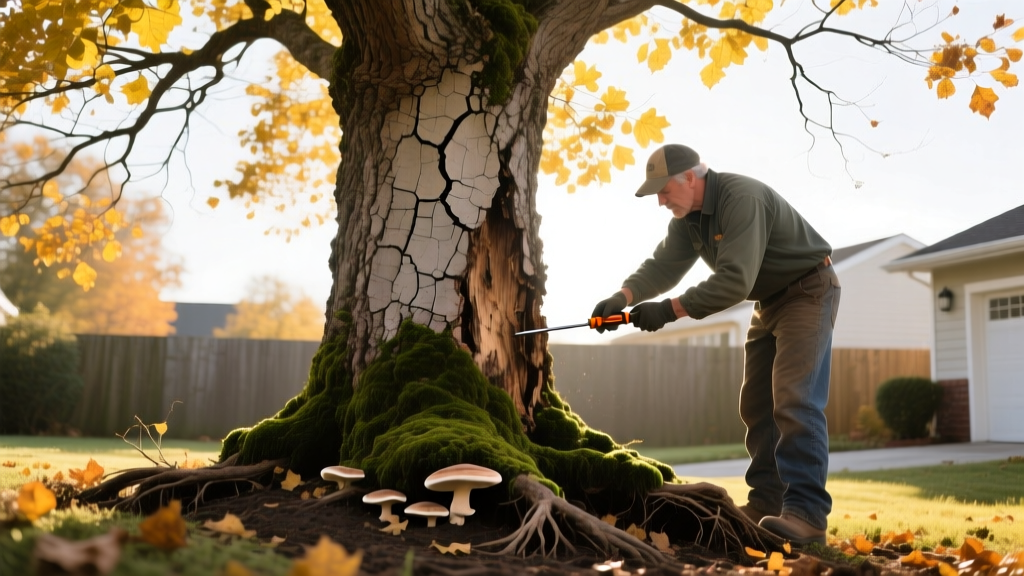
How to Tell if a Tree is Dying: 7 Symptoms & Rescue Fixes
The Scratch Test: Your First Diagnostic Step
Before evaluating canopy symptoms, you must verify the vascular system's status. Trees do not die overnight; they decline over seasons, often masking internal failure until the crown collapses. The most reliable immediate field test is the cambial scratch test.
Using a sterilized pocket knife or pruning shears (wiped with 70% isopropyl alcohol to prevent cross-contamination), make a shallow, 2-inch vertical incision through the outer bark on a lower branch and the main trunk. You are looking for the cambium layer just beneath the bark.
- Green and moist: The vascular tissue is active and transporting water. The branch or trunk section is alive.
- Brown, dry, or brittle: The cambium has died. If this is found on the main trunk, the tree is in systemic decline.
- Black and slimy: Indicates active bacterial wetwood or advanced internal rot.
If the trunk fails the scratch test but upper branches pass, you are likely dealing with a localized root issue or girdling root rather than total systemic failure. According to diagnostic frameworks from Penn State Extension, environmental stressors cause 80% of initial decline, which then invites the secondary pests and pathogens that ultimately kill the tree.
7 Critical Symptoms of a Dying Tree
Once the cambium is assessed, evaluate the macro-symptoms. A dying tree will display at least two or three of the following indicators simultaneously.
1. Crown Dieback (Top-Down Decline)
When the uppermost branches lose leaves or turn brown while the lower canopy remains green, the tree is sacrificing its extremities to conserve water and nutrients for the trunk. This is a hallmark of Verticillium wilt, severe drought stress, or root rot (Phytophthora).
2. Epicormic Sprouting (Water Sprouts)
If you see dense clusters of small, leafy shoots erupting directly from the main trunk or large scaffold branches, the tree is in survival mode. These epicormic sprouts are a desperate attempt to generate photosynthesis because the primary crown is failing.
3. Bark Slipping and Deep Fissures
Healthy bark is tightly fused to the wood. If large plates of bark are peeling away, or if you can easily slide your fingers behind the bark plates, the cambium has died and detached. Vertical fissures that expose rotting wood indicate structural compromise.
4. Fungal Conks and Basal Mushrooms
The presence of shelf fungi (conks) on the trunk or honey-colored mushrooms at the soil line is a non-negotiable red flag. Fungi like Ganoderma and Armillaria digest lignin and cellulose. By the time the fruiting bodies appear, at least 30% of the internal structural wood has already decayed.
5. Frass and D-Shaped Exit Holes
Accumulations of sawdust-like material (frass) at the trunk base or in bark crevices point to wood-boring insects. Look for D-shaped exit holes (Emerald Ash Borer) or perfectly round holes (Asian Longhorned Beetle). Borers only attack trees that are already emitting stress pheromones.
6. Leaf Scorch and Premature Drop
If leaves turn crispy brown at the margins and drop in July or August, the tree's hydraulic system is failing. This is often caused by girdling roots—roots that circle the trunk and choke off the phloem and xylem, preventing water from reaching the canopy.
7. Root Heaving and Soil Mounding
If the soil on one side of the trunk is lifting, or if you see a distinct mound forming at the base, the anchor roots are snapping. This indicates imminent mechanical failure, and the tree is a severe hazard to nearby structures.
Diagnostic Warning: Never rely on a single symptom to condemn a tree. A tree dropping leaves in August might just be experiencing temporary drought dormancy. Always cross-reference canopy symptoms with the scratch test and basal root inspection.
Symptom-to-Solution Decision Matrix
Use this matrix to determine if a tree can be rescued or if it requires removal. The Morton Arboretum emphasizes that treatment is only viable if the tree retains at least 50% of its live crown.
| Primary Symptom | Probable Cause | Rescue Viability | Immediate Action Required |
|---|---|---|---|
| Crown Dieback (< 30%) | Drought stress, minor root damage | High | Deep root watering, mulch ring expansion |
| Crown Dieback (> 50%) | Verticillium wilt, severe root rot | Low | Schedule removal; do not replant same species |
| Borer Insects (Frass) | EAB, Bronze Birch Borer | Moderate to High | Trunk injection of Emamectin benzoate |
| Fungal Conks on Trunk | Heart rot, Ganoderma | Zero | Immediate hazard removal |
| Girdling Roots | Improper planting, soil compaction | Moderate | Air-spading and root pruning by an arborist |
Rescue Fixes: Treatments, Costs, and Application Rates
If your tree falls into the "High" or "Moderate" rescue viability category, you must act within a specific seasonal window. Here are the exact protocols and 2026 market costs for professional and DIY interventions.
1. Systemic Insecticide for Borers
Soil drenches are ineffective for severe borer infestations because the damaged xylem cannot pull the chemical up to the canopy. You must use trunk injections.
- Active Ingredient: Emamectin benzoate (e.g., Tree-äge) or Dinotefuran (e.g., Safari).
- Dosage: Calculated strictly by Diameter at Breast Height (DBH). DBH is the trunk diameter measured exactly 4.5 feet above the ground.
- Cost: Professional trunk injection costs between $15 and $25 per inch of DBH. A 20-inch oak will cost $300–$500 per treatment, providing 2 to 3 years of protection.
- Timing: Inject in early spring just as sap begins to flow, prior to adult beetle emergence.
2. Fungicide Treatment for Oak Wilt and Anthracnose
For vascular fungal diseases, preventative or early-stage intervention is mandatory.
- Active Ingredient: Propiconazole 14.3% (e.g., Alamo, Propastat).
- Application: Macro-infusion via root flare injection.
- Cost: $20 to $30 per inch of DBH. Must be repeated every 18 to 24 months.
3. Air-Spading for Girdling Roots and Compaction
If the root flare is buried or roots are strangling the trunk, chemical treatments will not save the tree. Arborists use compressed air tools (air-spades) to excavate soil without slicing the bark.
- Procedure: Radial trenching and root collar excavation.
- Cost: Typically billed at $150 to $200 per hour, with most residential root-flare excavations taking 4 to 6 hours ($600–$1,200 total).
When to Abandon Rescue and Schedule Removal
Sentimentality is a liability in tree care. If a tree exhibits advanced structural decay, the cost of rescue will yield zero return, and the hazard risk compounds daily. You must hire an ISA Certified Arborist for removal if you observe:
- More than 50% of the canopy is dead.
- Large, hollow cavities in the main trunk or major scaffold unions.
- Fungal conks on the trunk or root flare.
- A severe lean that has developed recently, accompanied by soil heaving on the opposite side.
2026 Tree Removal Cost Estimates
Removal pricing has stabilized but remains heavily dependent on DBH, access, and crane requirements. Expect the following baseline costs for hazardous deadwood removal:
- Small Trees (Under 30 ft, < 12" DBH): $450 – $850
- Medium Trees (30–60 ft, 12"–24" DBH): $900 – $1,800
- Large Trees (60+ ft, > 24" DBH): $2,000 – $4,500+
- Crane Assist Surcharge: If the tree is over a roof or lacks drop-zone access, a mobile crane adds $900 to $1,400 per day to the invoice.
Always demand a certificate of insurance (COI) naming you as additionally insured before any crew steps onto your property. Dead trees are unpredictable; the wood is brittle, and standard rigging techniques used on healthy wood can cause sudden, catastrophic snapping during the takedown process.

