
Tree Care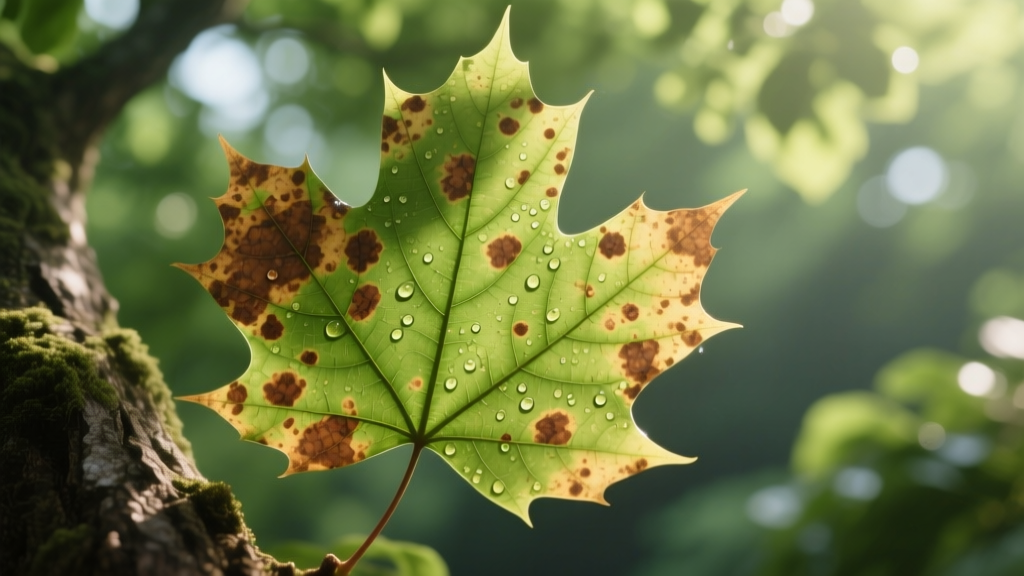
Brown Spots on Maple Leaves: Symptom Diagnosis & Rescue Fixes
The Diagnostic Decision Tree: Identifying the Trigger
Maples (Acer spp.) are highly susceptible to foliar blemishes, but treating a drought-stressed tree with fungicides is a waste of money and chemicals. Accurate diagnosis requires examining the spot's shape, margin, and location on the leaf. Use this diagnostic framework to pinpoint the exact cause of brown spots on maple leaves before initiating any rescue protocol.
- Raised, tar-like black/brown blisters: Tar Spot (Rhytisma acerinum). Primarily affects Norway and Silver maples. Spots appear mid-summer and thicken by autumn.
- Irregular brown patches along leaf veins: Anthracnose (Discula sp.). Common on Sugar and Japanese maples. Often accompanied by leaf curling and premature defoliation in cool, wet springs.
- Circular brown spots with purple borders and black centers: Phyllosticta Leaf Spot. The black centers are fruiting bodies (pycnidia) that release spores during rain.
- Crispy brown margins moving inward between veins: Environmental Leaf Scorch. Caused by drought, high winds, or root compaction. The tissue is entirely necrotic and brittle, not raised.
- Brown spots with distinct yellow halos on Japanese maples: Fertilizer burn or chemical drift from broadleaf herbicides applied to nearby lawns.
Fungal Pathogens: The Usual Suspects
When brown spots are fungal, the pathogen overwinters in fallen leaf litter and releases spores during spring rain events. According to Penn State Extension, fungal foliar diseases rarely kill a mature, established maple outright, but they severely reduce the tree's photosynthetic capacity, leading to stunted growth and increased vulnerability to secondary borers like the Asian longhorned beetle.
| Pathogen | Primary Host Species | Visual Symptoms | Peak Infection Window | First-Line Chemical Defense |
|---|---|---|---|---|
| Tar Spot | Norway, Silver, Red | 0.5-inch raised black/brown pustules | June - August | Copper octanoate (preventative) |
| Anthracnose | Sugar, Japanese, White | Irregular brown blotches along veins | April - May (bud break) | Chlorothalonil or Propiconazole |
| Phyllosticta | Amur, Sugar, Red | Circular spots with dark centers | May - July | Mancozeb (preventative) |
Targeted Fungal Rescue Protocol
If your diagnosis confirms a fungal pathogen, chemical intervention is only effective if timed correctly. Applying fungicides after the brown spots have already formed and thickened will not cure the existing lesions; it only protects new growth.
- Sanitation (Immediate): Rake and bag all fallen leaves. Do not compost them, as home compost piles rarely reach the 140°F (60°C) required to kill Rhytisma and Discula spores. Dispose of them in municipal yard waste bins.
- Chemical Application (Spring): For Anthracnose, apply a systemic fungicide containing propiconazole 1.67% (e.g., Ferti-lome Liquid Systemic Fungicide, approx. $35 for 16 oz). Mix at a rate of 2 fl oz per gallon of water. Spray at bud break and repeat at 14-day intervals for a total of three applications.
- Organic Alternative: For Tar Spot prevention, use a copper octanoate spray (e.g., Bonide Liquid Copper Fungicide, approx. $18 for 32 oz ready-to-spray). Apply just as leaves are expanding in spring. Note that copper can cause phytotoxicity (leaf burn) on Japanese maples if applied during high heat (>85°F), so spray only in the early morning.
Abiotic Stressors: Leaf Scorch and Chemical Burn
Not all brown spots on maple leaves are biological. Environmental leaf scorch is the most common abiotic trigger, particularly in shallow-rooted species like Japanese and Red maples planted in compacted urban soils or near reflective hardscaping.
Pro Tip: The 10-Gallon Rule
Maples suffering from drought-induced scorch require deep, slow watering. Apply exactly 10 gallons of water per inch of trunk diameter (measured at 4.5 feet above ground) every 7 to 10 days during summer droughts. Use a soaker hose coiled around the drip line, running it on a low trickle for 2 to 3 hours to ensure water penetrates 12 inches deep into the soil profile.
Maples suffering from drought-induced scorch require deep, slow watering. Apply exactly 10 gallons of water per inch of trunk diameter (measured at 4.5 feet above ground) every 7 to 10 days during summer droughts. Use a soaker hose coiled around the drip line, running it on a low trickle for 2 to 3 hours to ensure water penetrates 12 inches deep into the soil profile.
Correcting Fertilizer and Herbicide Damage
If brown spots appear shortly after lawn maintenance, suspect chemical drift. Broadleaf herbicides containing 2,4-D or dicamba can volatilize in temperatures above 80°F, drifting onto maple canopies and causing severe leaf cupping, browning, and necrosis. Flush the root zone with 1 inch of water immediately to dilute soil-borne residues. Avoid applying lawn fertilizers within the tree's drip line; maples are highly sensitive to excess salts, which draw moisture out of the fine feeder roots, manifesting as marginal leaf scorch.
Warning: When Spots Signal Vascular Collapse
Critical Alert: Verticillium Wilt
If brown, scorched leaves are accompanied by sudden branch dieback on only one side of the canopy, you are likely dealing with Verticillium wilt (Verticillium dahliae), a fatal soil-borne fungus. As University of Minnesota Extension notes, this pathogen blocks the tree's xylem. To confirm, peel back the bark on a dying branch; if the underlying sapwood shows olive-green or dark brown streaks, the tree is infected. There is no chemical cure for Verticillium. Focus on prolonging the tree's life with deep watering and balanced fertilization, and avoid planting susceptible species (like maples or ash) in that exact soil location in the future.
If brown, scorched leaves are accompanied by sudden branch dieback on only one side of the canopy, you are likely dealing with Verticillium wilt (Verticillium dahliae), a fatal soil-borne fungus. As University of Minnesota Extension notes, this pathogen blocks the tree's xylem. To confirm, peel back the bark on a dying branch; if the underlying sapwood shows olive-green or dark brown streaks, the tree is infected. There is no chemical cure for Verticillium. Focus on prolonging the tree's life with deep watering and balanced fertilization, and avoid planting susceptible species (like maples or ash) in that exact soil location in the future.
Preventative Maintenance Calendar
Long-term management of maple foliar health relies on altering the microclimate around the root zone to reduce stress and disrupt fungal life cycles.
- Early Spring (March-April): Apply a 3-to-4-inch layer of organic hardwood mulch extending to the drip line. Keep the mulch strictly 2 inches away from the root flare to prevent bark rot. This regulates soil temperature and retains moisture, preventing summer scorch.
- Late Spring (May): Monitor for Anthracnose. If the tree has a history of severe defoliation, initiate the propiconazole spray schedule.
- Summer (June-August): Prune out dead or crossing branches to increase air circulation through the canopy, which accelerates leaf drying and starves fungal spores of the moisture they need to germinate. Always sterilize pruning shears between cuts using 70% isopropyl alcohol to prevent cross-contamination.
- Autumn (October-November): Execute rigorous leaf removal. This is the single most effective cultural control for Tar Spot and Anthracnose, physically removing the overwintering inoculum from the property.
Frequently Asked Questions
Will brown spots on maple leaves kill my tree?
Fungal leaf spots like Tar Spot and Phyllosticta are primarily cosmetic and will not kill a mature, healthy maple. However, severe, repeated Anthracnose infections that cause total defoliation for multiple consecutive years can deplete the tree's carbohydrate reserves, leading to secondary pest infestations.
Should I prune off the leaves that have brown spots?
No. Removing spotted leaves manually causes more stress to the tree than the fungus itself. The remaining green tissue on the leaf is still photosynthesizing. Allow the tree to drop the leaves naturally in autumn, then remove them from the ground.
Can I use neem oil for maple leaf fungus?
Neem oil (clarified hydrophobic extract) acts as a mild contact fungicide and is somewhat effective against powdery mildew, but it is largely ineffective against entrenched pathogens like Tar Spot or Anthracnose. For reliable control on maples, synthetic fungicides (chlorothalonil) or metallic coppers (copper octanoate) applied at bud break offer significantly higher efficacy rates.

