
Tree Care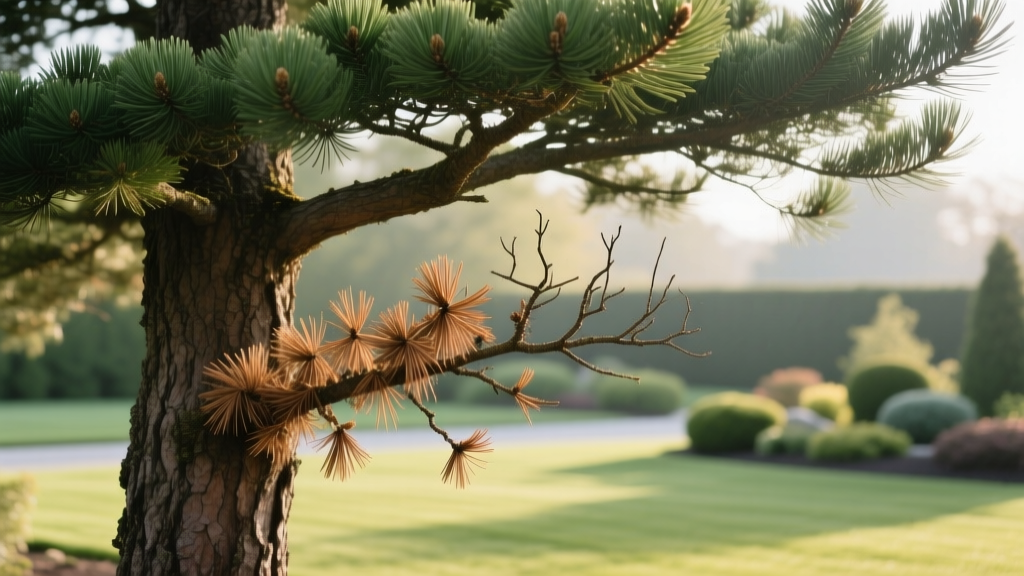
Landscaping With Evergreen Trees: Diagnosing and Fixing Dieback Issues
Landscaping with evergreen trees provides year-round architectural structure and privacy, but these species are highly susceptible to silent, compounding failures. Unlike deciduous trees that drop leaves and enter visible dormancy, evergreens retain their needles and continue to transpire throughout the winter. When environmental stress occurs, it often manifests as sudden, irreversible browning. Diagnosing the exact cause of dieback requires a systematic approach to differentiate between abiotic environmental stress, soil hydrology failures, and biotic pathogens.
Diagnostic Baseline: Before applying any treatments, scrape a small patch of bark on the affected branch with a sterilized knife. If the cambium layer underneath is green and moist, the branch is alive and can recover. If it is brown, brittle, and dry, that specific tissue is dead and must be pruned.
The Abiotic Stress Decision Tree: Winter Burn vs. Desiccation
The most frequent complaint when landscaping with evergreen trees is browning that appears in late February or early March. Homeowners often mistake this for a disease, but it is usually winter burn—a physiological drought. According to Penn State Extension, winter burn occurs when the sun and wind stimulate needle transpiration, but the root system cannot replace the lost water because the surrounding soil is frozen.
Symptom Differentiation
- Winter Burn Pattern: Browning is strictly localized to the windward side (usually north or west-facing) and the outermost needle tips. The interior needles and the leeward side remain green.
- Root Desiccation Pattern: Browning starts uniformly at the branch tips and progresses inward across the entire canopy, regardless of wind direction. This indicates the root zone dried out completely before the ground froze.
Targeted Remediation Protocols
For winter burn, the damage is already done, but the tree will push new growth from the surviving lateral buds in spring. Do not prune the brown tips until June; they protect the inner buds from further wind damage. To prevent recurrence, apply a polymeric antitranspirant like Wilt Pruf or VaporGard. These products coat the needles in a breathable resin, reducing moisture loss by up to 60%. Apply the first coat in late November (when temperatures are above 40°F) and a second coat in late February. A 1-quart concentrate costs approximately $25 and yields up to 20 gallons of spray.
Soil Hydrology: Testing and Correcting Drainage Failures
If your evergreen is browning from the bottom up, or if the entire canopy is turning a dull, chlorotic yellow before browning, you are likely dealing with Phytophthora root rot. This water-mold pathogen thrives in saturated, poorly draining soils, suffocating the fine root hairs. The University of Minnesota Extension notes that clay-heavy soils are the primary culprit in residential landscape failures.
The 60-Minute Percolation Protocol
Before attempting chemical treatments for root rot, you must verify your soil's drainage capacity using a standardized percolation test:
- Dig a hole 12 inches deep and 12 inches wide, exactly 3 feet from the tree's trunk (inside the dripline).
- Fill the hole completely with water and let it drain overnight to saturate the surrounding soil profile.
- Refill the hole to the top with water. Insert a yardstick to measure the water level.
- Wait exactly 60 minutes and measure the water drop.
Interpreting the Data: A drop of less than 1 inch per hour indicates severe drainage failure. If your soil fails this test, surface amendments will not help. You must install a French drain to intercept subsurface water, or carefully excavate the root flare and backfill with a 50/50 mix of native soil and expanded shale to create permanent macropores.
Biotic Threats: Pest and Disease Identification Matrix
When abiotic factors and drainage are ruled out, biotic agents are the next diagnostic target. Evergreens host specific pests that require precise timing for eradication. Below is a diagnostic matrix for the three most destructive threats in residential landscaping.
| Threat | Diagnostic Symptoms | Chemical/Organic Treatment | Application Timing |
|---|---|---|---|
| Spruce Spider Mite | Yellow stippling on needles; fine silk webbing visible at branch crotches; active in cool spring/fall weather. | Horticultural oil (organic) or Bifenthrin (synthetic). | Apply when mites are active; avoid oil during summer heat over 85°F. |
| Bagworms | 2-inch spindle-shaped 'bags' made of dead needles hanging from branches; severe defoliation starting at the top. | Spinosad or Btk (Bacillus thuringiensis var. kurstaki). | Early to mid-June, when larvae are small and actively feeding. |
| Rhizosphaera Needle Cast | Needles turn purplish-brown starting on the lowest, innermost branches; tiny black fruiting bodies visible on needles. | Chlorothalonil or Copper-based fungicides. | Apply when new needles are half-grown (May), repeat 3 weeks later. |
For bagworms specifically, University of Kentucky Entomology emphasizes that once the bags reach 1 inch in length and close up in late summer, chemical sprays cannot penetrate the silk casing. At that stage, manual removal and destruction of the bags is the only viable control method.
Corrective Pruning and Canopy Management
A critical mistake homeowners make when landscaping with evergreen trees is applying deciduous pruning logic to conifers. Understanding the latent bud structure of your specific species dictates whether a tree can be salvaged or must be removed.
The Conifer Pruning Rule: Pines, spruces, and firs do not possess latent buds on old wood. If you prune a pine branch back past the current year's green growth into the bare, brown wood, that branch will never regenerate foliage and will eventually die. Yews, arborvitae, and hemlocks, however, can sprout new growth from older wood and tolerate heavier renovation pruning.
Sanitation and Airflow Restoration
If your evergreen is suffering from fungal needle cast, the pathogen overwinters in fallen debris and dense, unpruned inner canopies. To restore airflow and reduce humidity within the canopy:
- Skirt Pruning: Remove the lowest tier of branches entirely, creating a 12-to-18-inch gap between the bottom foliage and the soil surface. This prevents soil-borne fungal spores from splashing onto the lower needles during rain events.
- Cross-Branch Removal: Identify branches that are rubbing against each other or growing inward toward the trunk. Remove these at the branch collar to open the center of the tree to UV light and wind, which naturally inhibit fungal sporulation.
- Debris Clearance: Rake out all dead, cast needles trapped in the lower branch crotches. Use a leaf blower on a low setting to dislodge needles caught deep in the canopy.
Frequently Asked Diagnostic Questions
My arborvitae is completely brown on one side. Can it be saved?
If the browning is limited to the side facing the road, it is likely suffering from salt damage from winter road plowing or heat reflection from asphalt. Perform the cambium scratch test. If the tissue is green, the tree will recover. Flush the root zone with 10 gallons of water per inch of trunk diameter in early spring to leach sodium salts below the root profile. Apply a gypsum (calcium sulfate) soil amendment at a rate of 50 lbs per 1,000 square feet to displace the sodium ions in the soil structure.
Why is my evergreen dropping a massive amount of interior needles in the fall?
This is often normal seasonal needle drop, not a disease. Evergreens do not keep their needles forever; pines typically hold needles for 2 to 4 years, while spruces hold them for 5 to 7 years. In autumn, the oldest needles (those closest to the trunk) will turn yellow or brown and drop simultaneously. As long as the outer 2 inches of the branch tips remain green and pliable, the tree is simply shedding expired foliage to conserve resources for winter.

