
Tree Care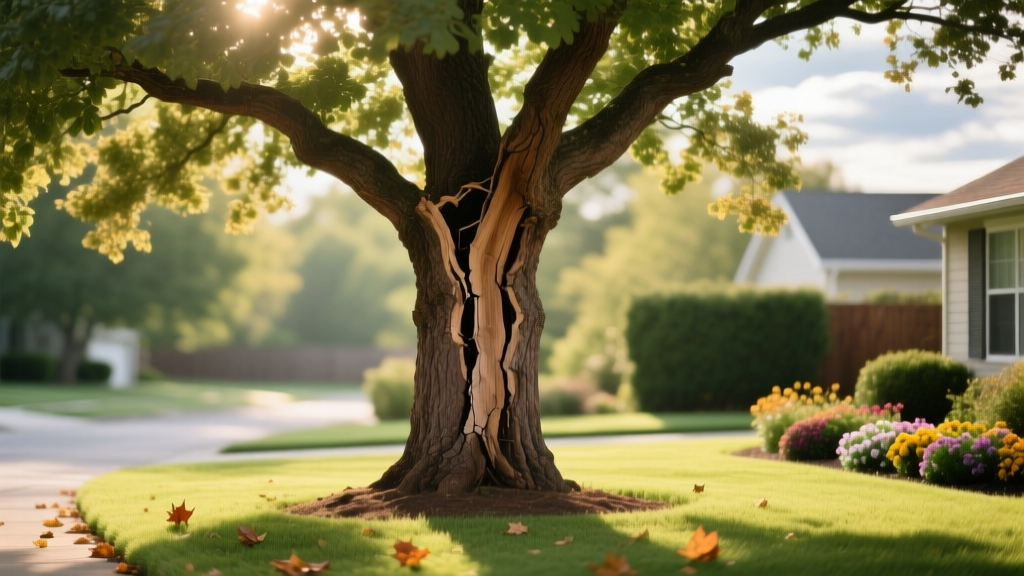
Diagnosing Weak Wood: How to Grow Strong Trees That Survive Storms
The Hidden Liability of Structurally Compromised Trees
Homeowners often assume that a tree with a full, green canopy is inherently healthy. However, canopy vigor rarely correlates with structural integrity. When a 60-mph microburst or heavy ice load hits, trees with hidden architectural flaws fail catastrophically, causing tens of thousands of dollars in property damage. Cultivating strong trees requires shifting your focus from superficial aesthetics to biomechanical stability and root architecture. This guide provides a diagnostic framework to identify structural red flags and actionable, professional-grade solutions to reinforce your landscape.
Core Principle: A tree's strength is determined in its first 10 to 15 years. Correcting structural defects in a mature, 50-foot oak is exponentially more expensive—and less successful—than subordination pruning on a 10-foot sapling.
Diagnostic Framework: Identifying Structural Red Flags
Before implementing solutions, you must accurately diagnose the failure points. Weak trees typically suffer from one of three primary structural defects.
1. Co-Dominant Stems and Included Bark
When two or more main stems grow upward from the same location, they form a V-shaped crotch. As these stems expand in diameter, they press against each other, trapping bark inside the union—a condition known as 'included bark.' This bark acts as a wedge, preventing the wood fibers from interlocking. According to the University of Minnesota Extension, V-shaped unions with included bark are the leading cause of mature tree split-trunk failures during wind events.
2. Girdling Roots and Buried Root Flares
A strong tree requires a wide, spreading root system anchored by the root flare (the trumpet-like widening at the base of the trunk). Trees planted too deeply, or left in narrow nursery containers too long, develop circling roots. Over time, these roots thicken and wrap around the trunk, effectively strangling the phloem and restricting water transport. A tree with a trunk that goes straight into the ground like a telephone pole is a major red flag.
3. Lion-Tailing and Over-Lifting
Improper pruning practices, such as stripping the lower branches from the trunk (lion-tailing), force all the canopy's weight and wind resistance to the very tips of the branches. This creates a lever effect that drastically increases the risk of branch snapping.
Structural Matrix: Weak vs. Strong Tree Indicators
| Diagnostic Feature | Weak Tree (Red Flag) | Strong Tree (Green Light) |
|---|---|---|
| Branch Unions | V-shaped crotches with trapped bark | U-shaped crotches with interlocking wood fibers |
| Trunk Base | Straight into soil; no visible root flare | Visible flare; surface roots radiate outward |
| Canopy Distribution | Foliage clustered only at branch tips | Interior lateral branches retained for taper |
| Leader Structure | Multiple competing vertical leaders | Single dominant central leader (for most species) |
Targeted Solutions for Building Strong Trees
Once you have identified the defects, apply these specific interventions to mitigate failure risk and promote long-term biomechanical strength.
Solution 1: Subordination Pruning
To fix co-dominant stems, do not remove the competing leader entirely, as this creates a massive wound that invites decay. Instead, use subordination pruning. Identify the weaker of the two stems and reduce its length using a reduction cut. Make the cut just above a lateral branch that is at least one-third the diameter of the stem being removed. This slows the growth of the subordinate stem, allowing the chosen central leader to dominate and build stronger wood. Never remove more than 15% to 20% of the live canopy in a single season to avoid triggering stress-induced water sprouting.
Solution 2: Root Crown Excavation
If your tree lacks a visible root flare or has girdling roots, hire an ISA-certified arborist to perform a root crown excavation. Professionals use a pneumatic air spade—a tool that uses supersonic compressed air to fracture compacted soil without damaging live roots.
- Process: The soil is blown away to a depth of 6 to 12 inches in a 4-foot radius around the trunk.
- Correction: Girdling roots are carefully severed and extracted using sterilized pruning saws.
- Cost Expectation: Typically ranges from $400 to $900 depending on soil compaction and tree size.
Solution 3: Dynamic Cabling and Bracing
When pruning alone cannot mitigate the risk of a multi-trunked mature tree, supplemental support is required. The industry has largely moved away from static steel J-lags and threaded rods, which restrict natural movement and cause the wood to become brittle. Modern arborists utilize dynamic systems like the Cobra Dynamic Cabling System. This braided polypropylene rope is installed high in the canopy, allowing the tree to sway naturally in light winds (which stimulates reaction wood growth) while abruptly catching and supporting the limbs during extreme storm loads. Expect to pay between $300 and $800 per cable installation, with mandatory inspections every 3 to 5 years as the hardware degrades under UV exposure.
When to Remove Instead of Fix: If a mature tree exhibits severe co-dominant stems with advanced decay (conks or fungal fruiting bodies) at the union, or if more than 30% of the root plate is compromised by girdling roots and soil heaving, cabling and pruning will not save it. Consult the International Society of Arboriculture (ISA) guidelines for risk assessment and schedule a safe removal.
Addressing Environmental Stressors: Soil Compaction
Strong trees require strong roots, and roots cannot penetrate compacted urban soils. If water pools around your tree for hours after a rainstorm, the soil is compacted, starving the roots of oxygen. Implement radial trenching to solve this. Using an air spade or a mechanical trencher, dig trenches 12 to 18 inches deep and 2 to 4 inches wide. Start the trenches 3 feet away from the trunk and radiate outward like spokes on a wheel, extending to the dripline. Backfill these trenches with a mix of coarse compost and expanded shale to permanently increase soil porosity and drainage.
Frequently Asked Questions
Can I fix a mature tree with weak V-crotches myself?
No. Subordination pruning and cabling on mature trees require climbing or aerial lift access, specialized rigging knowledge, and an understanding of ANSI A300 pruning standards. Improper cuts on large limbs can tear the trunk bark, causing catastrophic decay. Always hire an ISA-certified arborist for trees over 20 feet tall.
Does staking a newly planted tree make it stronger?
Actually, the opposite is true. Trees develop trunk taper and reaction wood in response to wind sway. Staking a tree too tightly, or leaving stakes on for more than one growing season, results in a weak, spindly trunk that is highly prone to snapping once the stakes are removed. Only stake trees in extreme wind corridors or if the root ball is unstable, and use wide, flexible straps.
How often should I inspect my yard trees for structural flaws?
Conduct a visual inspection twice a year: once in early spring before the canopy fills in (making branch unions visible) and once in late autumn after leaf drop. Look for new cracks, hanging branches, fungal growth on the trunk, or soil heaving at the base.

