
Tree Care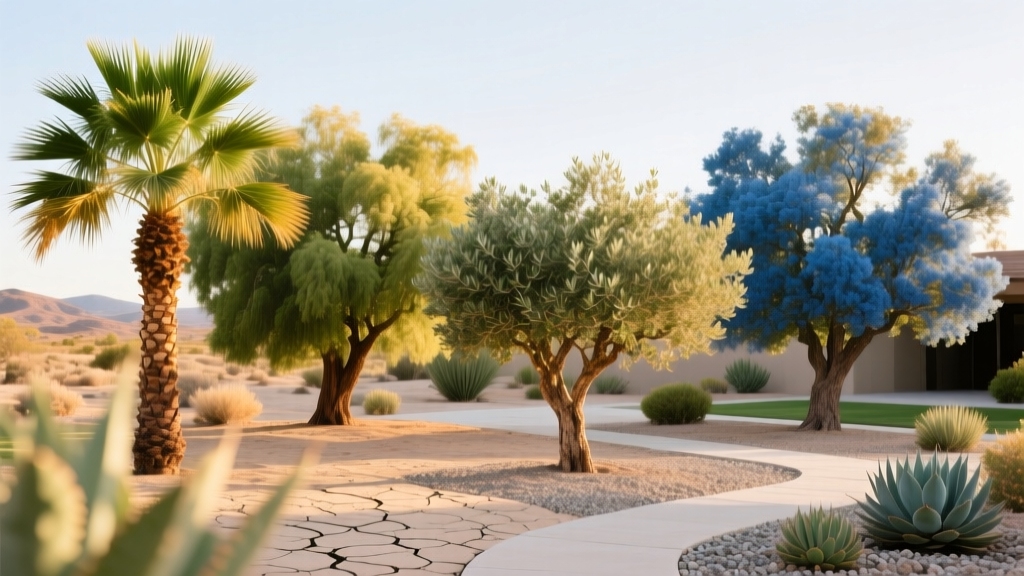
Best Drought Hardy Trees for Dry Yards and Water-Restricted Zones
The Site-Condition Challenge: Landscaping in Water-Restricted Zones
As municipal water restrictions tighten across North America in 2026, homeowners in arid and semi-arid regions are increasingly forced to rethink their landscapes. Tier 2 and Tier 3 water alerts frequently ban traditional turf irrigation, leaving dry, compacted, and sun-baked yards in need of structural shade. The solution is not merely abandoning plants for gravel; it is strategically deploying drought hardy trees engineered to thrive in low-moisture, high-stress site conditions.
However, selecting the right species is only half the battle. A tree marketed as "drought-tolerant" will still fail if planted in incompatible soil or subjected to the "bathtub effect" during its first 24 months. This guide provides a site-condition problem-solving framework to match specific drought hardy trees to your exact soil profile, ensuring long-term survival without relying on municipal water hookups.
The Science of Drought Tolerance: How These Trees Survive
Drought hardy trees do not simply "endure" dry spells; they possess specialized physiological adaptations. According to the USDA Plants Database, xerophytic and drought-adapted mesophytic trees utilize three primary mechanisms to survive site conditions with less than 15 inches of annual rainfall:
- Xylem Cavitation Resistance: During severe moisture deficit, the water column in a tree's xylem can snap, creating air bubbles (embolisms) that block water transport. Drought hardy species like the Lacebark Elm have narrower, denser xylem vessels that resist this cavitation.
- Stomatal Regulation: Species such as the Desert Willow feature narrow, linear leaves that reduce the surface area available for transpiration, effectively closing their stomata during peak afternoon heat to lock in moisture.
- Deep Taproot Architecture: Unlike shallow-rooted shade trees (e.g., Silver Maples), true drought survivors rapidly sink a primary taproot 4 to 8 feet into the subsoil within their first three years to access deep capillary water tables.
Decision Matrix: Matching Drought Hardy Trees to Your Soil Type
Site-condition problem solving requires matching the tree to your existing dirt, rather than amending the dirt to suit the tree. Use this matrix to select the correct species based on your yard's baseline soil profile.
| Tree Species | Botanical Name | Ideal Soil Profile | pH Tolerance | Mature Canopy | USDA Zones |
|---|---|---|---|---|---|
| Desert Willow | Chilopsis linearis | Sandy, rocky, fast-draining | 6.5 - 8.5 | 15-25 ft spread | 7-9 |
| Shantung Maple | Acer truncatum | Heavy clay, alkaline, compacted | 6.0 - 8.2 | 20-25 ft spread | 4-8 |
| Lacebark Elm | Ulmus parvifolia | Loam, clay-loam, urban fill | 5.5 - 8.0 | 35-45 ft spread | 5-9 |
| Western Redbud | Cercis occidentalis | Sandy loam, dry slopes | 6.5 - 8.0 | 10-15 ft spread | 7-9 |
| Vitex (Chaste Tree) | Vitex agnus-castus | Poor, rocky, highly alkaline | 6.5 - 8.5 | 10-15 ft spread | 6-9 |
Top 5 Drought Hardy Trees for Residential Landscapes
1. Shantung Maple (Acer truncatum)
The Problem Solver: Alkaline clay soils where traditional Sugar Maples suffer from severe iron chlorosis.
The Shantung Maple is a workhorse for difficult urban sites. It thrives in heavy, poorly aerated clay and highly alkaline conditions. It offers brilliant red and orange fall color, a rare trait in trees that tolerate high-pH clay. Failure Mode: Planting in heavily shaded areas. While drought-tolerant, it requires full sun to develop its signature dense canopy and vibrant autumn pigmentation.
2. Lacebark Elm (Ulmus parvifolia)
The Problem Solver: Large-scale shade requirements in hot, dry urban heat islands.
Unlike the American Elm, the Lacebark Elm is highly resistant to Dutch Elm Disease. Its exfoliating, puzzle-piece bark provides stunning winter interest. Once established, it handles prolonged 100°F+ heatwaves with minimal supplemental water. Pro Tip: Source "Drake" or "Allee" cultivars from the Arbor Day Foundation or local nurseries to ensure uniform growth habits and superior branch angles that resist windthrow.
3. Desert Willow (Chilopsis linearis)
The Problem Solver: Low-water accent planting in xeriscapes and dry creek beds.
Despite the name, this is not a true willow and will not destroy your plumbing seeking water. It is a deciduous shrub/tree native to the Southwest that produces stunning trumpet-shaped, orchid-like flowers from late spring through early fall. Failure Mode: Winter watering. Desert Willows are highly susceptible to root rot if watered during their winter dormancy in cold, wet soils.
4. Western Redbud (Cercis occidentalis)
The Problem Solver: Small patio shade and spring color in dry, sloped yards.
Native to California and the Southwest, this multi-trunked small tree explodes with magenta flowers in early spring before leafing out. It is exceptionally adapted to dry summer slopes where water runoff is rapid. Growth Rate: Slow to moderate (12-18 inches per year). Do not over-fertilize; high nitrogen levels promote weak, leggy growth prone to splitting.
5. Vitex / Chaste Tree (Vitex agnus-castus)
The Problem Solver: Replacing water-thirsty lilacs and hydrangeas in full-sun, poor-soil zones.
Often trained as a multi-stemmed tree, Vitex produces massive panicles of purple, bee-attracting flowers in mid-summer when most other trees have finished blooming. It thrives in neglect and actually blooms better in poorer soils. Maintenance: Requires aggressive winter pruning (cutting back to main scaffolds) to maintain a tree form and prevent it from reverting to a sprawling shrub.
Warning: The "Establishment Myth"
No tree is drought-tolerant on day one. The EPA WaterSense program emphasizes that all drought hardy trees require consistent, deep supplemental watering for the first 18 to 24 months to establish their deep root systems. Planting a "drought-tolerant" tree and immediately withholding water will result in 100% mortality.
Planting Protocol: Ensuring Survival in the First 24 Months
Improper planting kills more drought hardy trees than actual drought. Follow this strict protocol to avoid the "bathtub effect"—a phenomenon where water pools in loose, compost-amended backfill and drowns the roots in surrounding dense clay.
- Dig Wide, Not Deep: Excavate a hole 3 times the width of the root ball, but exactly the same depth. The root flare (where the trunk widens at the base) must sit 1 to 2 inches above the surrounding grade.
- Skip the Compost Backfill: Do not mix peat moss or heavy compost into the backfill. Use the native soil you just dug out. If the native soil is pure bedrock or unworkable caliche, use a 50/50 mix of native soil and coarse pine bark fines to maintain drainage parity.
- Apply the Mud Slurry: As you backfill, periodically add water to create a mud slurry. This eliminates air pockets without the need for mechanical tamping, which destroys soil structure.
- Mulch Correctly: Apply a 3-inch layer of coarse arborist wood chips. Keep the mulch exactly 4 inches away from the trunk flare to prevent collar rot and rodent damage.
Real Costs: Budgeting for a Xeriscape Tree Installation
Transitioning to a drought-hardy landscape requires upfront capital. Here is a realistic 2026 cost breakdown for installing a single, high-quality shade tree:
- Tree Material (2-inch caliper, Balled & Burlapped): $350 - $600 depending on species and nursery proximity.
- Tree Material (15-gallon container): $85 - $140 (requires 2 extra years to reach canopy size).
- Drip Irrigation Conversion Kit: $45 - $75. (Convert existing spray heads to a drip ring with four 2-GPH emitters).
- Coarse Arborist Mulch (1 cubic yard): $40 - $65 delivered.
- Professional Planting Labor (Optional): $250 - $450 per tree, including auger rental and debris hauling.
Total DIY Cost per mature tree: $520 - $880.
Common Failure Modes & Troubleshooting
Even the most resilient species will fail if site conditions are mismanaged. Watch for these specific indicators:
Troubleshooting Chlorosis vs. Drought Stress
If the leaves of your Shantung Maple turn yellow while the veins remain green, you are looking at iron chlorosis, often caused by overwatering which locks up nutrients in alkaline soils. If the leaves are crisp, brown at the margins, and drooping in the morning, it is true drought stress. Treat chlorosis with chelated iron (EDDHA form for high pH soils), not more water.
Frequently Asked Questions
Can I use a soaker hose for drought hardy trees?
Soaker hoses are inefficient for individual tree watering because they lose pressure over distance and water the surface too broadly. Use a dedicated drip ring with adjustable 2-GPH (gallon per hour) emitters placed 12 inches from the trunk. This delivers water directly to the root zone, minimizing evaporation.
How much water do established drought hardy trees actually need?
Once fully established (year 3+), most of these species require approximately 10 to 15 gallons of deep supplemental water once every 3 to 4 weeks during peak summer droughts. Apply this water slowly over a 4-hour period using a drip system to allow it to penetrate 18 inches into the soil profile.
Do drought hardy trees provide enough shade for energy savings?
Yes. Species like the Lacebark Elm and Shantung Maple develop dense, broad canopies. Strategically planting them on the south and west sides of your home can reduce summer cooling costs by 15% to 25%, offsetting their initial purchase cost within a decade while complying with local water conservation mandates.

