
Tree Care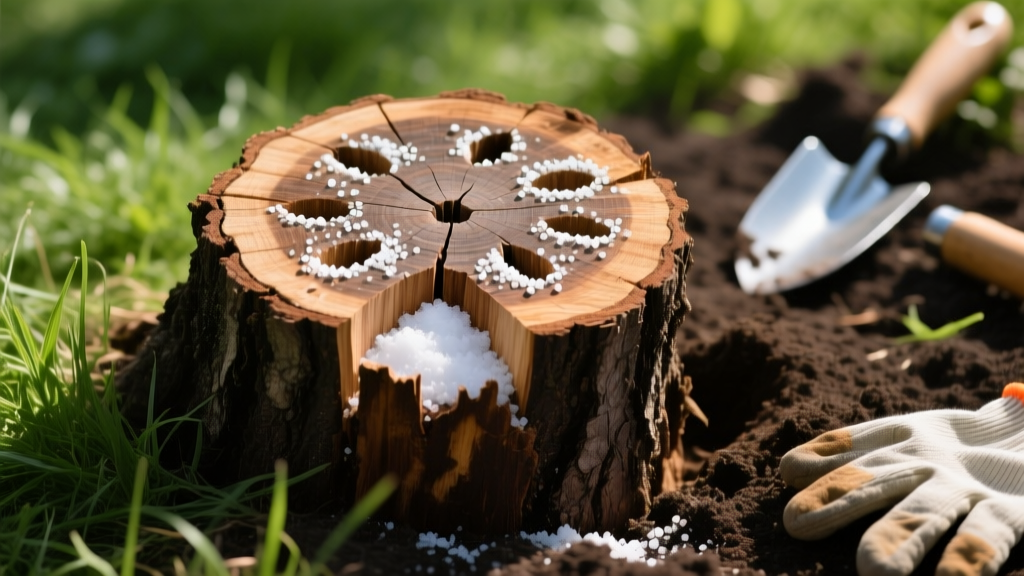
Using Epsom Salt for Tree Stump Removal: The Complete Guide
Leaving a freshly cut tree stump in your yard transforms it into a primary harbor for carpenter ants, termites, and wood-decay pathogens like Armillaria root rot. While mechanical grinding costs between $150 and $400 per stump, and chemical potassium nitrate accelerators can take six months to soften wood, using Epsom salt for tree stump removal offers a highly effective, low-cost desiccation strategy. When applied correctly, magnesium sulfate draws moisture out of the wood cells via osmosis, killing the root system and accelerating natural decay without permanently sterilizing your soil.
⚠️ CRITICAL SOIL WARNING: Never substitute Epsom salt (magnesium sulfate) with rock salt (sodium chloride) or standard table salt. According to Penn State Extension, sodium chloride permanently destroys soil structure, annihilates beneficial mycorrhizal fungal networks, and causes severe osmotic stress to surrounding desirable plants. Epsom salt is vastly safer, though excessive concentrations can still temporarily alter soil magnesium levels.
The Osmotic Desiccation Process
Epsom salt is chemically known as magnesium sulfate heptahydrate. When packed into a tree stump, it creates a hyper-saline environment. Water naturally moves from areas of low solute concentration (inside the living tree cells) to areas of high solute concentration (the Epsom salt). This rapid moisture extraction collapses the cellular structure of the cambium and sapwood layers. Unlike commercial stump killers that rely on high-nitrogen compounds to feed wood-eating fungi, Epsom salt kills the stump by starving and dehydrating it, preventing any chance of epicormic sprouting (suckering) from the roots.
Exact Materials and Cost Breakdown
To execute this playbook, you need specific tools. Using a standard twist bit or failing to use pure magnesium sulfate will result in failure. Below is the required inventory based on 2026 hardware store pricing.
| Item | Specification | Est. Cost (2026) |
|---|---|---|
| Epsom Salt | 100% pure magnesium sulfate (NO added scents, dyes, or bath oils) | $18 - $24 (10 lb bag) |
| Drill Bit | 1-inch to 1.5-inch carbon steel spade/paddle bit | $8 - $12 |
| Power Drill | Corded or high-torque 18V/20V cordless drill | Owned / $45 rental |
| Tarp | 6-mil black polyethylene sheeting | $15 - $20 |
| Mulch/Rocks | Heavy bricks or landscape staples to secure tarp | $0 (scavenged) |
The 5-Step Stump Eradication Playbook
Follow this exact sequence to ensure the salt penetrates the taproot and lateral root system. Surface application alone will not work; the salt must be introduced directly into the stump's vascular system.
- Drill the Penetration Grid: Using your 1-inch or 1.5-inch spade bit, drill holes vertically into the top of the stump. Space the holes 2 to 3 inches apart in a grid pattern. Critical Depth: Drill each hole 8 to 12 inches deep. If the stump is smaller than 12 inches in diameter, angle the outer holes at 45 degrees toward the center to intersect the lateral roots.
- Pack the Magnesium Sulfate: Fill each drilled hole to the brim with pure Epsom salt. Do not dilute it beforehand. You will likely use 3 to 5 pounds of salt for a standard 24-inch diameter stump. Tap the side of the stump with a mallet to settle the crystals and top them off.
- Activate the Osmosis: Using a watering can with a gentle rose attachment, pour just enough water into each hole to dissolve the top layer of salt and carry it down into the wood fibers. Do not flood the holes. Over-watering will cause the hyper-saline solution to spill over the edges and pool on your lawn, which can scorch the surrounding grass.
- Seal the Stump: Immediately cover the entire stump and the surrounding 2-foot radius with your 6-mil black polyethylene tarp. This serves two vital functions: it blocks UV light to prevent any remaining leaves from photosynthesizing, and more importantly, it prevents rainwater from washing the Epsom salt out of the holes before it can penetrate the roots.
- Secure and Wait: Weigh down the edges of the tarp with heavy bricks, pavers, or landscape staples. Leave the tarp completely undisturbed for a minimum of 4 to 8 weeks.
Decay Timeline and Maintenance Matrix
Stump desiccation is not an overnight process. The density of the wood (e.g., softwood pine vs. hardwood oak) dictates the timeline. Use this matrix to track your progress.
| Timeframe | Stump Condition | Required Action |
|---|---|---|
| Week 2 | Salt may have dissolved and settled deep into the holes. | Briefly lift tarp, top off holes with dry Epsom salt, add a splash of water, and reseal. |
| Week 4 | Bark begins to peel; wood sounds hollow when tapped with a hammer. | No action required. Ensure tarp remains securely weighted against wind. |
| Week 8 | Wood is heavily desiccated, brittle, and easily pierced with a screwdriver. | Remove tarp. Break apart the stump with a mattock, digging bar, or axe. |
| Week 10+ | Remaining roots are spongy and rotting. | Extract major lateral roots. Backfill the void with topsoil and compost. |
Troubleshooting Common Failure Modes
If your stump is still pushing out green suckers after 8 weeks, one of the following edge cases has occurred:
- Rainwater Dilution: If you failed to use a heavy-duty tarp, or if water pooled under the tarp due to poor grading, the rain washed the magnesium sulfate into the subsoil before it could dehydrate the taproot. Fix: Re-drill the holes, re-apply the salt, and use a tarp with a raised berm of soil around the edges to divert runoff.
- Using Scented Bath Salts: Many homeowners mistakenly buy lavender-scented Epsom bath salts. These contain oils and fragrances that coat the wood fibers, creating a hydrophobic barrier that prevents the salt from penetrating the cambium layer. Fix: Only use 100% pure agricultural or unscented drugstore magnesium sulfate.
- Shallow Drilling: Drilling holes only 3 or 4 inches deep only kills the upper sapwood. The deep taproot remains alive and will push new growth through the side of the stump. Fix: You must use an extension bit or a long spade bit to reach at least 10 inches into the core.
Frequently Asked Questions
Will Epsom salt harm the grass around the stump?
While magnesium sulfate is a common fertilizer component, a massive concentrated spill will cause localized fertilizer burn due to osmotic shock. By keeping the stump covered with a tarp, you prevent the salt from leaching into the surrounding lawn. Once the stump is removed, the residual magnesium will safely dissipate into the soil profile.
Can I just pile Epsom salt on top of the stump without drilling?
No. Surface application is entirely ineffective. As noted by University of Minnesota Extension, the outer bark and heartwood of a tree are highly resistant to surface chemicals. Drilling is mandatory to bypass the protective bark and introduce the desiccant directly into the porous xylem and phloem tissues.
For further reading on the chemical realities of using magnesium sulfate in landscaping, the Garden Professors provide excellent peer-reviewed context on how this compound interacts with soil biology, reinforcing why it is the superior choice over sodium-based alternatives for localized stump treatment.

