
Tree Care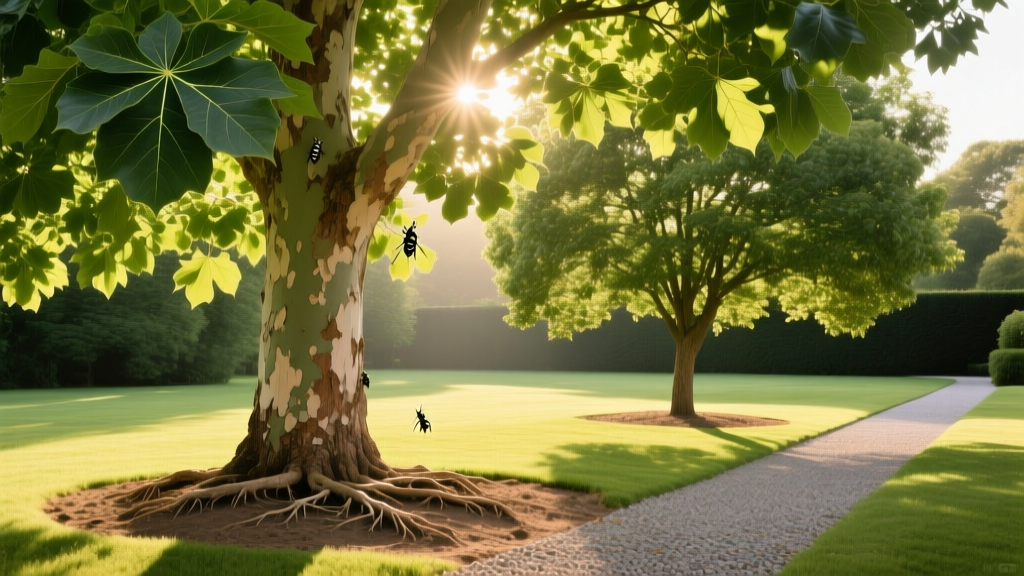
Fastest Growing Shade Tree Picks for Tough Soil and Hot Sites
The Site-Condition Matrix: Matching the Tree to the Turf
When your patio bakes in the afternoon sun and your soil resembles concrete, you need the fastest growing shade tree that can actually survive your specific site conditions. Planting a generic "fast grower" like the Silver Maple or Bradford Pear into compacted clay or poorly drained depressions guarantees structural failure, surface root heaving, or root rot within five years. True problem-solving in arboriculture requires matching the tree’s physiological tolerances to your yard’s exact edaphic (soil) and microclimate constraints.
Below is a decision matrix for 2026 to help you select the right rapid-growth canopy based on your specific site limitations.
| Site Condition | Recommended Species | Average Annual Growth | Mature Canopy Spread | Primary Failure Risk |
|---|---|---|---|---|
| Compacted Clay / Urban Heat | American Sycamore (Platanus occidentalis) | 2.0 – 4.0 feet | 60 – 80 feet | Anthracnose, surface roots |
| Poor Drainage / Wet Feet | Bald Cypress (Taxodium distichum) | 1.5 – 2.5 feet | 20 – 30 feet | Pneumatophores (knees) in mowed areas |
| Alkaline Soil (pH > 7.5) | Common Hackberry (Celtis occidentalis) | 1.0 – 2.0 feet | 30 – 50 feet | Hackberry nipple gall (cosmetic) |
| Dry / Drought-Prone Sand | Northern Catalpa (Catalpa speciosa) | 2.0 – 3.0 feet | 20 – 40 feet | Brittle branches, messy seed pods |
Solving Compacted Clay and Urban Heat Islands
Heavy clay soils suffocate the fine feeder roots of most shade trees, while urban heat islands accelerate transpiration and moisture loss. If your yard features dense, unyielding soil and high radiant heat, the American Sycamore is your most reliable fast-growing option.
American Sycamore (Platanus occidentalis)
The Sycamore thrives in heavy soils where oaks and maples stall. It achieves canopy closure rapidly, often adding 3 to 4 feet of vertical growth per year once established. Its massive, mottled bark provides year-round visual interest, and its broad leaves cast deep, cooling shade.
⚠ Warning: The Anthracnose Factor
Sycamores are susceptible to sycamore anthracnose, a fungal disease that causes severe leaf drop in cool, wet springs. The Fix: Do not plant Sycamores in enclosed, damp courtyards. Plant them in open areas with high air circulation to dry the canopy quickly. Rake and destroy fallen leaves in autumn to break the fungal lifecycle.
Tackling Poor Drainage and "Wet Feet" Sites
Low-lying areas that hold water for 24+ hours after a rainstorm will drown most shade trees by displacing soil oxygen. If you need the fastest growing shade tree for a boggy depression or near a retention pond, you must look to riparian (river-adapted) species.
Bald Cypress (Taxodium distichum)
Though it is a conifer, the Bald Cypress is deciduous, dropping its rust-colored needles in winter. It is uniquely adapted to saturated soils, capable of growing 2 feet annually even in standing water. In 2026, nursery pricing for a 2-inch caliper B&B (balled and burlapped) Bald Cypress averages $350 to $450, a worthwhile investment for its 500+ year lifespan.
Managing the "Knees"
In saturated soils, Bald Cypress develops pneumatophores, or "knees," which protrude above the ground to facilitate gas exchange.
- In mulch beds: Knees are harmless and add architectural interest.
- In mowed turf: Knees will damage mower blades and trip pedestrians. If planting in a lawn area, improve the site drainage artificially (e.g., French drains) before planting. If the soil drains well, the tree will rarely produce knees.
Overcoming Alkaline, Dry, and Nutrient-Poor Dirt
Soils with a pH above 7.5 lock up essential micronutrients like iron and manganese. Planting a Red Maple or Pin Oak in alkaline clay results in severe iron chlorosis (yellowing leaves with green veins) and stunted growth. For high-pH sites, the Common Hackberry is the ultimate problem solver.
Common Hackberry (Celtis occidentalis)
The Hackberry is exceptionally tolerant of alkaline soils, urban pollution, and drought. While its growth rate of 1 to 2 feet per year is slightly slower than the Sycamore, its wood is significantly stronger, making it highly resistant to windthrow and ice storms. Its elm-like leaves provide dappled shade, which is ideal if you are trying to grow shade-tolerant groundcovers like hostas or liriope beneath the canopy.
The "Fast-Growing" Trap: Mitigating Weak Wood
The biological trade-off for rapid vertical growth is lower wood density. Fast-growing trees produce longer internodes and wider branch angles, which can lead to weak, V-shaped crotches prone to splitting during high winds.
Structural Pruning Protocol
To ensure your fast-growing shade tree survives its first decade without catastrophic limb failure, implement subordination pruning during the first 3 to 5 years. According to the University of Minnesota Extension, you should identify a single, dominant central leader and prune back competing leaders by 30%. This forces the tree to develop U-shaped branch unions, which are structurally sound and resist splitting under heavy snow or wind loads.
2026 Planting Protocol: Exact Measurements for Rapid Establishment
A $200 tree planted in a $2,000 hole will thrive; a $2,000 tree planted in a $2 hole will die. To maximize the growth rate of your new shade tree, follow these exact specifications:
- Locate the Root Flare: Brush away nursery soil from the top of the root ball until you see the trunk flare (where the trunk widens at the base). This flare must sit 1.5 to 2 inches above the final grade.
- Dig Wide, Not Deep: The hole must be 2.5 to 3 times the width of the root ball, but no deeper than the root ball itself. Digging deeper and backfilling creates a settling effect that buries the root flare, leading to fatal girdling roots.
- Skip the Soil Amendments: Do not mix peat moss or compost into the backfill. According to Arbor Day Foundation guidelines, amending the planting hole creates a "bathtub effect" in heavy clay, trapping water and rotting the roots. Backfill entirely with the native soil you just dug out.
- Apply Mycorrhizal Inoculant: Dust the root ball with a granular endo/ectomycorrhizal fungi product (costs roughly $15 to $25 per 2lb bag). This symbiotic fungi expands the root surface area by up to 100x, accelerating water and nutrient uptake during the critical first year.
- Mulch Correctly: Apply a 3-inch layer of hardwood mulch in a 4-foot diameter ring. Keep the mulch exactly 3 inches away from the trunk bark to prevent vole damage and trunk rot.
By diagnosing your specific site conditions and selecting the correct species, you can establish a massive, cooling canopy in half the time it takes for traditional, slow-growing hardwoods.

