
Tree Care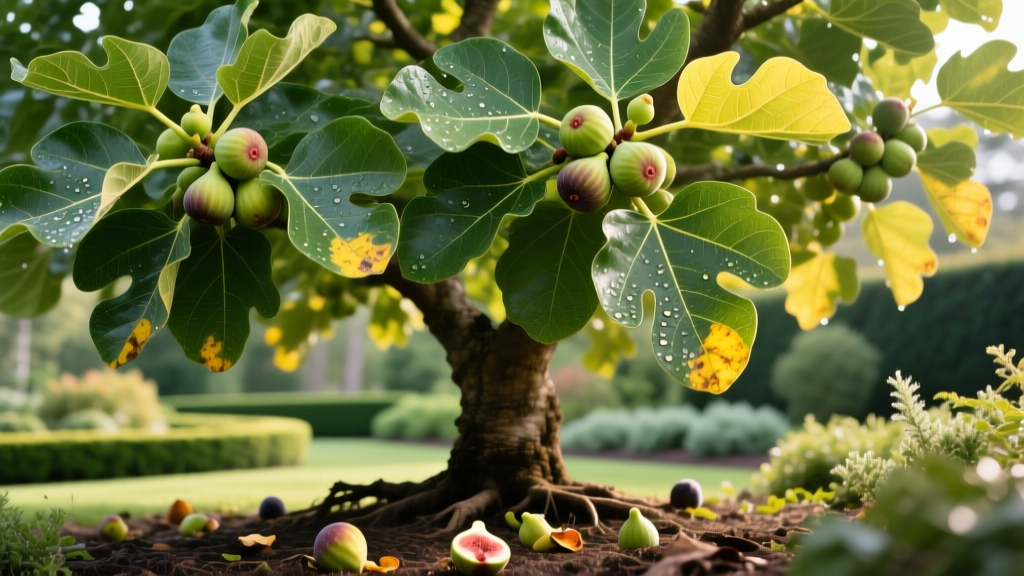
Fig Tree Gardening: Diagnosing Yellow Leaves and Fruit Drop Issues
The Diagnostic Approach to Fig Tree Gardening
While Ficus carica is celebrated for its resilience, successful fig tree gardening requires precise environmental management. When a fig tree declines, homeowners often misattribute the failure to a single cause. In reality, foliar chlorosis and premature fruit abscission are usually the result of compounding stressors: incorrect cultivar selection for the local hardiness zone, soil-borne pathogens, or micro-nutrient lockouts. This guide provides a clinical framework for diagnosing and resolving the most persistent physiological and pathogenic failures in home orchards.
Pro Tip: Before applying fertilizers or fungicides, verify your soil pH. Figs require a pH between 6.0 and 6.5. Outside this range, essential micronutrients like iron and magnesium become chemically locked in the soil, mimicking disease symptoms.
Symptom-to-Solution Decision Matrix
| Primary Symptom | Probable Cause | Secondary Suspect | Immediate Diagnostic Action |
|---|---|---|---|
| Uniform leaf yellowing | Nitrogen deficiency or waterlogging | Root-knot nematodes | Check soil moisture at 6-inch depth; inspect roots for galls. |
| Interveinal chlorosis | Magnesium deficiency | Fig Mosaic Virus (FMV) | Apply Epsom salt foliar spray; look for yellow ring mottling. |
| Premature fruit drop | Cultivar pollination mismatch | Drought stress or Fig Rust | Verify if cultivar is parthenocarpic or Smyrna-type. |
| Fruit souring/fermentation | Open ostiole (eye) entry | Endosepsis fungal infection | Check fruit eye size; switch to closed-eye cultivars in humid zones. |
Foliar Failures: Decoding Yellow Leaves and Defoliation
Yellowing leaves in fig trees generally fall into three distinct categories: nutritional deficits, hydrological stress, and viral presence. Distinguishing between them requires close observation of the chlorosis pattern.
Nutritional Deficits vs. Water Stress
Nitrogen deficiency presents as a uniform, pale green to yellow coloration across the entire leaf, starting with the older, lower canopy leaves. Conversely, overwatering or poorly draining clay soils cause root hypoxia, which also triggers uniform yellowing but is accompanied by leaf wilting and a sour, anaerobic soil odor. According to the University of Florida IFAS Extension, mature fig trees require roughly 1/2 pound of 8-8-8 or 10-10-10 fertilizer per year of tree age, up to a maximum of 5 pounds, split into three applications in late winter, early summer, and mid-summer.
If the yellowing is interveinal (the veins remain green while the tissue between them yellows), the tree is likely suffering from magnesium deficiency, which is highly common in acidic, sandy soils. A foliar spray of 1 tablespoon of Epsom salts (magnesium sulfate) per gallon of water provides a rapid, temporary correction, while incorporating dolomitic lime into the soil profile addresses the long-term deficit.
Fig Mosaic Virus (FMV)
FMV is endemic in a vast majority of commercial and home fig stock. Transmitted by the microscopic fig mite (Aceria ficus), FMV causes distinct yellow ring-mottling, banding along the veins, and leaf distortion. While FMV cannot be cured, it rarely kills the tree. The severity of symptoms fluctuates with environmental stress. Maintaining optimal irrigation, aggressive weed control, and high nitrogen availability suppresses the visual expression of the virus and maintains fruit yields.
Fruit Development Failures: Drop, Rust, and Souring
Fruit loss is the most frustrating aspect of fig tree gardening. To diagnose fruit drop, you must first understand the reproductive biology of your specific cultivar.
The Smyrna Pollination Trap
Many homeowners unknowingly purchase Smyrna-type figs, such as 'Calimyrna'. These cultivars are not parthenocarpic; they require cross-pollination by the fig wasp (Blastophaga psenes) to set fruit. Because this specific wasp is largely absent in the Eastern and Midwestern United States, Smyrna figs in these regions will reliably drop 100% of their main crop when the fruit reaches the size of a marble. If you live outside of California or the Mediterranean and experience total main-crop drop, the solution is not more fertilizer—it is removing the tree and replanting a common, parthenocarpic type like 'Celeste' or 'Chicago Hardy'.
Fig Rust (Cerotelium fici)
In humid, coastal environments, Fig Rust causes severe premature defoliation, which halts fruit maturation and causes the developing figs to shrivel and drop. Rust manifests as small, reddish-brown, angular lesions on the underside of the leaves. The UC Statewide IPM Program notes that while rust rarely kills the tree, repeated annual defoliation weakens the root system. Management requires rigorous sanitation (removing all fallen leaves) and preventative applications of copper-based fungicides (such as Bordeaux mixture or copper octanoate) applied at the first sign of lesions in early summer. Do not apply copper when temperatures exceed 85°F to prevent phytotoxicity.
Endosepsis and Fruit Souring
If your figs ripen but taste fermented or attract swarms of ants and beetles, the fruit is souring. This occurs when insects and yeast enter the fruit through the ostiole (the 'eye' at the bottom of the fig). Cultivars with large, open eyes (like 'Brown Turkey' or 'Black Mission') are highly susceptible to souring in regions with high summer humidity and frequent afternoon thunderstorms. The only permanent solution is transitioning to closed-eye cultivars.
Subterranean Threats: Root-Knot Nematodes
In sandy soils, particularly across the Southeastern US, root-knot nematodes (Meloidogyne spp.) are the primary limiting factor in fig tree gardening. These microscopic worms invade the root cortex, forming distinct galls (knots) that restrict water and nutrient uptake. Above ground, the tree exhibits stunted growth, wilting during peak heat despite moist soil, and progressive dieback.
Warning: Do not attempt to chemically fumigate home garden soil for nematodes. Nematicides available to consumers are largely ineffective against established populations. Instead, rely on genetic resistance and biological competition.
To mitigate nematode pressure, interplant French marigolds (Tagetes patula) densely around the fig's drip line; their roots exude alpha-terthienyl, which suppresses nematode egg hatching. For severe infestations, the most effective strategy is to remove the susceptible tree and replant using a nematode-tolerant cultivar, or graft your desired scion onto a resistant rootstock.
Cultivar Resistance and Selection Matrix
Selecting the right genetics prevents 90% of common fig tree gardening failures. Use the matrix below to match cultivars to your specific regional challenges.
| Cultivar | Fruit Type | Nematode Tolerance | Eye Status (Souring Risk) | Best Climate Application |
|---|---|---|---|---|
| 'Celeste' | Common (Parthenocarpic) | High | Closed (Low Risk) | Humid Southeast, heavy clay soils |
| 'LSU Purple' | Common (Parthenocarpic) | Very High | Closed (Low Risk) | Sandy soils with high nematode pressure |
| 'Chicago Hardy' | Common (Parthenocarpic) | Moderate | Semi-Open (Moderate) | Zones 5-7, requires winter protection |
| 'Brown Turkey' | Common (Parthenocarpic) | Low | Open (High Risk) | Arid West, Mediterranean climates |
| 'Calimyrna' | Smyrna (Requires Wasp) | Low | Open (High Risk) | Central Valley California only |
Seasonal Maintenance Protocol
Implementing a structured seasonal routine minimizes environmental stressors that trigger the problems outlined above.
- Late Winter (Dormancy): Prune out dead, diseased, or crossing branches. Apply a 2-inch layer of arborist wood chips, keeping it 4 inches away from the trunk to prevent crown rot. Apply the first dose of granular 8-8-8 fertilizer.
- Early Spring (Bud Break): Monitor for the fig mite and apply horticultural oil (neem or dormant oil) if FMV symptoms were severe the previous year. Ensure soil moisture is consistent to support the breba (early) crop.
- Summer (Fruit Set & Maturation): Maintain 1 to 1.5 inches of water per week via drip irrigation. Overhead watering must be avoided entirely to prevent Fig Rust spore germination. Apply the second and third fertilizer doses. Scout the undersides of leaves weekly for rust lesions.
- Autumn (Post-Harvest): Remove all mummified fruit and fallen leaves from the orchard floor to break the disease cycle. Do not fertilize, as late-season growth will be killed by the first frost, creating entry points for wood-decaying fungi.
By shifting from reactive treatments to proactive cultivar selection and precise soil management, homeowners can transform a struggling Ficus carica into a highly productive, multi-decade landscape asset. For further regional specifics, consult your local cooperative extension office or refer to the Clemson HGIC Fig Guide for localized hardiness data.

