
Tree Care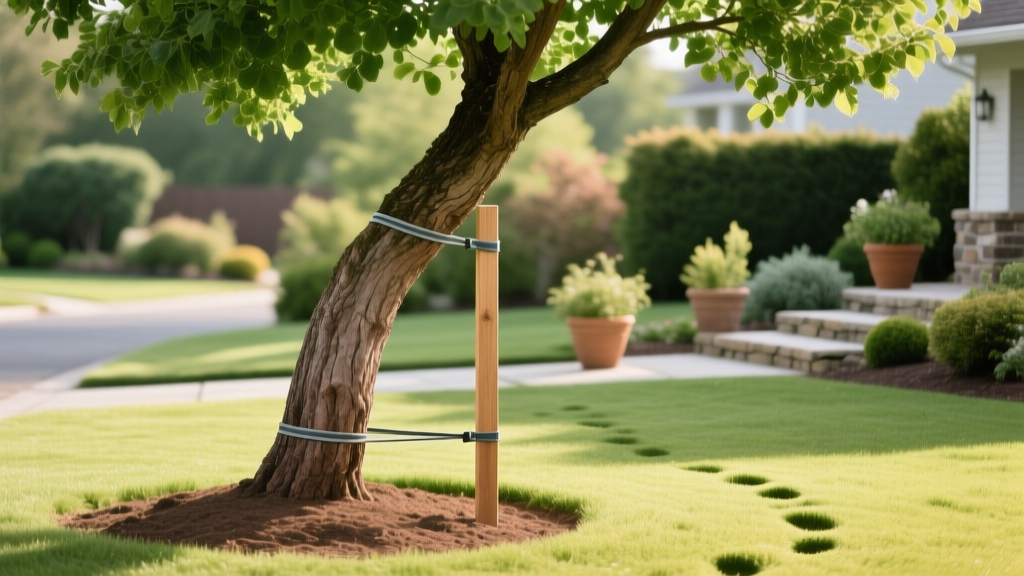
How to Fix a Tree Bend: Staking and Straightening Guide
Assessing the Tree Bend: Can It Be Saved?
Before purchasing materials, you must determine the mechanical cause of the tree bend. Trees typically bend for three reasons: phototropism (growing toward a dominant light source), windthrow (root ball displacement during severe storms), or apical dominance loss (the central leader snapped, causing lateral branches to bend upward). If the trunk itself is curved but the base is firmly planted, you are dealing with a structural trunk bend. If the entire tree leans from the soil line, the root ball has shifted.
The 45-Degree Rule: If a tree is bent or leaning past a 45-degree angle from vertical, the root system is likely compromised beyond recovery, especially in trees over three years old. Saplings and trees with a caliper (trunk diameter) under 2 inches can usually be corrected. Mature trees with severe bends require professional cabling or removal.
According to forestry guidelines from the University of Minnesota Extension, staking should only be used when absolutely necessary. Over-staking prevents the development of reaction wood—the dense, supportive tissue trees grow in response to mechanical stress. Your goal is to provide temporary support while the tree re-establishes its own structural integrity.
Materials and Cost Breakdown
Do not use wire wrapped in old garden hose. This outdated method creates friction burns that sever the phloem layer, effectively strangling the tree. As of 2026, professional-grade woven polyester arbor ties are the industry standard. Below is the exact bill of materials needed for a standard two-stake straightening job on a sapling with a 1.5-inch caliper.
| Material | Specification | Estimated Cost (2026) |
|---|---|---|
| Stakes | 8-foot galvanized steel T-posts or 2x2 pressure-treated wooden stakes | $18 - $25 (pair) |
| Arbor Ties | 1.5-inch to 2-inch wide woven polyester strap with D-rings | $12 - $18 |
| Post Driver | 10 lb steel post pounder (for T-posts) | $25 (rent or buy) |
| Soil Amendment | Mycorrhizal root stimulator (optional but recommended for rootball shock) | $10 - $15 |
Total project cost typically ranges from $40 to $65. Avoid cheap plastic zip-ties or rigid nylon cords, which slice into the bark as the trunk sways in high winds.
Step-by-Step: The Two-Stake Straightening Method
Correcting a tree bend requires patience. You cannot force a curved trunk into a perfectly vertical line in a single afternoon without snapping the xylem vessels. Use the gradual tensioning method outlined below.
Step 1: Hydrate the Root Zone
Two days before straightening, deeply water the tree's root zone. Apply 10 to 15 gallons of water per inch of trunk caliper. Saturating the soil reduces root shear stress and allows the root ball to pivot slightly in the earth without snapping fine feeder roots.
Step 2: Position the Stakes
Drive two stakes into the ground outside the root ball. For a tree bending toward the north, place the stakes on the east and west sides of the trunk, exactly 18 inches away from the base. Drive the stakes 18 to 24 inches deep using a post pounder. Leaving 4 to 5 feet of stake above ground provides the necessary leverage.
Step 3: Apply the Primary Tie
Wrap the 2-inch polyester strap around the trunk at roughly two-thirds of the tree's total height. This is the optimal fulcrum point for leverage. Thread the strap ends through the D-rings on the stakes. Critical detail: Leave exactly 2 inches of slack between the trunk and the stake. The tree must be able to sway slightly in the wind to trigger reaction wood growth.
Step 4: Gradual Tensioning Schedule
Do not pull the tree completely vertical on day one. Tighten the straps to correct 50% of the bend. Wait 14 days, then tighten further to correct 75% of the bend. By week six, the tree should be fully vertical. This slow adjustment allows the cambium layer to adapt without tearing.
Guy-Wire Anchoring for Severe Bends
If your tree has a caliper larger than 2.5 inches, or if the bend is caused by a massive root-ball tilt rather than a curved trunk, standard stakes will fail. You must use a guy-wire anchoring system.
The Penn State Extension recommends a three-point guy-wire system for larger specimens. Drive 3-foot rebar stakes into the ground at a 45-degree angle, pointing away from the tree, placed 120 degrees apart from each other at a distance of 8 to 10 feet from the trunk. Run 1/8-inch galvanized aircraft cable from the rebar up to the trunk, protecting the trunk with a 24-inch section of 3/4-inch rubber garden hose to prevent bark girdling. Use a turnbuckle on one of the lines to apply precise, measurable tension over several weeks.
Critical Failure Modes to Avoid
Homeowners frequently make mistakes that kill the tree they are trying to save. Avoid these specific failure modes:
- Trunk Girdling: Leaving ties on for more than one growing season. As the trunk expands in diameter, rigid ties cut off nutrient flow. Remove or loosen all ties after 9 to 12 months.
- Pencil-Trunk Syndrome: Tying the tree too tightly so it cannot move. Trees require mechanical stress to thicken their base. A tree that is locked rigidly in place will grow tall but remain dangerously thin, eventually snapping at the tie line during a storm.
- Root Ball Rotation: When pulling a leaning tree upright, the root ball can twist in the soil cavity, shearing the taproot or primary structural roots. Always excavate a small trench on the tension side of the root ball to allow it to pivot cleanly.
Expert Insight: 'A tree bend is often a symptom of poor nursery practices, specifically trees that were staked too high and too tight before sale. When planting a new tree, remove all nursery stakes immediately. The tree will flop over temporarily, but this forces the roots to anchor deeply and the trunk to build natural taper.' — Urban Forestry Best Practices
Post-Straightening Maintenance Timeline
Once the tree is vertical, the work shifts to root establishment and canopy balancing. Prune no more than 15% of the canopy to reduce wind-sail effect while the roots re-anchor. Apply a 3-inch layer of organic hardwood mulch over the root zone, keeping it 4 inches away from the trunk flare to prevent rot. Monitor the arbor ties monthly. If you see the bark bulging over the edges of the polyester strap, loosen the tie immediately. By the second spring, the tree should have generated enough internal reaction wood to stand independently, allowing you to remove the hardware entirely and let the tree support its own weight.

