
Tree Care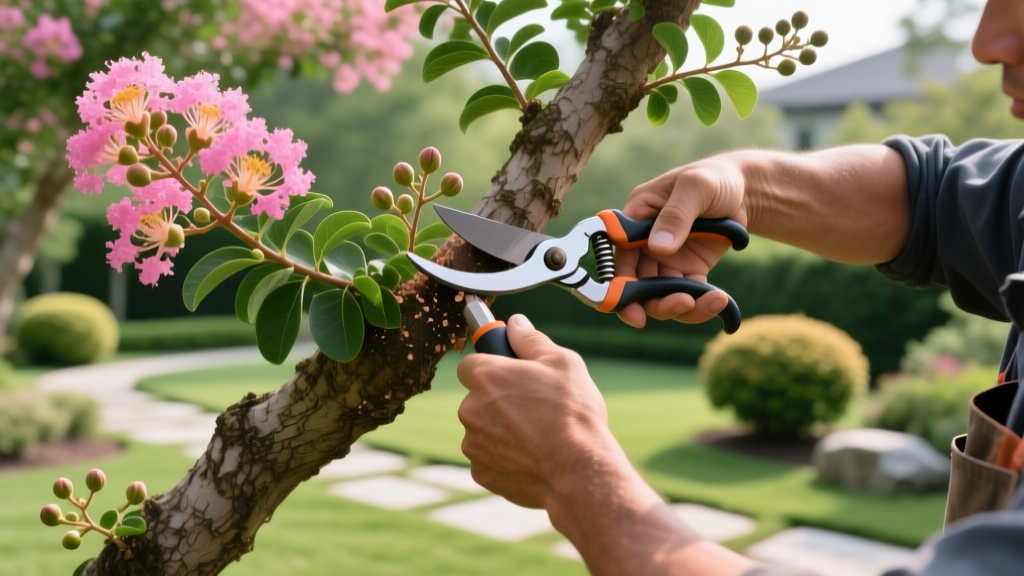
How to Cut Crepe Myrtles Without Committing Crepe Murder
The Anatomy of Crepe Murder and Why It Ruins Trees
The phrase "crepe murder" refers to the severe, indiscriminate topping of crepe myrtle (Lagerstroemia) trees, a practice that remains stubbornly common despite universal condemnation from certified arborists. When homeowners or untrained landscapers hack off the top third of the canopy, they destroy the tree's natural architectural form, which should resemble a graceful, multi-stemmed vase or a broad, spreading umbrella depending on the cultivar.
Topping forces the tree to push out dozens of weak, whip-like epicormic shoots from the cut stubs. Because these new shoots are attached to the parent branch by only a thin layer of wood and bark, they lack structural integrity. When the massive, heavy bloom panicles develop in mid-summer, these spindly shoots frequently snap under the weight or during high winds. Furthermore, the repeated accumulation of cut stubs creates unsightly, swollen "knuckles" or "knobs" at the branch junctions, which become permanent entry points for wood-decaying fungi and boring insects.
The Topping Myth: Bigger Blooms?
A persistent myth suggests that severe pruning yields larger flowers. While topped trees may produce slightly larger individual panicles due to the concentration of sap into fewer shoots, the overall number of blooms decreases, flowering is delayed by several weeks, and the bloom clusters are held on weak wood that droops awkwardly. Properly pruned trees produce a vastly superior volume of structurally sound flowers.
Optimal Timing: When to Make the Cut
Crepe myrtles bloom on new wood, meaning the flowers develop on the current season's growth. Because of this physiological trait, the timing of your pruning is critical. The optimal window for structural pruning is late winter to very early spring, typically between late January and early March, depending on your USDA Hardiness Zone (Zones 7 through 9). You want to prune while the tree is fully dormant but just before the sap begins to rise and buds start to swell.
Pruning too early in the fall, immediately after the leaves drop, can stimulate new, tender growth that will be killed by the first hard freeze, causing dieback that extends down into the older wood. Conversely, pruning too late in the spring after the tree has already leafed out wastes the tree's stored carbohydrate reserves, resulting in stunted growth and reduced bloom production for that year. For deadheading (removing spent flower clusters to encourage a second, lighter flush of blooms), make those specific cuts in late summer, no later than early September.
Professional-Grade Tool Selection
Using the correct, razor-sharp tools is non-negotiable. Dull blades crush the cambium layer rather than slicing it, leaving jagged wounds that take twice as long to compartmentalize and heal. Avoid anvil-style pruners entirely; they are designed for dead wood and will crush living crepe myrtle tissue. Always use bypass blades.
| Tool Type | Recommended Model (2026 Market) | Approx. Cost | Maximum Cut Diameter |
|---|---|---|---|
| Hand Pruner | Felco 2 Classic Bypass | $65 - $75 | Up to 1 inch (25mm) |
| Bypass Lopper | Corona SL 3264 ComfortGEL | $45 - $55 | Up to 1.5 inches (38mm) |
| Folding Saw | Silky Gomboy 240 (Medium Teeth) | $55 - $65 | Up to 4 inches (100mm) |
Step-by-Step Execution: How to Cut Crepe Myrtles
Proper pruning is an exercise in subtraction, not butchery. Your goal is to remove specific branches to improve structure, airflow, and light penetration while leaving the tree's natural silhouette intact. Follow this systematic approach to ensure you cut crepe myrtles correctly.
Phase 1: Structural Clearing (The Three Ds)
Begin at the base of the tree and work your way up. First, remove all Dead, Damaged, and Diseased wood. Cut dead branches back to their point of origin on the main trunk or a larger lateral branch. Do not leave stubs; make the cut just outside the branch collar (the swollen area where the branch meets the trunk). Leaving stubs prevents the tree from forming wound wood (callus tissue) over the cut, inviting decay. If you encounter branches damaged by winter storms, cut back to the nearest healthy, outward-facing lateral bud.
Phase 2: Canopy Thinning and Crossing Branches
Once the compromised wood is gone, evaluate the canopy for congestion. Crepe myrtles are highly susceptible to powdery mildew (Erysiphe lagerstroemiae) and Cercospora leaf spot, both of which thrive in stagnant, humid air. Thin the canopy by removing branches that cross through the center of the tree, rub against one another, or grow sharply inward.
When deciding between two crossing branches, keep the one that grows outward at a wider, stronger angle (closer to 45-60 degrees from the trunk) and remove the one with a narrow, weak crotch angle. When making thinning cuts on smaller lateral branches, always cut at a 45-degree angle, exactly 1/4 inch above an outward-facing bud. Cutting too far above the bud leaves a dead stub; cutting too close damages the bud's vascular connection.
Phase 3: Basal Sucker and Water Sprout Eradication
Crepe myrtles are notorious for pushing vigorous, vertical shoots from their root systems (suckers) and from the main trunks (water sprouts). These shoots divert massive amounts of energy away from the primary canopy and bloom production. Remove basal suckers by pulling them downward to snap them off at the root collar, or cut them as flush to the main trunk as possible using your hand pruners. Do not just shear them off at ground level with a string trimmer, as this leaves the base intact and guarantees they will return thicker the following spring.
Rehabilitation Protocol: Fixing a Mutilated Tree
If you have purchased a home with a previously topped crepe myrtle, or if you committed crepe murder in the past, the tree can be rehabilitated, though it requires a multi-year commitment. You cannot simply chop off the ugly knobs; this will only trigger another explosion of weak sprouts. Instead, follow this three-year restoration framework recommended by the Clemson University Home and Garden Information Center.
Year 1: Sprout Selection. In late winter, examine the swollen knobs at the top of the chopped trunks. Select one to three of the strongest, best-angled sprouts emerging from each knob. These will become your new primary branch leaders. Using a sharp hand pruner, rub off or cut flush all other sprouts emerging from that same knob. It requires discipline to leave only a few shoots, but this concentrates the tree's energy into building thick, structurally sound wood on the chosen leaders.
Year 2: Lateral Management. Allow the selected leaders to grow unimpeded during the spring and summer. The following winter, remove any lateral side-branches that have formed on the lower 3 to 4 feet of these new leaders to encourage a clean trunk line. Continue to remove any new, unwanted sprouts that attempt to grow directly out of the old knob.
Year 3: Resuming Normal Pruning. By the third winter, your selected leaders should be thick enough to support heavy bloom panicles. You can now transition to standard canopy thinning practices, treating the new leaders as you would any naturally grown branch. The old knobs will remain visible for several years, but they will gradually be obscured as the new canopy matures and expands.
The Ultimate Solution: Right Plant, Right Place
The most effective way to avoid the need for heavy pruning is to select a cultivar that naturally fits the spatial constraints of your landscape at maturity. According to data from the University of Florida IFAS Extension, many crepe myrtle varieties easily exceed 25 feet in height. Planting a 'Natchez' (white, 25-30 ft) or 'Muskogee' (lavender, 20-25 ft) directly under a 15-foot power line guarantees a lifetime of aggressive, necessary hacking. If you have a small courtyard or a planting bed near a single-story roofline, select true dwarf or semi-dwarf varieties like 'Pocomoke' (pink, 3-5 ft), 'Chickasaw' (lavender, 4-6 ft), or 'Acoma' (white, 8-10 ft). Matching the mature genetics of the tree to the physical space eliminates the urge to cut crepe myrtles into unnatural shapes.
Additional Authoritative Resources
- International Society of Arboriculture (ISA): Pruning Mature Trees - Detailed guidelines on branch collar identification and proper cut placement.
- Local County Extension Offices - Always consult your local agricultural extension for specific pruning timelines tailored to your exact microclimate and local fungal disease pressures.

