
Tree Care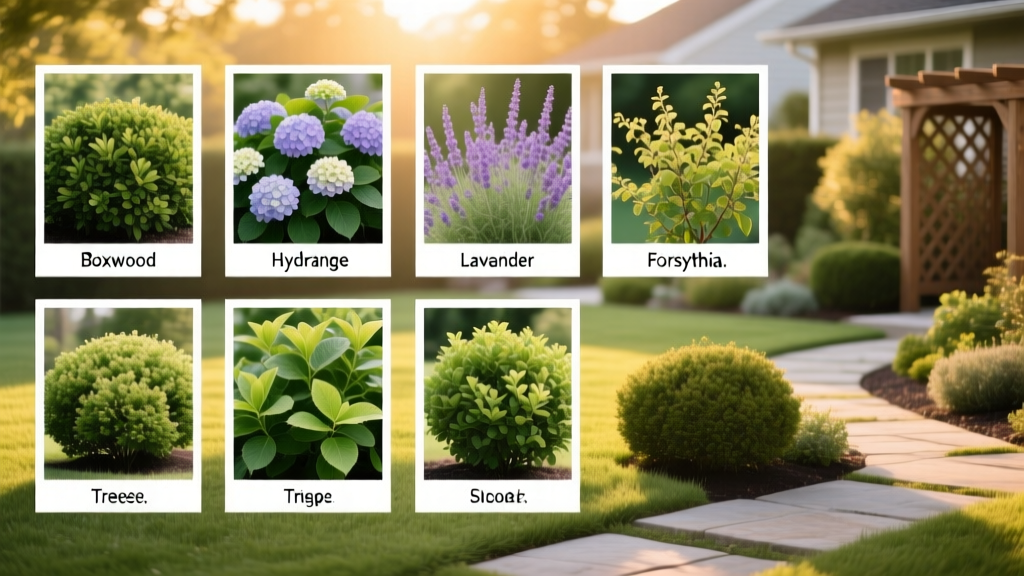
Identifying 10 Common Types of Bushes for Home Landscaping
The Cost of Misidentification in Shrub Care
Accurately identifying the specific types of bushes in your landscape is the foundational step of proper woody plant care. Misidentification leads to costly errors: pruning spring-blooming lilacs in autumn removes the following year's flower buds, while applying alkaline fertilizer to acid-loving rhododendrons induces severe iron chlorosis. According to the Virginia Tech Dendrology Department, understanding leaf morphology, bark texture, and growth habits allows homeowners to transition from reactive maintenance to proactive horticultural management.
This guide provides a botanical framework for identifying the most prevalent residential shrubs, detailing exact soil requirements, mature dimensions, and pruning protocols to ensure your landscape thrives.
Core Botanical Traits: Reading the Leaves
Before memorizing individual species, you must understand how to read leaf arrangement and margins. These traits immediately narrow down the plant family. Use a 10x jeweler's loupe to examine the leaf nodes (where the leaf meets the stem).
| Trait Category | Characteristic | Visual Description | Common Shrub Examples |
|---|---|---|---|
| Arrangement | Opposite | Leaves emerge in pairs directly across from each other on the stem. | Viburnum, Lilac, Forsythia, Boxwood |
| Arrangement | Alternate | Leaves stagger along the stem, one per node. | Hydrangea, Spirea, Holly, Arborvitae |
| Margin | Entire | Smooth edge with no teeth or lobes. | Rhododendron, Boxwood, Privet |
| Margin | Serrate | Saw-toothed edges pointing forward. | Spirea, Weigela, Hydrangea |
| Type | Needle/Scale | Modified leaves adapted for moisture retention. | Juniper, Arborvitae, Yew |
5 Essential Evergreen Types of Bushes
Evergreens provide year-round structural interest and privacy screens. They generally require less frequent pruning than deciduous varieties but are highly susceptible to winter desiccation and soil pH imbalances.
1. Common Boxwood (Buxus sempervirens)
Identification: Opposite, simple, leathery leaves with entire (smooth) margins. Leaves are dark green above and pale yellow-green beneath. Bark is pale gray and heavily fissured on mature specimens.
Cultivar Focus: 'Suffruticosa' (Dutch Boxwood) remains compact at 2 to 3 feet tall.
Care Specifics: Requires well-draining soil with a pH of 6.5 to 7.0. Shallow-rooted; apply a 2-inch layer of pine bark mulch to regulate soil temperature. Prune by shearing in late spring after the first flush of growth hardens off.
2. Emerald Green Arborvitae (Thuja occidentalis 'Smaragd')
Identification: Scale-like leaves arranged in flat, fan-shaped sprays. Foliage remains vibrant emerald green through winter, unlike standard arborvitae which bronze in cold weather.
Care Specifics: Thrives in USDA Zones 3-8. Plant 3 to 4 feet apart for a dense privacy hedge. Highly susceptible to bagworms (Thyridopteryx ephemeraeformis); inspect branch tips in early June and treat with Bacillus thuringiensis (Bt) if larvae are present.
3. Japanese Holly (Ilex crenata)
Identification: Often mistaken for boxwood, but Japanese holly has alternate leaf arrangement and produces small, black, berry-like drupes in autumn (boxwood produces inconspicuous brown seed capsules).
Care Specifics: Prefers acidic soil (pH 5.0 to 6.0). Apply an acidifying fertilizer like Holly-tone (4-3-4) in early spring at a rate of 1 cup per foot of branch spread.
4. Catawba Rhododendron (Rhododendron catawbiense)
Identification: Large, thick, alternate leaves that curl inward like cigars during freezing temperatures to prevent moisture loss. Produces massive trusses of lavender-pink flowers in late May.
Care Specifics: Strictly requires acidic soil (pH 4.5 to 5.5). Never cultivate the soil beneath the drip line, as the root system is fibrous and sits in the top 4 inches of topsoil. Deadhead spent flower trusses by snapping them off by hand within one week of blooming to redirect energy into next year's buds.
5. Creeping Juniper (Juniperus horizontalis)
Identification: Prostrate growth habit, hugging the ground. Foliage consists of sharp, awl-like juvenile needles and softer, overlapping scale-like mature leaves. Often exhibits a blue-green or silver hue.
Care Specifics: Extremely drought-tolerant once established. Prone to Phomopsis blight in humid, poorly ventilated areas. Space plants at least 4 feet apart to ensure adequate airflow across the foliage.
5 Essential Flowering & Deciduous Types of Bushes
Deciduous shrubs offer seasonal color transitions and spectacular blooms, but their pruning schedules are strictly dictated by whether they bloom on 'old wood' (previous year's growth) or 'new wood' (current season's growth).
6. Panicle Hydrangea (Hydrangea paniculata)
Identification: Opposite, ovate leaves with serrated margins and a rough, sandpapery texture. Distinguished from other hydrangeas by its cone-shaped (panicle) flower clusters rather than rounded mopheads.
Cultivar Focus: 'Limelight' features chartreuse blooms that age to deep pink in autumn.
Care Specifics: Blooms on new wood. Prune aggressively in late winter or early spring, cutting back to a framework of 18 to 24 inches to promote massive, sturdy flower stems. Retail pricing for mature 5-gallon 'Limelight' specimens averages $55 to $75 in 2026.
7. Common Lilac (Syringa vulgaris)
Identification: Opposite, heart-shaped (cordate) leaves with smooth margins. Gray, rough bark on older trunks. Highly fragrant, cone-shaped panicles of purple, pink, or white flowers in mid-spring.
Care Specifics: Blooms on old wood. Prune immediately after flowers fade in June. Removing suckers at the base annually prevents the shrub from reverting to a leggy, non-blooming thicket. Requires a winter chill period and struggles in USDA Zones 9 and above.
8. Forsythia (Forsythia x intermedia)
Identification: Opposite leaves, but uniquely features hollow stems between the nodes (a key diagnostic trait). Brilliant yellow, four-petaled flowers erupt along bare, arching canes before leaves emerge in early spring.
Care Specifics: Blooms on old wood. Implement a renewal pruning strategy: immediately after flowering, cut the oldest, thickest one-third of the canes entirely to the ground to stimulate vigorous new shoots from the base.
9. Weigela (Weigela florida)
Identification: Opposite, elliptical leaves with finely serrated margins. Tubular, trumpet-shaped flowers in shades of pink, red, or white, highly attractive to ruby-throated hummingbirds.
Cultivar Focus: 'Wine & Roses' features striking dark burgundy-purple foliage that contrasts sharply with its hot pink blooms.
Care Specifics: Blooms primarily on old wood, with a lighter rebloom on new wood. Prune lightly after the main spring flush. Apply a balanced 10-10-10 granular fertilizer in early spring as the leaf buds begin to swell.
10. Japanese Spirea (Spiraea japonica)
Identification: Alternate, narrow lance-shaped leaves with doubly serrated margins. Flat-topped clusters (corymbs) of tiny pink, white, or crimson flowers at the stem tips in summer.
Care Specifics: Blooms on new wood. Tolerates heavy shearing. If the shrub becomes overgrown or stops flowering prolifically, perform a hard rejuvenation prune in late winter, cutting the entire plant back to 6 inches above the soil line.
Field Identification Decision Matrix
When encountering an unknown shrub in your yard, follow this sequential diagnostic flow to narrow down the species before applying any chemical treatments or pruning cuts:
- Check Leaf Retention: Does the plant hold its leaves through winter? If yes, proceed to Evergreens. If no, proceed to Deciduous.
- Examine Leaf Arrangement: Pluck a stem and look at the nodes. Are leaves paired (opposite) or staggered (alternate)? This eliminates 50% of potential species immediately.
- Inspect the Stem Pith: Snip a small twig with bypass pruners. Is the center (pith) solid, hollow, or chambered? (e.g., Forsythia has hollow pith; Viburnum has solid pith).
- Observe Bud Scale: Look at the dormant winter buds. Are they covered in overlapping scales, or are they 'naked' (covered only in fine hairs)?
- Cross-Reference with Regional Databases: Input your morphological findings into the Missouri Botanical Garden Plant Finder or the USDA NRCS Plants Database to confirm the exact botanical nomenclature.
Expert Warning: Never apply systemic herbicides like glyphosate or triclopyr to an unidentified shrub. Many desirable ornamental bushes are closely related to invasive species (e.g., cultivated Viburnum vs. invasive European Cranberrybush), and misapplied chemicals can drift through root grafts, destroying adjacent desirable landscape plants.
Mastering the identification of these common types of bushes transforms you from a passive observer into an active steward of your landscape. By aligning your pruning schedules, soil amendments, and planting locations with the specific botanical needs of each shrub, you ensure decades of vigorous growth and reliable seasonal color.

