
Tree Care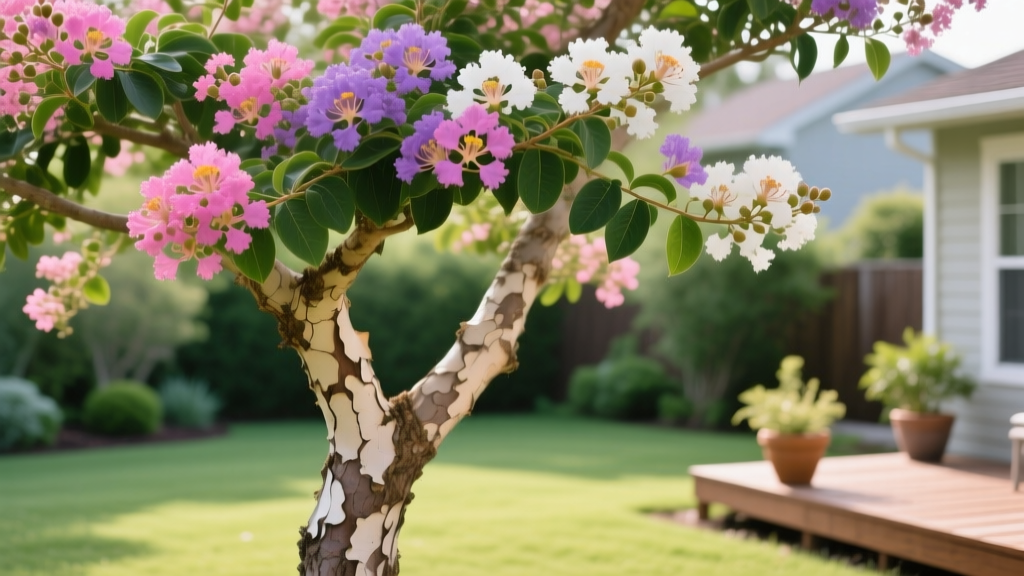
Types of Crepe Myrtles: Identification Guide for Homeowners
Choosing the right crepe myrtle (Lagerstroemia) requires looking past the summer blooms. While the vibrant flower panicles are the primary draw for most homeowners, the structural integrity, bark exfoliation patterns, and disease resistance of the underlying species dictate how the tree will perform in your landscape over the next 30 years. There are over 50 species of crepe myrtle globally, but the horticultural trade in North America relies almost entirely on two foundational species and their interspecific hybrids.
This identification guide breaks down the botanical categories, sizing classifications, and specific cultivar traits you need to select the exact right tree for your soil, climate, and spatial constraints.
The Three Main Botanical Categories
To accurately identify a crepe myrtle, you must first determine its genetic lineage. The trees sold in commercial nurseries fall into three distinct botanical groups, each with unique visual and physiological markers.
1. Lagerstroemia indica (Common Crape Myrtle)
Native to China and Korea, L. indica is the original species introduced to the American South in the late 1700s. Pure indica varieties are easily identified by their smaller stature (rarely exceeding 20 feet), smaller leaves, and a high susceptibility to powdery mildew (Erysiphe lagerstroemiae). The bark on mature indica trees is typically smooth and gray, lacking the dramatic peeling characteristics of modern hybrids. While they produce abundant flowers, they require rigorous fungicide applications in humid climates to maintain canopy health.
2. Lagerstroemia fauriei (Japanese Crape Myrtle)
Introduced to the United States in the 1950s from Japan, L. fauriei is the genetic powerhouse behind modern disease resistance. You can identify a pure fauriei by its towering height (often reaching 30 to 40 feet), larger leaves, and spectacular exfoliating bark that peels away in large, papery sheets to reveal a striking cinnamon-to-mahogany inner wood. The flowers are exclusively white, and the tree possesses near-total immunity to powdery mildew.
3. Interspecific Hybrids (The Modern Standard)
Beginning in the 1960s, the U.S. National Arboretum crossed L. indica and L. fauriei to combine the vibrant flower colors of the former with the disease resistance and striking bark of the latter. According to the Clemson University Home & Garden Information Center, these hybrids (often named after Native American tribes, such as 'Natchez', 'Tuscarora', and 'Muskogee') now dominate the market. They are identified by their intermediate size, highly textured peeling bark, and robust resistance to both powdery mildew and Cercospora leaf spot.
Identification Matrix: Bark, Bloom, and Canopy Traits
Use the following comparison matrix to identify the species group of an existing tree or to select a new planting based on specific visual and maintenance traits.
| Trait | L. indica (Pure) | L. fauriei (Pure) | Interspecific Hybrids |
|---|---|---|---|
| Mature Height | 10 - 20 ft | 30 - 40 ft | 15 - 30 ft |
| Bark Exfoliation | Minimal; smooth gray | Heavy; cinnamon/mahogany | Moderate to Heavy; varies by cultivar |
| Mildew Resistance | Low to Moderate | Very High | High to Very High |
| Flower Colors | White, Pink, Red, Purple | White only | White, Pink, Red, Purple |
| Fall Foliage | Yellow to Orange | Yellow | Orange to Deep Red |
Sizing Up Your Options: The Four Industry Size Classes
One of the most common landscaping errors is planting a standard-size crepe myrtle under a low roofline or near power lines, leading to the destructive pruning practice colloquially known as 'crape murder.' To avoid this, the nursery industry categorizes types of crepe myrtles into four distinct size classes. The University of Florida IFAS Extension recommends selecting your size class based on the tree's 15-year mature height, not its size at the time of purchase.
Warning: The 'Crape Murder' Myth
Topping or severely heading back crepe myrtles in winter does not increase bloom size or quantity. It destroys the tree's natural architectural form, promotes weak, whip-like growth that breaks in high winds, and drastically increases susceptibility to wood-decaying fungi. Always choose a cultivar whose natural mature height fits your space.
Miniature (Under 3 Feet)
These are groundcover or low-border shrubs. They rarely develop a woody trunk and are best used in mass plantings or rock gardens.
- 'Pocomoke': Rose-pink blooms, dense mounding habit, reaches 2 feet tall and 3 feet wide.
- 'Chickasaw': Lavender-pink blooms, highly mildew resistant, maxes out at 2.5 feet.
Dwarf (3 to 6 Feet)
Ideal for foundation plantings and small patio containers. They can be maintained as multi-stemmed shrubs.
- 'Acoma': Pure white blooms, silvery bark, reaches 4 to 5 feet with a weeping habit.
- 'Hopi': Light pink blooms, excellent fall color, matures at 5 to 6 feet.
Intermediate (7 to 15 Feet)
The most versatile class for residential landscapes. They function perfectly as large screening hedges, specimen patio trees, or driveway liners.
- 'Tuscarora': Dark coral-red blooms, light brown exfoliating bark, reaches 12 to 15 feet.
- 'Catawba': Deep purple blooms (one of the truest purples available), matures at 10 to 12 feet.
Standard / Tree-Form (Over 15 Feet)
These develop massive, sculptural trunks and are intended to be shade trees or grand boulevard specimens.
- 'Natchez': White blooms, spectacular cinnamon-peeling bark, fast-growing to 25-30 feet.
- 'Muskogee': Light lavender-pink blooms, gray-tan bark, reaches 20-25 feet with a wide canopy.
Real-World Selection Framework: Matching Site to Species
Identifying the right type of crepe myrtle goes beyond aesthetics. Use this decision framework to match the tree's physiological needs to your specific site conditions.
- Heavy Clay Soil & High Humidity (USDA Zones 7b-9a): You must prioritize interspecific hybrids or pure L. fauriei. The high humidity in the Deep South creates a perfect breeding ground for powdery mildew and Cercospora leaf spot. Avoid pure L. indica entirely unless you are committed to a bi-weekly preventative fungicide spray schedule from May to August.
- Alkaline Soil (pH > 7.0): Crepe myrtles prefer a slightly acidic soil pH between 5.0 and 6.5. In alkaline soils, they suffer from iron chlorosis, manifesting as yellowing leaves with green veins. If your soil pH is high, select dwarf varieties that can be grown in large, raised containers filled with acidified potting mix, or amend the planting bed heavily with elemental sulfur and peat moss before planting.
- High Wind / Hurricane Zones: According to Texas A&M AgriLife Extension, standard-size crepe myrtles have high wind resistance due to their flexible wood and open canopy structure, which allows wind to pass through. However, trees that have been improperly topped ('crape murdered') are highly prone to windthrow because the dense, weakly attached whips act like a sail. Always select un-topped, standard-form trees for high-wind corridors.
- Marginal Cold Climates (USDA Zone 6b): While crepe myrtles are generally hardy to Zone 7, they can survive in Zone 6b if planted in a protected microclimate (e.g., against a south-facing brick wall that radiates heat). In these zones, opt for dwarf or intermediate sizes, as the tops may die back to the ground during severe freezes, but the root system will survive to push new growth in spring.
Frequently Asked Identification Questions
Why is the bark on my crepe myrtle peeling off in large strips?
This is a natural and highly desirable trait known as exfoliation. As the tree matures, the outer layer of bark dies and sloughs off to reveal the smooth, colorful inner bark. This process helps the tree shed lichens and mosses. Do not pull the peeling bark off manually; let it fall naturally to avoid damaging the live cambium layer beneath.
How can I tell if my tree is a hybrid or a pure indica without seeing the flowers?
Examine the underside of the leaves and the texture of the young stems. Pure L. indica leaves are generally smaller (under 2 inches) and the young stems are distinctly square-shaped and often heavily winged. Hybrids tend to have larger leaves (2 to 3 inches) and rounder, less winged young stems. Additionally, if the trunk bark is heavily exfoliating in shades of brown or cinnamon, it is almost certainly a hybrid or fauriei, as pure indica trunks remain relatively smooth and gray.
My crepe myrtle leaves are turning black and sooty in late summer. What species is prone to this?
The black coating is sooty mold, which grows on the honeydew excreted by crepe myrtle aphids. While all types of crepe myrtles can host these aphids, pure L. indica and older, non-resistant hybrids are significantly more prone to severe infestations. Modern interspecific hybrids generally exhibit better aphid tolerance. To manage this, apply a systemic imidacloprid soil drench in early spring before the aphids establish, or use horticultural oil sprays during the summer.
Summary Checklist for Purchasing
- Verify the botanical name on the nursery tag (look for Lagerstroemia indica x fauriei for best disease resistance).
- Confirm the mature height class matches your overhead clearance (add 5 feet to the listed height for safety margins near power lines).
- Inspect the trunk base for signs of previous topping cuts; reject trees with large, flat, scarred pruning wounds at the top of the main trunks.
- Check the root flare at the base of the container; if the trunk plunges straight into the soil without a visible flare, the tree is planted too deep and will likely suffer from girdling roots and trunk rot.

