
Tree Care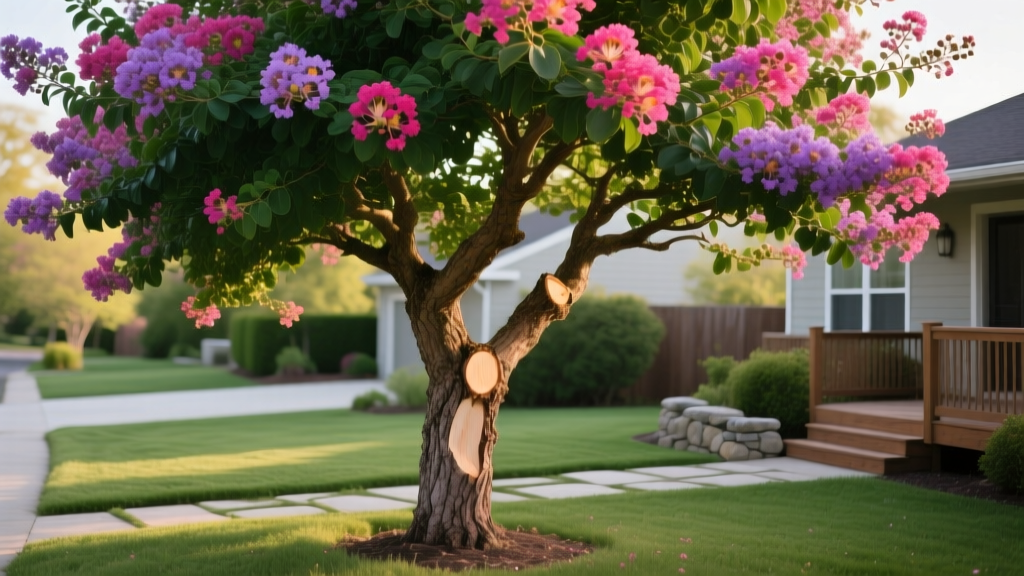
Avoid Crape Murder: Trimming Crepe Myrtle Trees the Right Way
The Lagerstroemia indica, commonly known as the crepe myrtle, is a staple of southern landscapes, prized for its vibrant summer panicles and striking exfoliating bark. Yet, every late winter, thousands of homeowners and inexperienced landscapers commit a widespread horticultural sin known as "crape murder." This aggressive topping practice decapitates the tree's main scaffolds, ruining its natural architectural beauty and severely compromising its long-term health. Properly trimming crepe myrtle trees requires an understanding of their specific growth habits, precise timing, and targeted structural thinning rather than blunt reduction.
The Biological Cost of Topping (Why "Crape Murder" Fails)
When you indiscriminately chop off the top third of a crepe myrtle, you trigger a survival mechanism called epicormic growth. The tree responds to the massive loss of canopy by pushing out dozens of weak, fast-growing watersprouts directly below the cut sites. These sprouts are poorly attached to the parent wood, lacking the deep structural integration of natural branches.
Warning: Structural Failure Risk
Watersprouts generated from topping cuts have a high failure rate during summer thunderstorms. Because the flower panicles develop at the tips of these weak sprouts, the added weight of the blooms combined with wind load frequently causes the branches to snap at the knobby, disfigured cut sites.
Furthermore, topping reduces the tree's overall photosynthetic capacity. While the tree will still produce flowers, the panicles will be noticeably smaller, and the tree will expend vital energy reserves on regrowing lost wood rather than developing a robust root system or resisting pathogens like powdery mildew and Cercospora leaf spot.
Timing Your Pruning: The Dormancy Window
The timing of your pruning cuts is just as critical as the cuts themselves. Trimming crepe myrtle trees must occur during deep dormancy, after the tree has fully hardened off for the winter but before the spring sap flow begins. Pruning too early (December or early January) can stimulate premature budding if a sudden warm spell occurs; a subsequent hard freeze will then kill the new, tender growth.
According to Clemson University's Home and Garden Information Center, the ideal window shifts based on your specific USDA Hardiness Zone. Use the matrix below to schedule your pruning.
| USDA Zone | Ideal Pruning Window | Average Last Frost Date |
|---|---|---|
| Zone 7a/7b | Late February to Mid-March | April 1 - April 15 |
| Zone 8a/8b | Mid-February to Early March | March 15 - April 1 |
| Zone 9a/9b | Early February to Late February | February 15 - March 1 |
Step-by-Step Framework for Trimming Crepe Myrtle Trees
Approach the tree with a clear hierarchy of cuts. Never make a cut without first identifying the specific structural or health issue it resolves.
Step 1: Basal Sucker and Root Sprout Removal
Crepe myrtles are notorious for pushing suckers from the root flare and lower trunk. Using sharp bypass pruners, cut these flush against the trunk or root. Do not leave stubs, as stubs will simply sprout multiple new suckers the following spring. If your tree is grafted, ensure no suckers are emerging below the graft union, as these will be from the rootstock and will not match the canopy's bloom color.
Step 2: The 3 D's (Dead, Damaged, Diseased)
Remove any wood that is dead, mechanically damaged, or showing signs of fungal cankers. Make your cuts just outside the branch collar—the swollen area where the branch meets the trunk. Never cut flush into the trunk, as this destroys the tree's natural compartmentalization zone (CODIT) and invites wood-decaying fungi.
Step 3: Canopy Thinning and Crossing Branches
A mature crepe myrtle should have a multi-trunk structure with 3 to 5 main scaffolds. Thin out any secondary trunks that are rubbing against the primary scaffolds or growing inward toward the center of the canopy. The goal is to create an open, vase-like structure that allows sunlight to penetrate the inner canopy and air to circulate freely, which drastically reduces the humidity that fosters powdery mildew.
Step 4: Elevating the Canopy
For trees planted near walkways or driveways, selectively remove the lowest lateral branches to elevate the canopy. Aim for a clearance of 6 to 8 feet above pedestrian paths and 10 to 12 feet above driveways. Always cut back to a lateral branch that is at least one-third the diameter of the branch being removed to maintain proper sap flow and structural balance.
The Seed Head Myth: What NOT to Do
"A persistent myth in southern landscaping is that you must remove all spent seed heads from the previous summer to force new blooms. This is biologically false. Crepe myrtles bloom on new wood. Tipping the branches to remove old seed heads only delays spring flush and often results in a dense, ugly cluster of twigs at the cut site."
While research from the University of Florida IFAS Extension confirms that removing seed heads does not increase the total number of flowers, it can slightly hasten the initial bloom time by a few days. However, the labor involved and the high risk of making improper, damaging cuts far outweigh this negligible benefit. Leave the seed heads alone unless they are on small, dwarf varieties where they are easily reachable and visually distracting.
Tool Selection and Sanitation Protocols
Using the wrong tools crushes the delicate cambium layer of the crepe myrtle's smooth bark, leading to dieback and unsightly scarring. Avoid anvil pruners entirely; their crushing action is detrimental to this species.
- Hand Pruners (Under 1/2 inch cuts): Invest in a high-quality bypass pruner like the Felco F-2 (approx. $65-$75). The hardened steel blade holds an edge through dozens of cuts without tearing the bark.
- Loppers (1/2 inch to 1.5 inch cuts): Use 28-inch bypass loppers, such as the Fiskars Pro Bypass ($45-$55), which provide the leverage needed for thicker scaffold branches without crushing.
- Pruning Saws (Over 1.5 inch cuts): A Japanese pull saw like the Silky Gomboy 210 ($45) cuts cleanly on the pull stroke, preventing the bark from peeling down the trunk.
Sanitation Protocol:
Crepe myrtles are highly susceptible to Cercospora leaf spot and bacterial blight. You must sanitize your blades between every single tree. Wipe the blades with a rag soaked in 70% isopropyl alcohol or a 10% bleach solution. If using bleach, oil the blades immediately afterward to prevent severe corrosion of the steel.
Reversing Past Topping Damage (Restoration Pruning)
If you have recently purchased a home with a previously "murdered" crepe myrtle, do not attempt to fix it in a single season. Restoration pruning is a three-year process. According to pruning guidelines endorsed by the Arbor Day Foundation, aggressive corrective cuts can shock the tree.
- Year 1: Identify the ugly, knobby "fists" where the tree was previously topped. Select two or three of the strongest, most outward-growing watersprouts emerging just below the knob. Cut all other sprouts flush to the knob. Do not cut the main knob off yet.
- Year 2: Return the following winter. The selected sprouts should now be thick enough to support the canopy. Make a final cut to remove the old, dead knob just above the point where your chosen sprouts attach. Apply a clean, angled cut to shed water.
- Year 3: Thin the new canopy to remove any secondary crossing branches that have developed on your new scaffolds. The tree will now resume a natural, vase-like growth habit.
Frequently Asked Questions
Can I trim my crepe myrtle in the fall after the leaves drop?
No. Pruning in late fall (November or December) before the tree has entered deep dormancy can stimulate new growth if temperatures fluctuate. This new growth will be highly vulnerable to winter kill. Wait until late February at the earliest.
How many main trunks should a crepe myrtle have?
The ideal structure consists of 3 to 5 main trunks. Trees with more than 5 trunks often become overly congested, restricting airflow and increasing the prevalence of fungal diseases. Select the strongest, most widely spaced trunks and remove the rest at the soil line.
My crepe myrtle is leaning heavily. Can I prune it to balance the weight?
You can perform selective, light thinning on the heavier side to reduce wind resistance, but you should never "top" the heavy side to match the lighter side. If the lean is severe and the root plate is lifting, consult a certified arborist for potential cabling or removal, as the structural integrity of the root system may be compromised.

