
Tree Care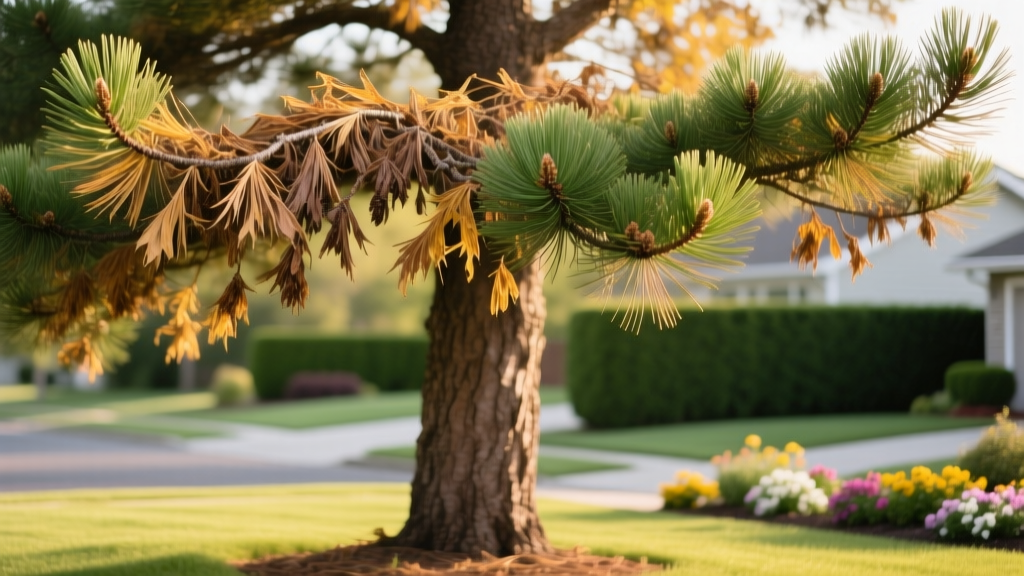
Diagnosing Browning and Drop in Pine Trees with Long Needles
The Unique Challenges of Long-Needle Pines
Pine trees with long needles—specifically Longleaf (Pinus palustris), Slash (Pinus elliottii), and Ponderosa (Pinus ponderosa)—present unique diagnostic challenges for homeowners. Unlike short-needled varieties like the Eastern White Pine, these species feature needles ranging from 5 to 18 inches in length. While visually striking, their extended needle structure and specific biological rhythms make them highly susceptible to distinct fungal pathogens, scale insects, and severe soil acidification issues. When a homeowner notices premature browning or excessive needle drop in these species, the cause is rarely simple winter desiccation. Accurate diagnosis requires examining the specific location of the browning on the needle, the age of the affected foliage, and the thickness of the forest floor duff layer.
Symptom-to-Cause Diagnostic Matrix
Before applying any chemical treatments, use this diagnostic matrix to identify the primary stressor affecting your long-needle pine. Misdiagnosing a fungal blight as a nutrient deficiency will waste time and allow the pathogen to sporulate.
| Primary Symptom | Needle Location & Age | Most Likely Cause | Immediate Action Required |
|---|---|---|---|
| Red or yellow bands on needles | Mid-to-tip of current year's needles | Dothistroma Needle Blight | Prune affected branches; apply copper fungicide in late spring. |
| Stunted, brown, resinous new shoots | Terminal buds and newest growth only | Diplodia Tip Blight | Remove infected shoots; apply Chlorothalonil at bud swell. |
| White, waxy flecks on needle surface | Scattered across all needle ages | Pine Needle Scale | Apply 2-4% dormant horticultural oil in late winter. |
| Uniform browning of oldest needles | Innermost needles (3+ years old) in autumn | Natural Senescence (Normal) | No action needed; monitor for excessive drop beyond 30%. |
Fungal Pathogens: Dothistroma vs. Diplodia
Fungal diseases are the most common cause of pathological browning in long-needle pines. The two most aggressive pathogens in North America are Dothistroma septosporum and Diplodia sapinea. Because long needles retain moisture longer in the lower canopy, they create an ideal microclimate for fungal sporulation.
Identifying Dothistroma Needle Blight
Dothistroma manifests as distinct reddish-brown bands across the needle. The tissue beyond the band (toward the tip) dies and turns brown, while the base remains green. This "scorched" look is often mistaken for drought stress. According to NC State Extension, the fungus overwinters in infected needles on the ground and in the canopy, releasing spores during spring rains.
Identifying Diplodia Tip Blight
Diplodia targets the new growth. If your long-needle pine is producing stunted, brown shoots that are heavily coated in white resin, Diplodia is the culprit. Look closely at the base of the dead shoots with a magnifying glass; you will see tiny black fruiting bodies (pycnidia) embedded in the bark.
⚠️ CRITICAL FUNGICIDE TIMING WARNING:
Applying fungicides in the summer for Diplodia tip blight is entirely ineffective. You must apply a protective spray containing Chlorothalonil (e.g., Daconil Weather Stik) or Propiconazole exactly when the buds are swelling and beginning to break dormancy in early spring. A second application is required 14 days later. Summer applications cannot penetrate the hardened resin of infected shoots.
Pest Infestations Specific to Long Needles
The extended surface area of long-needle pines provides ample real estate for sap-sucking insects. The most pervasive is the Pine Needle Scale (Chionaspis pinifoliae). These pests look like tiny, white, oyster-shaped flecks scattered across the green needles. Heavy infestations cause the needles to turn yellow, then brown, eventually leading to branch dieback.
- Dormant Season Control: The most effective and ecologically sound treatment is a dormant horticultural oil spray applied in late winter (when temperatures are above 40°F but before bud break). Mix the oil to a 3% to 4% concentration to suffocate the overwintering eggs hidden beneath the white waxy armor.
- Active Season Systemic Control: If the infestation is severe and discovered in mid-summer, dormant oils will not penetrate the crawler stage effectively. Use a systemic insecticide containing Dinotefuran (such as Safari 20SG). Apply it as a basal trunk spray or soil drench at a rate of 1.5 to 2.5 ounces per inch of trunk diameter. The tree's vascular system will pull the chemical into the needles, killing the scales as they feed.
The Duff Layer Dilemma: Soil Acidification and Turf Death
One of the most significant non-pathological problems with pine trees with long needles is the accumulation of the "duff" layer. Unlike deciduous leaves that break down in a single season, the high lignin and resin content of Longleaf and Slash pine needles means they take 2 to 4 years to decompose. This creates a thick, hydrophobic mat that repels water, harbors fungal spores, and drastically lowers soil pH.
As the needles decompose, they release organic acids that can drive the soil pH below 5.0. At this level, essential nutrients like phosphorus and magnesium become locked up, and beneficial soil microbes die off. If you are attempting to grow turfgrass beneath the canopy, the combination of extreme acidity, water shedding, and physical smothering will inevitably kill the grass.
Step-by-Step Duff Management Protocol
- Measure the Duff Depth: Use a trowel to check the needle depth near the trunk. The duff layer should never exceed 2 to 3 inches. Anything thicker restricts oxygen to the feeder roots and promotes Phytophthora root rot.
- Rake and Remove: Use a heavy-duty steel leaf rake to pull excess needles out to the drip line. Do not use a metal rake directly against the trunk to avoid damaging the shallow root flare. Compost the removed needles or use them in distant garden beds where acid-loving plants (like azaleas) are grown.
- Test Soil pH: Purchase a digital soil pH meter or send a core sample to your local university extension. If the pH is below 5.5, amendment is required.
- Apply Dolomitic Limestone: To raise the pH and add necessary magnesium, apply pelletized dolomitic lime. The standard application rate is 50 lbs per 1,000 square feet to raise the pH by approximately 0.5 points. Water the area deeply immediately after application to begin dissolving the lime into the soil profile.
"Homeowners often mistake the thick, matted needle drop under Longleaf pines for a disease issue, when in reality, the tree is suffering from self-induced soil asphyxiation and extreme acidification. Managing the duff layer is just as critical as pruning the canopy."
— Adapted from University of Florida IFAS Longleaf Pine Management Guidelines
Environmental Stressors and Root Rot
Long-needle pines are inherently adapted to well-drained, sandy soils. When planted in heavy clay or poorly graded suburban yards, they face chronic hypoxia (lack of oxygen at the root zone). This environmental stress weakens the tree's natural resin defenses, making it a prime target for secondary invaders like the Southern Pine Beetle or black turpentine beetle.
If you notice sudden, catastrophic browning of the entire canopy starting from the top down, accompanied by small "pitch tubes" (popcorn-sized globs of resin) on the lower trunk, the tree is likely suffering from a combination of root rot and bark beetle attack. According to Clemson University HGIC, once a pine tree shows systemic crown dieback from beetle infestation combined with root rot, chemical intervention is futile. The tree must be removed promptly to prevent the beetles from spreading to adjacent healthy pines.
When to Call a Certified Arborist
While homeowners can manage duff layers and apply dormant oils, certain situations require professional intervention. If your long-needle pine exceeds 30 feet in height, applying fungicides for Dothistroma or Diplodia requires high-pressure hydraulic sprayers to reach the upper canopy. Furthermore, if you suspect Pine Wilt Nematode (characterized by rapid, total tree browning in late summer without visible pitch tubes), an arborist must take a core sample for laboratory analysis. Attempting to prune a massive, compromised long-needle pine without professional rigging equipment poses severe safety risks, especially given the heavy, resinous nature of the dead wood.

