
Tree Care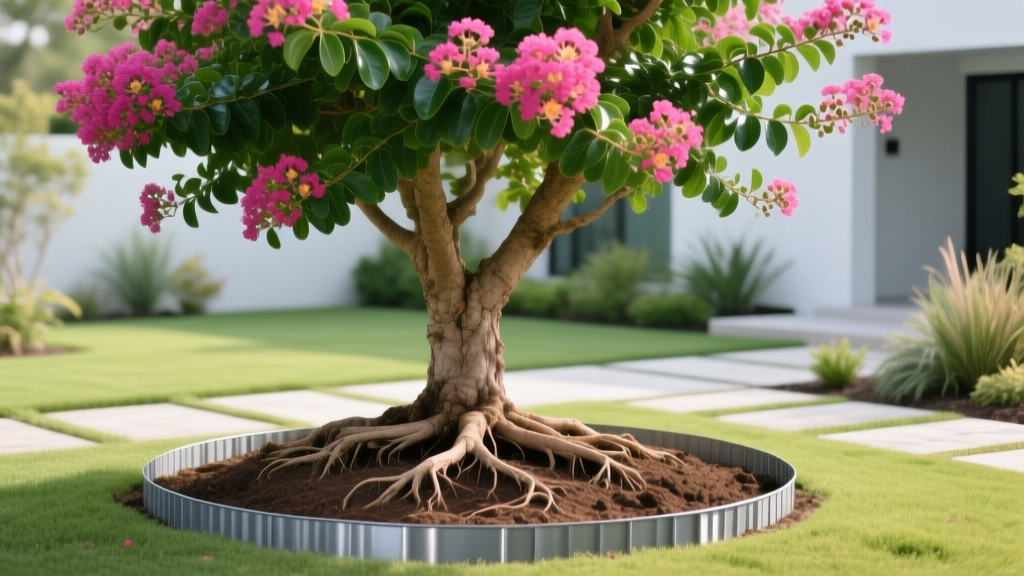
Managing Crepe Myrtle Tree Roots: Planting & Barrier Guide
The Anatomy of Crepe Myrtle Tree Roots
Before breaking ground, it is critical to understand the physiological behavior of crepe myrtle tree roots (Lagerstroemia species). Unlike silver maples or weeping willows, crepe myrtles do not possess aggressive, structural taproots that actively seek out and fracture solid concrete or cast-iron plumbing. Instead, they develop a shallow, highly fibrous root matrix.
According to research from the Clemson University Home and Garden Information Center, the majority of a crepe myrtle's absorbing roots reside in the top 12 to 18 inches of the soil profile. The root spread typically extends 1.5 to 2 times the width of the mature canopy. While they are not inherently destructive, these roots are highly opportunistic moisture-seekers. If planted in compacted clay soils or near chronic moisture leaks, the fibrous roots will densely colonize the surface, leading to exposed surface roots and potential competition with nearby turfgrass or shallow hardscapes.
Fast Facts: Crepe Myrtle Root Profile
- Root Depth: 80% of the root mass is located within the top 12–18 inches of soil.
- Root Spread: Extends 1.5x to 2x the diameter of the mature canopy drip line.
- Invasiveness: Low. They do not actively crack intact foundations or sewer lines.
- Primary Threat: Surface heaving in compacted soils and moisture competition with lawns.
Strategic Planting: Minimum Clearance Distances
Proper placement is the most effective way to manage crepe myrtle tree roots without resorting to physical barriers or aggressive pruning. The required clearance depends entirely on the mature size of the specific cultivar you are planting. Large cultivars like 'Natchez' or 'Muskogee' can reach heights of 25 to 30 feet, meaning their root systems can easily span 20 feet in diameter. Conversely, dwarf varieties like 'Pocomoke' or 'Chickasaw' rarely exceed 5 feet in height and have proportionally smaller root zones.
| Cultivar Type | Examples | Mature Canopy Width | Min. Distance from Foundation | Min. Distance from Hardscapes |
|---|---|---|---|---|
| Large / Standard | Natchez, Dynamite, Muskogee | 15 – 25 feet | 10 – 12 feet | 6 – 8 feet |
| Semi-Dwarf | Acoma, Hopi, Tonto | 8 – 12 feet | 6 – 8 feet | 4 – 5 feet |
| Dwarf / Miniature | Pocomoke, Chickasaw, Centennial | 3 – 5 feet | 3 – 4 feet | 2 – 3 feet |
How to Install a Root Barrier for Existing Trees
If you have inherited a poorly placed crepe myrtle, or if a tree’s canopy has expanded closer to a driveway or foundation than anticipated, installing a high-density polyethylene (HDPE) root barrier is the most reliable physical solution. The Arbor Day Foundation recommends physical barriers to deflect roots downward rather than severing them, which compromises tree stability.
The industry standard for residential applications is the DeepRoot UB 24-2 panel system. These panels are 24 inches deep and feature vertical ribs that physically train roots to grow downward rather than horizontally.
Materials & 2026 Cost Breakdown
- DeepRoot UB 24-2 Panels: $18 – $24 per 2-foot panel (Available at commercial landscaping suppliers or online).
- Stainless Steel Zip Ties or Panel Connectors: $15 per pack (Do not use standard plastic zip ties; they degrade in UV and soil acidity within 3 years).
- Rent a Mini-Excavator or Trencher: $150 – $250 per day (A walk-behind trencher is ideal for narrow 4-inch trenches).
- Root Pruning Saw (e.g., Silky Zubat 270): $85 – $110 (For clean cuts on roots up to 2 inches thick).
Step-by-Step Trenching and Installation
- Map the Trench Line: Dig the trench at least 2 feet away from the foundation or hardscape you are protecting. Never trench inside the tree's critical root zone (defined as 1 foot of radius per 1 inch of trunk diameter) unless absolutely necessary, as this causes severe canopy dieback.
- Excavate a 24-Inch Trench: The trench should be exactly 24 inches deep and 4 to 6 inches wide. Ensure the bottom of the trench is level.
- Sever Intrusive Roots: Using a sharp pruning saw, make clean, vertical cuts through any roots crossing the trench line. Jagged tears from shovel blades invite fungal pathogens like Armillaria root rot.
- Insert and Connect Panels: Drop the HDPE panels into the trench. The top edge of the panel must protrude exactly 1/2 inch above the final soil grade to prevent roots from growing over the top. Overlap panel joints by 1 inch and secure them with stainless steel hardware.
- Backfill and Compact: Backfill the trench with the native soil you excavated. Do not use loose, amended topsoil for backfilling, as it will settle over time and create a depression that pools water against your foundation. Tamp the soil firmly every 6 inches.
Managing Exposed Surface Roots Without Harming the Tree
In heavy clay soils, crepe myrtle tree roots often push upward, creating tripping hazards in the lawn. A common and fatal mistake homeowners make is taking a rototiller to the surface roots or covering them with 6 inches of heavy topsoil. Both actions suffocate the fine feeder roots and trigger rapid decline.
Arborist Warning: Never remove more than 15% of a crepe myrtle's surface root system in a single season. Severing large structural roots near the trunk compromises the tree's mechanical anchor, making it highly susceptible to windthrow during late-summer storms.
The Correct Top-Dressing Protocol:
- Carefully remove any existing turfgrass or weeds over the roots using a hand trowel to avoid slicing the root bark.
- Apply a maximum of 1 to 1.5 inches of coarse, aged pine bark mulch over the exposed roots. Coarse mulch allows oxygen and water penetration while suppressing grass.
- If you must plant over the roots, use only shallow-rooted, drought-tolerant groundcovers like Asiatic jasmine (Trachelospermum asiaticum) or Liriope, which will not compete heavily for moisture.
Frequently Asked Questions
Will crepe myrtle roots damage my PVC sewer lines?
Crepe myrtle roots do not possess the crushing force to break intact PVC pipes. However, if your sewer line has pre-existing cracks or loose joints, the fibrous roots will detect the moisture vapor and infiltrate the gaps, eventually causing blockages. Always maintain a 10-foot clearance between large crepe myrtles and known sewer lines.
How often should I water to encourage deep root growth?
Shallow, frequent watering (e.g., 10 minutes daily) trains crepe myrtle tree roots to stay near the surface. To force roots deeper, water established trees deeply once a week, applying roughly 1 inch of water (about 0.6 gallons per square foot of canopy area). Use a soil moisture probe to verify water penetration down to the 12-inch mark.
Can I use copper sulfate to stop root growth near pipes?
While copper sulfate is sometimes used to clear roots from sewer lines, applying it to the soil around a crepe myrtle is highly toxic to the tree and the surrounding soil microbiome. It will cause severe leaf chlorosis and stunted growth. Physical HDPE barriers are the only safe, long-term solution for residential landscapes.

