
Tree Care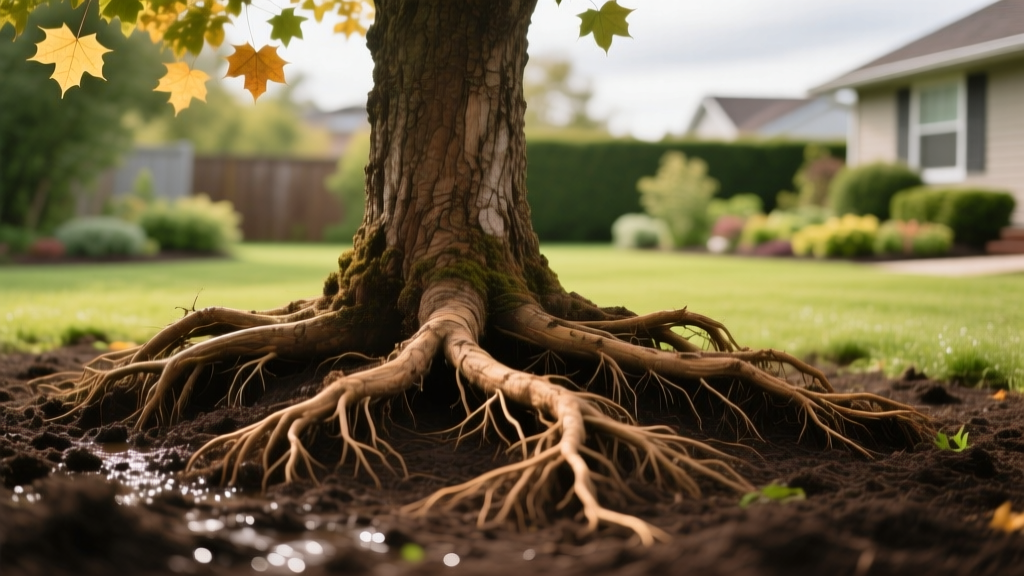
How to Manage the Root System of Maple Trees in Residential Yards
Understanding Maple Root Architecture
Maples (Acer species) are prized for their vibrant fall foliage and dense canopy shade, but their subterranean behavior frequently conflicts with residential infrastructure. The root system of maple trees is predominantly lateral and shallow, especially in species adapted to riparian or floodplain environments. While a mature oak might drive a deep taproot into the subsoil, maples typically concentrate 80% to 90% of their fine absorbing roots in the top 12 to 18 inches of soil. This maximizes oxygen intake and nutrient capture but creates severe uplift risks for sidewalks, driveways, and shallow foundations.
According to research published by the Morton Arboretum, tree roots extend far beyond the drip line, often reaching 1.5 to 2 times the height of the tree. However, the structural roots responsible for hardscape damage are usually confined to the upper soil profile and radiate outward in a wagon-wheel pattern from the root flare.
Species-Specific Root Profiles
- Silver Maple (Acer saccharinum): Highly aggressive, shallow-rooting. Notorious for surface roots that break concrete. Requires a minimum 30-foot setback from foundations.
- Norway Maple (Acer platanoides): Dense, fibrous surface roots that outcompete turfgrass. Moderate uplift risk. 25-foot setback recommended.
- Sugar Maple (Acer saccharum): Deeper rooting profile than Silver/Norway, but still develops wide lateral structural roots. 20-foot setback recommended.
- Japanese Maple (Acer palmatum): Non-aggressive, relatively shallow but slow-growing. Safe for planting 8 to 10 feet from hardscapes.
Step-by-Step: Installing Root Barriers for Maples
If you are planting a new Silver or Norway maple near a property line or driveway, or attempting to retrofit an existing tree, installing a subsurface root barrier is the most effective mechanical defense. We recommend high-density polyethylene (HDPE) corrugated barriers, specifically the DeepRoot UB 24-2 model, which features a 24-inch depth and integrated root-deflecting ridges.
- Locate the Trench Line: Dig a trench at least 3 feet away from the trunk for every 1 inch of trunk diameter (DBH) to avoid severing critical structural roots. For a 10-inch DBH maple, trench 30 feet away if possible, or at minimum 15 feet to protect the hardscape.
- Excavate to 24 Inches: Use a trenching shovel or a mini-excavator with a 4-inch bucket. The trench must be exactly 24 inches deep and 4 inches wide. Ensure the bottom of the trench is level.
- Position the HDPE Panels: Drop the DeepRoot UB 24-2 panels into the trench. The corrugated ridges must face the tree, forcing roots to deflect downward rather than curling around the barrier. Ensure the top edge of the barrier sits 1 inch above the final grade to prevent roots from creeping over the top.
- Seal the Joints: Overlap panels by at least 4 inches and secure them using stainless steel zip ties or the manufacturer’s interlocking joints. Unsealed gaps are the primary failure point for root barriers.
- Backfill and Tamp: Backfill with the native soil, tamping every 6 inches to eliminate air pockets that could cause the barrier to shift during frost heave cycles.
Cost Expectation: Professional installation of HDPE root barriers typically ranges from $18 to $28 per linear foot in 2026, depending on soil compaction and hardscape cutting requirements.
Mitigating Surface Roots Without Killing the Tree
When the root system of maple trees breaches the soil surface, homeowners often resort to severing the roots or covering them with topsoil. Both practices are fatal to the tree over a 3-to-5-year timeline. Severing structural roots invites Armillaria root rot and compromises stability, while burying roots under more than 2 inches of soil suffocates the fine root hairs, leading to canopy dieback.
| Mitigation Strategy | Implementation Details | Impact on Tree Health |
|---|---|---|
| Arborist Wood Chip Mulch | Apply 3-4 inches of coarse wood chips over the root zone. Maintain a 3-inch bare-soil buffer around the trunk flare. | Excellent. Retains moisture, regulates soil temperature, and prevents lawnmower damage to surface roots. |
| Permeable Paver Conversion | Remove heaved concrete and replace with flexible permeable pavers set on a gravel base over geotextile fabric. | Very Good. Allows gas exchange and water infiltration while accommodating future root expansion. |
| Targeted Root Pruning | Only sever roots under 2 inches in diameter, and never cut roots closer than a distance of 12x the trunk DBH. | Risky. Must be done in late winter. Requires clean cuts with a sterilized pruning saw to prevent pathogen entry. |
| Adding Topsoil Over Roots | Dumping 4+ inches of soil over the root zone to hide roots and level the lawn. | Fatal. Suffocates roots, causes hypoxia, and leads to secondary pest infestations and canopy death. |
For comprehensive guidance on soil management around mature trees, the University of Minnesota Extension strongly advises against adding soil grades over existing root flares, emphasizing that oxygen deprivation is the leading cause of urban maple decline.
Planting Distances: A Decision Framework
Preventing root conflicts begins at installation. Use the following decision framework to determine the minimum planting distance from foundations, septic fields, and underground utilities. This framework calculates the Critical Root Zone (CRZ) based on mature canopy expectations rather than current sapling size.
The ANSI A300 Rule of Thumb: For every 1 inch of trunk diameter (measured at 4.5 feet above grade), the tree requires 1 foot of critical root radius for structural stability. However, for water and nutrient foraging, the root system of maple trees will extend 2 to 3 times the drip line. Always size your planting space for the mature canopy, not the nursery container.
- Silver/Norway Maples (Mature spread 40-60 ft): Plant minimum 25 feet from foundations, 30 feet from septic drain fields, and 15 feet from driveways.
- Sugar/Red Maples (Mature spread 30-50 ft): Plant minimum 20 feet from foundations, 25 feet from septic systems, and 10 feet from driveways.
- Japanese Maples (Mature spread 10-20 ft): Plant minimum 8 feet from foundations and 5 feet from hardscapes.
Troubleshooting Common Maple Root Failures
Symptom: Trunk Swells at the Base Like a Telephone Pole
Cause: Girdling roots or a buried root flare. This is exceptionally common in container-grown maples that were planted too deeply or left in their nursery pots too long. Roots circle the inside of the pot and eventually strangle the trunk as they thicken, cutting off the phloem and restricting carbohydrate transport.
Fix: Hire an ISA Certified Arborist to perform a Root Collar Excavation using an AirSpade (a pneumatic excavation tool operating at 90-120 PSI). The compressed air safely fractures compacted soil without tearing the delicate bark of the root flare. Expect to pay between $450 and $800 for this service. Once exposed, the arborist will use sterilized bypass pruners to carefully sever the girdling roots, allowing the tree to recover over the next 2 to 3 growing seasons.
Symptom: Premature Fall Color and Leaf Scorch in Mid-July
Cause: Root desiccation or severed absorbing roots. Maples have high transpiration rates and require consistent soil moisture. If a recent construction project, trenching for irrigation, or severe soil compaction from heavy equipment has damaged the fine feeder roots in the top 12 inches of soil, the canopy will exhibit drought stress even if the surface soil appears moist.
Fix: Implement deep-root watering using a root feeder probe inserted 8 to 12 inches into the soil at the drip line. Apply water at a slow rate (approx. 10 gallons per inch of trunk DBH) once a week during dry spells. Follow up with a 3-inch layer of organic mulch to reduce surface evaporation and lower soil temperatures.
Successfully integrating maples into a residential landscape requires respecting their subterranean footprint. By utilizing mechanical barriers, preserving the root flare, and adhering to species-specific planting distances, you can enjoy decades of brilliant autumn color without sacrificing your hardscapes.

