
Tree Care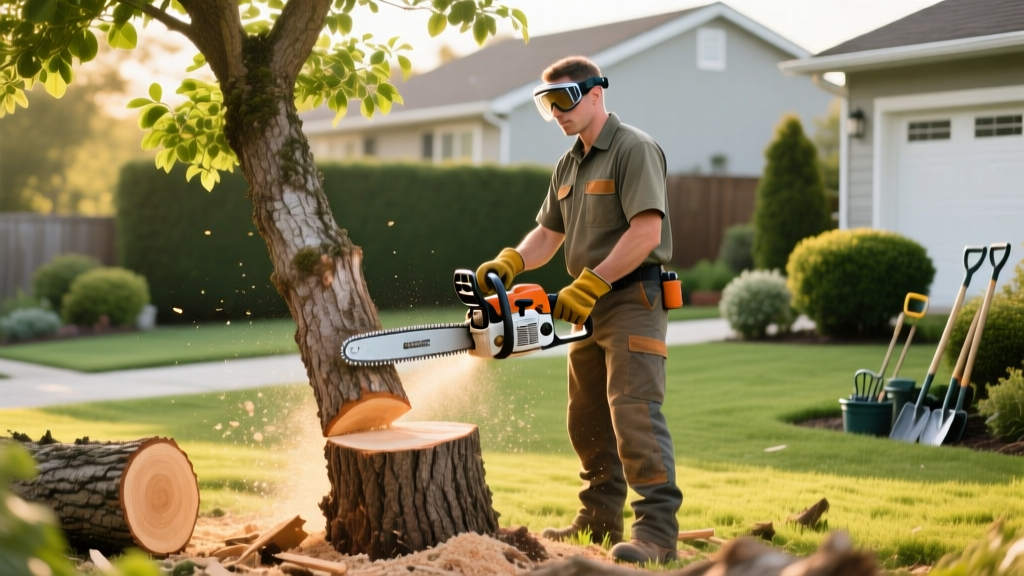
How to Cut Down a Small Tree Safely: A Step-by-Step Guide
Defining the Parameters: What Qualifies as a Small Tree?
Before engaging the chainsaw, establish whether your tree falls within the safe limits for DIY removal. In arboriculture, a 'small tree' suitable for manual felling by a homeowner is strictly defined as having a Diameter at Breast Height (DBH) of less than 6 inches and a total height under 20 feet. Trees exceeding these dimensions possess exponential kinetic energy during a fall and require professional rigging.
Felling a 6-inch DBH tree generates approximately 400 pounds of lateral force at the stump. Misjudging the lean or hinge thickness can result in the trunk splitting vertically—a catastrophic failure known as a 'barber chair'—which propels heavy wood backward toward the operator.
Pre-Felling Assessment and Hazard Matrix
Walk a 360-degree perimeter around the tree. You are looking for overhead obstructions, uneven terrain, and the tree's natural lean. Use the following matrix to determine if the tree is safe to fell manually or requires a certified arborist.
| Hazard Factor | Safe for DIY Felling | Call a Professional |
|---|---|---|
| Natural Lean | Less than 5 degrees off vertical | Heavy lean toward structures or power lines |
| Crown Symmetry | Even branch distribution | Severe 'wolf tree' canopy with heavy one-sided weight |
| Trunk Decay | Solid wood, no fungal conks | Visible mushrooms, hollow cavities, or carpenter ant frass |
| Fall Zone | Clear, flat ground with 2x tree height clearance | Sloped terrain, fences, or neighboring property lines |
Essential Gear and Tool Specifications
Do not compromise on Personal Protective Equipment (PPE). The Occupational Safety and Health Administration (OSHA) mandates specific protections for chainsaw operators. For small tree removal, equip yourself with the following:
- Chainsaw: For trees under 6 inches DBH, a 14-inch or 16-inch bar is optimal. Recommended models include the battery-powered Husqvarna 120i (excellent for low-vibration, quiet cuts) or the gas-powered Stihl MS 170. Ensure the chain is a 3/8-inch low-profile pitch with a .043-inch gauge for fast, narrow kerf cutting.
- Manual Alternatives: If avoiding power tools, use a Silky Katanaboy 500mm professional folding pull-saw or a 24-inch Fiskars Super Splitting Axe. Manual felling a 4-inch tree takes roughly 15-20 minutes of sustained effort.
- PPE: ASTM F1897-20 certified chainsaw chaps (minimum 5-ply Kevlar or Tek warp), an ANSI Z89.1 Type I forestry helmet with integrated mesh face shield and 25-decibel noise reduction earmuffs, and steel-toe boots.
The Two-Cut Felling Method: Executing the Open-Faced Notch
Abandon the outdated 45-degree conventional notch. Modern forestry standards, endorsed by the International Society of Arboriculture (ISA), dictate the use of an open-faced notch (70 to 90 degrees). This geometry allows the tree to fall further before the hinge wood snaps, providing superior directional control.
Step 1: The Top Cut
Stand to the side of the tree, never directly behind it. Aim your chainsaw at a downward angle of roughly 70 degrees. Cut into the trunk to a depth of exactly one-third (33%) of the tree's total DBH. For a 6-inch tree, your top cut should penetrate 2 inches deep.
Step 2: The Bottom Cut
Make a perfectly horizontal cut that meets the exact endpoint of your top cut. The intersection must be precise; an overcut or undercut creates a 'step' that will prematurely break the hinge and ruin your directional control. Remove the wedge of wood.
Step 3: The Felling Cut (Back Cut)
Move to the opposite side of the tree. Position your bar exactly 1 to 2 inches higher than the horizontal bottom cut of your notch. This elevation is non-negotiable—it prevents the tree from sitting back on the stump and kicking the chainsaw bar upward. Cut horizontally toward the notch, but stop before you reach the notch. You must leave a 'hinge' of uncut wood.
CRITICAL WARNING: The Hinge Rule
The hinge wood must be exactly 10% of the tree's DBH. For a 6-inch tree, leave 0.6 inches of solid wood uncut. This hinge acts as a biological pivot, steering the tree into the fall zone. Never cut completely through the trunk.
The hinge wood must be exactly 10% of the tree's DBH. For a 6-inch tree, leave 0.6 inches of solid wood uncut. This hinge acts as a biological pivot, steering the tree into the fall zone. Never cut completely through the trunk.
Step 4: Using Wedges
As soon as your back cut is deep enough to fit a wedge, tap a 6-inch high-density polyethylene felling wedge into the kerf with a felling axe. This prevents the tree from leaning back and pinching your chainsaw bar, a common failure mode that ruins chains and causes kickback.
Limbing and Bucking: Managing Tension and Compression
Once the tree is on the ground, the danger shifts to stored kinetic energy in the bent branches and trunk. Limbing (removing branches) should always be done from the base of the tree working toward the top, keeping the trunk between you and the chainsaw as a physical shield.
When bucking (cutting the trunk into firewood rounds), you must identify tension and compression wood to prevent the saw from getting trapped. According to University of Minnesota Extension guidelines, misreading these forces is the leading cause of equipment damage during DIY processing.
| Log Position | Tension Side (Wood pulls apart) | Compression Side (Wood pushes together) | Cutting Technique |
|---|---|---|---|
| Supported at both ends | Bottom of the log | Top of the log | Cut top down 1/3, then bottom up to meet it. |
| Supported at one end | Top of the log | Bottom of the log | Cut bottom up 1/3, then top down to meet it. |
| Flat on the ground | N/A | Top of the log | Cut straight down from the top; use a cant hook to roll. |
Cost Breakdown: DIY Felling vs. Professional Removal
Understanding the financial implications helps contextualize the effort required for manual removal. Below is a realistic cost comparison for removing a single 15-foot, 5-inch DBH backyard tree in 2026.
| Expense Category | DIY Approach | Professional Arborist |
|---|---|---|
| Labor & Expertise | $0 (Your time: 3-5 hours) | $250 - $450 |
| Equipment (Purchase/Rental) | $150 (Chainsaw) or $40 (Rental) | Included in service fee |
| PPE & Safety Gear | $85 - $120 (Chaps, helmet, gloves) | Included in service fee |
| Debris Hauling / Chipping | $0 (If keeping for firewood) or $50 (Dump fee) | $75 - $150 (Usually included) |
| Stump Grinding | $100 (Daily rental for grinder) | $100 - $200 (Add-on service) |
| Total Estimated Cost | $185 - $410 | $425 - $800 |
While the DIY route offers upfront savings, the hidden costs of equipment maintenance, chain sharpening, and physical fatigue quickly add up. If your tree exhibits any of the hazard factors listed in the assessment matrix, the professional premium is a necessary investment in property and personal safety.

