
Tree Care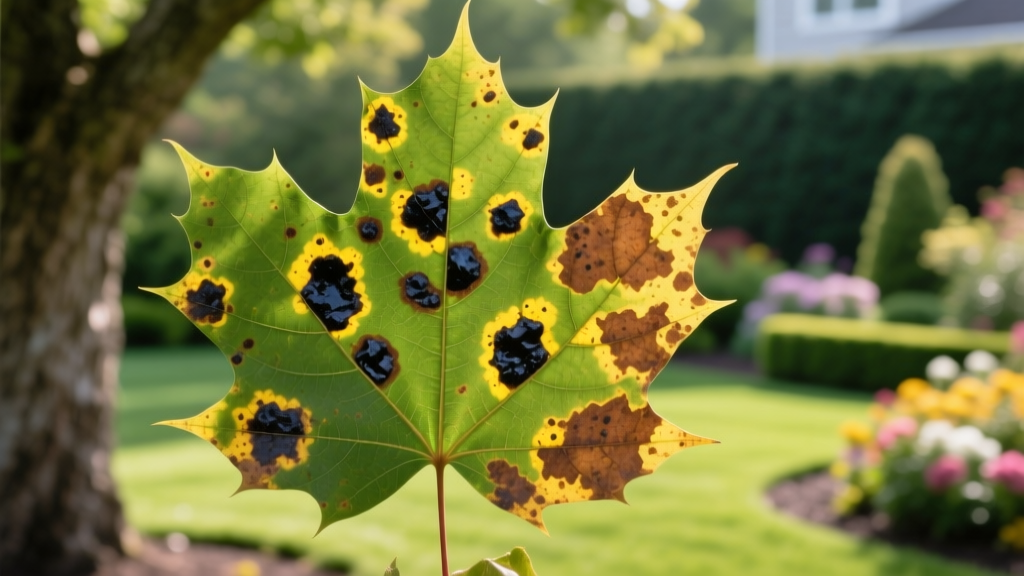
Diagnosing Maple Tree Spots: Tar Spot vs. Anthracnose Rescue Fixes
The Diagnostic Matrix: Decoding Maple Tree Spots
Maples (Acer spp.) are prized for their dense shade and brilliant autumn color, but mid-summer canopy blemishes often trigger alarm. When homeowners notice maple tree spots, the immediate assumption is a fatal systemic infection. In reality, most foliar spots are cosmetic nuisances, though a few require immediate intervention to prevent structural dieback. Accurate diagnosis hinges on examining the spot's texture, margin, and relationship to the leaf veins.
| Disease / Issue | Spot Color & Shape | Texture & Elevation | Primary Trigger | Threat Level |
|---|---|---|---|---|
| Tar Spot (Rhytisma acerinum) | Black, circular, up to 0.5 inches | Raised, glossy, tar-like stroma | Wet spring, infected leaf litter | Low (Cosmetic) |
| Anthracnose (Discula campestris) | Brown/tan, irregular blotches | Papery, often follows leaf veins | Cool, wet spring weather | Moderate (Twig dieback) |
| Phyllosticta Leaf Spot | Tan center, dark purple border | Flat, papery, may drop out | High humidity, poor airflow | Low (Cosmetic) |
| Maple Bladder Gall (Eriophyid mites) | Red to black, pinhead-sized | Raised, hollow blisters on top | Mite feeding at bud break | Low (Cosmetic) |
Tar Spot: The Black Blister
According to the Cornell University Plant Clinic, tar spot is one of the most common and easily identifiable maple tree spots, particularly on Norway and Silver maples. The fungus overwinters in fallen leaf litter. In spring, ascospores are ejected from the old leaves and carried by wind to newly emerging foliage. The initial infection appears as small, pale yellow spots in early June, which gradually enlarge and turn into the characteristic raised, black, tar-like blisters by late July.
Expert Insight: Tar spot rarely causes premature defoliation severe enough to harm the tree's overall vitality. The primary damage is aesthetic. However, heavy infections year-over-year can weaken young or newly transplanted maples, making them susceptible to secondary stressors like drought or borers.
Tar Spot Rescue Protocol
- Autumn Sanitation: This is the single most effective control measure. Rake and destroy all fallen leaves by mid-November. Do not compost infected leaves unless your compost pile reliably reaches and sustains 140°F for at least three consecutive days to kill the fungal stroma.
- Preventative Fungicide: If your tree suffered severe premature defoliation the previous year, apply a protective fungicide containing chlorothalonil (e.g., Daconil, $18–$25 per pint) or mancozeb. Spray at bud break and repeat every 14 days if spring conditions remain wet and cool (below 65°F).
Anthracnose: The Irregular Brown Blotch
Unlike tar spot, anthracnose is a more aggressive pathogen that can cause significant twig dieback and canopy thinning. The Morton Arboretum notes that anthracnose lesions are typically irregular, brown, and tend to follow the leaf veins rather than forming perfect circles. In severe cases, the fungus girdles small twigs, causing them to wither and die, a symptom known as "shoot blight."
Anthracnose Rescue Protocol
- Canopy Pruning: Remove dead, diseased, or crossing branches during late winter dormancy. This increases sunlight penetration and airflow, rapidly drying the canopy in spring to prevent spore germination.
- Tool Sterilization: Anthracnose spores easily transfer on pruning shears. Wipe your bypass pruners with 70% isopropyl alcohol between every single cut. Bleach solutions (1:9 ratio) will pit and ruin your steel blades over time.
- Copper-Based Sprays: Apply a copper octanoate fungicide (e.g., Bonide Liquid Copper Fungicide, roughly $16 per 16oz concentrate) just before bud break. Copper creates an inhospitable barrier on the bark and emerging leaf tissue.
Calculating Treatment Volume by DBH
When scaling up from a pump sprayer to a professional-grade hose-end sprayer for larger shade trees, guessing the chemical volume leads to phytotoxicity or wasted product. Use the Diameter at Breast Height (DBH) to calculate soil drench or trunk injection requirements if utilizing systemic treatments like propiconazole.
- Measure the trunk circumference at exactly 4.5 feet above ground level using a soft measuring tape.
- Divide the circumference by 3.14 (Pi) to get the DBH in inches.
- For systemic soil drenches (e.g., Ferti-lome Liquid Systemic Fungicide), the standard application rate is 3 ounces of concentrate per inch of DBH, diluted in 1 gallon of water per inch of DBH.
- Apply the drench in a 12-inch band around the drip line, not directly against the trunk flare, to target the active feeder roots.
Warning: Never apply systemic fungicides or insecticides to maples that are currently experiencing severe drought stress. The tree's vascular system (xylem) will not translocate the active ingredient effectively, and the chemical solvents can cause root burn in dry soils. Water the tree deeply (1 inch of water per week) for two weeks prior to soil drenching.
DIY vs. Professional Arborist Intervention
Knowing when to abandon DIY treatments saves both money and the tree. The decision largely depends on the tree's size, the severity of the infection, and the equipment required to reach the upper canopy.
The Decision Framework
- DIY Territory (Trees under 15 feet tall): If the tree's canopy is fully reachable with a standard 2-gallon pump sprayer, and the spots are limited to Tar Spot or mild Phyllosticta, stick to manual sanitation and over-the-counter contact fungicides. Total annual cost: $20–$40.
- Call a Certified Arborist (Trees over 20 feet or >12 inches DBH): Once a maple exceeds 20 feet, hydraulic spraying is required to achieve proper canopy coverage. Furthermore, if Anthracnose has caused widespread shoot blight, an arborist can perform trunk injections using emamectin benzoate or propiconazole (e.g., Arborjet systems). Expect to pay $15 to $25 per inch of DBH for professional trunk injections, which provide 12 to 24 months of systemic protection without environmental drift.
Long-Term Canopy Resilience
While treating active maple tree spots is necessary for immediate relief, long-term prevention relies on cultural practices that reduce microclimate humidity. Avoid overhead irrigation from lawn sprinklers; switch to drip irrigation or soaker hoses placed at the tree's drip line. Apply a 2-to-3-inch layer of organic hardwood mulch over the root zone, keeping it strictly 3 inches away from the trunk flare to prevent collar rot. As noted by Penn State Extension, maintaining vigorous root health through proper mulching and deep, infrequent watering allows mature maples to easily compartmentalize and outgrow minor foliar fungal infections without chemical intervention.

