
Tree Care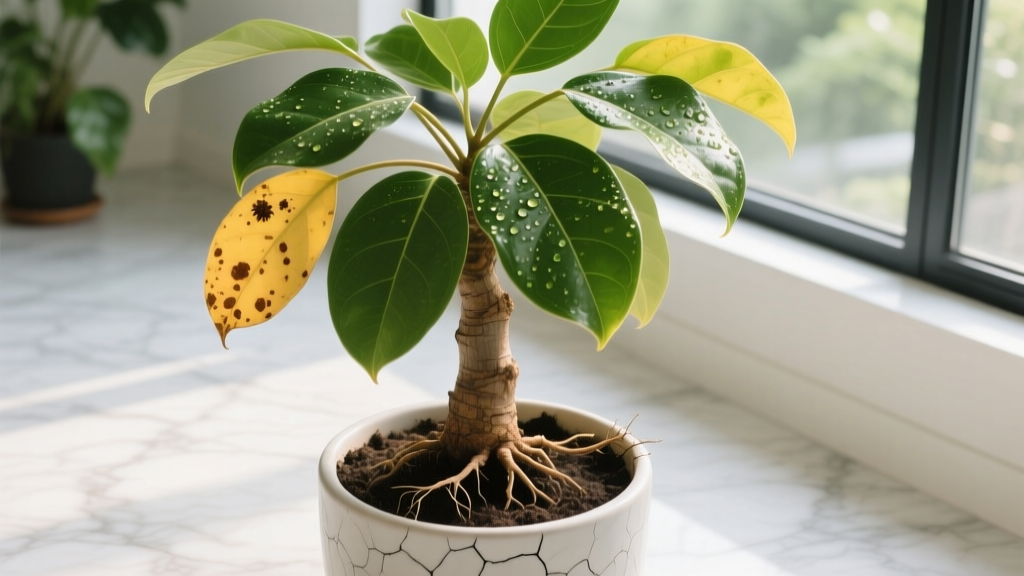
Money Tree Care: Diagnosing Yellow Leaves, Pests, and Root Rot
The Glued Pebble Trap: Uncovering Hidden Root Rot
Most commercial Pachira aquatica specimens are sold in nursery pots topped with decorative pebbles glued together with hot glue or resin. While aesthetically pleasing, this practice creates an impermeable barrier that traps evaporative moisture, suffocates the soil surface, and prevents you from checking soil moisture levels. According to the Missouri Botanical Garden, prolonged soil saturation is the primary catalyst for Phytophthora root rot in tropical houseplants.
Immediate Action Required: If your money tree has glued pebbles, use a flathead screwdriver and a heat gun (on low setting) to carefully pry the pebble layer off. Discard the glued stones. Never water a money tree through a decorative rock layer.
Once the barrier is removed, inspect the base of the braided trunks. If the lower two inches of the braid feel soft, spongy, or emit a sour, anaerobic odor, the saplings are actively rotting. Because commercial money trees are typically 3 to 5 individual saplings woven together, one rotting trunk will quickly spread fungal pathogens to the healthy ones.
Surgical Removal of a Rotting Braid
- Unpot the plant and gently wash away the soil from the root ball to expose the individual root systems.
- Identify the rotting sapling (it will have black, mushy roots and a brown, peeling trunk).
- Using sterilized bypass pruners (wiped with 70% isopropyl alcohol), cut the rotting trunk at the soil line.
- Trace its specific root mass and carefully untangle it from the healthy saplings. Do not pull forcefully, as this will snap the fragile feeder roots of the healthy trees.
- Repot the remaining healthy saplings in a freshly sanitized terracotta pot.
Symptom-to-Solution Diagnostic Matrix
Money trees communicate distress through specific foliar and structural changes. Use this matrix to pinpoint the exact environmental failure.
| Symptom | Primary Cause | Corrective Protocol |
|---|---|---|
| Lower leaves turning yellow and dropping | Chronic overwatering or heavy, water-retentive soil | Repot in a 50/30/20 aroid mix; water only when top 3 inches are bone dry. |
| Crispy brown leaf tips and margins | Low humidity (<30%), fertilizer salt burn, or fluoride in tap water | Flush soil with distilled water; use a humidifier to reach 45-50% RH. |
| Leaves drooping but soil is dry | Underwatering or root-bound circling roots | Bottom-water the pot in a basin for 30 minutes; check for root binding. |
| White, web-like stippling on leaf undersides | Spider mite infestation (Tetranychus urticae) | Apply horticultural neem oil every 5 days for three cycles. |
| Sticky residue (honeydew) and white cottony masses | Mealybugs (Pseudococcidae) in leaf axils | Spot treat with 70% isopropyl alcohol on cotton swabs; apply systemic granules. |
Precision Watering: The Wooden Skewer Method
Moisture meters are notoriously inaccurate in highly aerated, chunky soil mixes, often reading 'dry' when the center of the root ball is saturated. For Pachira aquatica, the wooden skewer test provides exact data on core moisture levels.
Insert a standard 10-inch bamboo BBQ skewer into the soil, pushing it halfway between the trunk and the pot edge, down to the bottom of the pot. Leave it for 10 minutes. Pull it out and feel the wood. If the bottom three inches of the skewer feel cool, damp, or show darkened water stains, do not water. Only water when the skewer comes out completely dry and room-temperature. When you do water, apply enough room-temperature filtered water until 20% of the total volume drains out of the bottom holes, flushing out accumulated fertilizer salts.
Eradicating Pests: A 14-Day Treatment Protocol
Money trees are highly susceptible to spider mites, especially when placed near HVAC vents or in rooms with humidity below 40%. Because mite eggs hatch in 3 to 5 days depending on ambient temperature, a single application of pesticide will fail. You must interrupt the reproductive cycle.
The Neem Oil Escalation Schedule
Use a cold-pressed, clarified hydrophobic extract of neem oil (such as Bonide Neem Oil, typically priced around $12 for a 16oz concentrate). The EPA recognizes botanical oils as effective contact pesticides that smother soft-bodied insects and disrupt their hormonal feeding cycles.
- Day 1 (Initial Knockdown): Mix 1 tablespoon of neem oil and 1/2 teaspoon of mild liquid castile soap per quart of lukewarm water. Shake vigorously. Spray the entire plant, focusing heavily on the undersides of the leaves and the deep crevices where the petioles meet the trunk. Wipe off excess oil from the leaves with a microfiber cloth to prevent stomata blockage.
- Day 5 (First Hatch): Repeat the exact application. This targets the nymphs that hatched from eggs surviving the Day 1 treatment.
- Day 10 (Final Sweep): Apply a third round. By day 10, any remaining eggs will have hatched, and this final application ensures no adults survive to lay a new clutch.
Pro Tip for Mealybugs: Neem oil struggles to penetrate the waxy, cottony coating of adult mealybugs. Dip a cotton swab in 70% isopropyl alcohol and physically touch every visible mealybug. The alcohol instantly dissolves their waxy armor and desiccates them on contact. Follow up with a neem oil spray for the crawling nymphs.
Formulating the Ideal Pachira Soil Mix
Standard indoor potting soils (like Miracle-Gro Indoor Mix) retain too much moisture for money trees, leading to hypoxia in the root zone. Pachira aquatica requires a chunky, fast-draining aroid mix that mimics its native Central American wetland edges, where roots experience periodic flooding but require high oxygen exchange during dry spells.
The 50/30/20 Drainage Recipe
Mix the following components by volume in a large tote:
- 50% High-Quality Cactus/Succulent Mix: Provides the base nutrients and structure. (e.g., Hoffman Organic Cactus and Succulent Soil Mix).
- 30% Orchid Bark: Fir or pine bark chunks (1/2 inch size) create large air pockets, preventing soil compaction over time.
- 20% Coarse Perlite or Pumice: Ensures rapid drainage and prevents the soil from holding water against the trunk base. Avoid vermiculite, as it is designed to retain moisture.
When repotting, always select a pot that is only 1 to 2 inches wider in diameter than the current root ball. Placing a small money tree in an oversized pot creates a massive volume of wet soil that the roots cannot dry out, guaranteeing root rot.
Fertilizer Salts and Leaf Drop
Money trees are light feeders. Applying full-strength fertilizer to a stressed or recovering plant will cause osmotic shock, drawing water out of the roots and resulting in rapid, massive leaf drop. Use a balanced, water-soluble fertilizer like Dyna-Gro Foliage Pro (9-3-6) or Jack's Classic (20-20-20), but dilute it to 25% of the manufacturer's recommended dose. Apply only during the active growing season (April through August), and never fertilize a plant that is currently suffering from root rot or pest damage.
Frequently Asked Questions
Are money trees toxic to cats and dogs?
No. According to the ASPCA Toxic and Non-Toxic Plants database, Pachira aquatica is completely non-toxic to both cats and dogs. However, ingestion of large amounts of fibrous leaves can still cause mild gastrointestinal upset or vomiting simply due to the physical irritation of the plant matter in the stomach.
Why is my money tree's braided trunk oozing sap?
Sap oozing, or gummosis, from the braided trunk is a severe stress response. It is almost always caused by mechanical damage (the braid being tied too tightly with wire or twine as the tree thickens) or a bacterial/fungal infection entering through a wound. Inspect the braid for embedded wire ties. If you find wire cutting into the bark, carefully snip it with wire cutters to allow the trunk to expand. If the oozing is accompanied by soft, mushy bark, the trunk is rotting and must be surgically removed as detailed in the first section.
Can I unbraided a mature money tree?
Attempting to unbraid a mature, woody money tree will almost certainly snap the trunks. As the saplings age, their bark hardens and they fuse together at the points of contact. If you dislike the braided look, your only option is to propagate new cuttings from the healthy upper branches and grow them as single, unbraided trunks.

