
Tree Care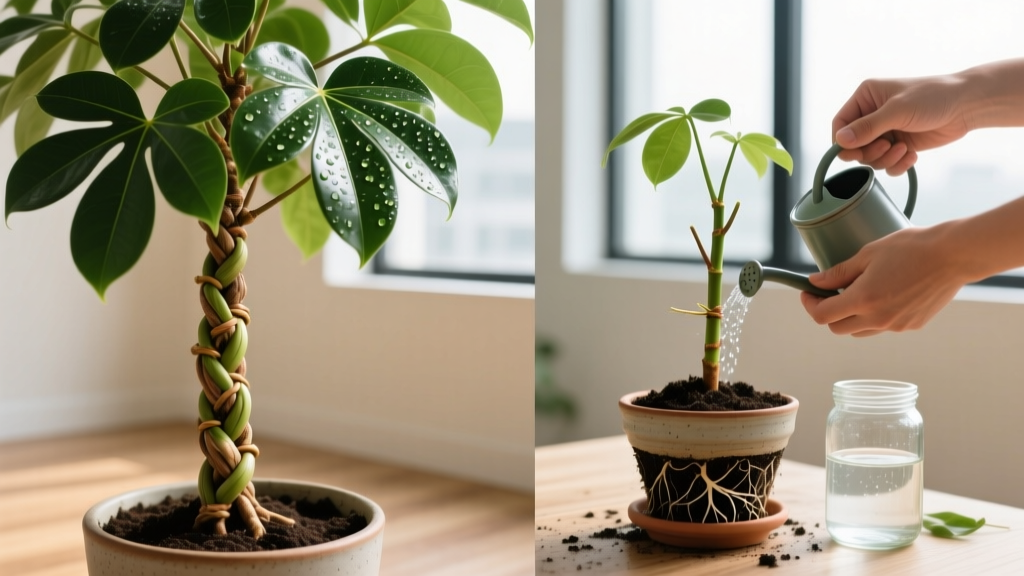
Money Tree How To: Braiding, Watering, and Propagation Guide
The Core Money Tree How-To: Watering and Soil Matrix
Pachira aquatica, commonly known as the money tree, is a tropical wetland species in the Malvaceae family. In its native Central and South American habitat, it thrives in swampy conditions, but as a containerized indoor or patio tree, its root system is highly susceptible to hypoxia (oxygen deprivation) from waterlogged soil. The most critical aspect of money tree care is abandoning standard potting soil in favor of a highly aerated, fast-draining substrate.
Custom Soil Formulation
Commercial cactus mixes retain too much moisture for the dense root ball of a mature money tree. Mix your own substrate using the following ratio by volume:
- 50% Coco Coir or Sphagnum Peat: Provides baseline moisture retention and buffers pH between 6.0 and 6.5.
- 25% Coarse Perlite (Horticultural Grade #3 or #4): Creates macro-pores for rapid drainage.
- 25% Orchid Bark (Fir or Pine): Prevents soil compaction over time and encourages beneficial mycorrhizal colonization.
Precision Watering Schedule
Never water on a fixed calendar schedule. Use the 'soak and dry' method, verified with a digital moisture meter (such as the XLUX or Atree analog probes). Insert the probe 3 inches deep; water only when the reading drops to 2 or 3 (dry). When watering, apply enough volume to achieve a 10-15% runoff from the drainage holes to flush accumulated mineral salts.
| Pot Diameter | Approx. Soil Volume | Target Water Volume (Per Soak) | Expected Dry-Down Time (70°F Indoor) |
|---|---|---|---|
| 6 inches | 1.2 Gallons | 12 - 16 oz | 5 - 7 Days |
| 10 inches | 3.5 Gallons | 32 - 40 oz | 8 - 12 Days |
| 14 inches | 7.0 Gallons | 64 - 80 oz | 14 - 21 Days |
Step-by-Step Braiding Technique for Young Trunks
The iconic braided trunk is not a natural growth habit; it is a horticultural manipulation performed while the tree is juvenile. If you purchase a mature, lignified (brown and woody) money tree, attempting to bend the trunks will cause them to snap. Braiding must be executed when the trunks are semi-hardwood, green, and between 1/4 to 1/2 inch in diameter.
- Preparation: Select 3 to 5 young Pachira aquatica seedlings planted in the same container. Strip the lower 6 to 8 inches of foliage from each trunk to expose the flexible green bark.
- Base Securing: Gather the trunks tightly at the soil line. Secure them with a soft jute twine or a velcro plant tie. Avoid wire, which will girdle and strangle the expanding vascular tissue.
- The Weave: Cross the outer left trunk over the center trunk, then cross the outer right trunk over the new center. Pull each cross snug, but leave a 1/8-inch gap to allow for secondary growth (trunk thickening).
- Continuous Tying: Every 3 to 4 inches of braid, wrap a loose piece of jute twine around the bundle to hold the tension. Continue until you reach the leaf canopy.
- Canopy Release: Allow the top foliage to grow freely. As the tree matures, the green bark will lignify, fusing the trunks together into a single, stable structure.
Warning: As the braided trunks thicken, they will naturally fuse. If you used rubber bands or non-biodegradable ties during the braiding process, you must carefully cut them away after 6 months to prevent fatal girdling.
Propagation: Stem Cuttings vs. Air Layering
While money trees produce large, edible seed pods in the wild, indoor specimens rarely flower. Therefore, vegetative propagation is the standard method for multiplying your plant. According to the National Gardening Association, stem cuttings are the most accessible method, though air layering yields higher success rates for thicker, older branches.
Stem Cuttings Protocol
Take 6 to 8-inch cuttings from semi-hardwood stems in late spring. Ensure each cutting has at least two leaf nodes. Strip the lower leaves and dip the basal 1 inch into a rooting hormone containing 0.1% to 0.3% Indole-3-butyric acid (IBA). Plant the cutting in a 50/50 mix of perlite and peat moss. Cover the pot with a clear plastic humidity dome to maintain 85-90% relative humidity, and place under bright, indirect light (1,500 foot-candles). Rooting typically initiates in 21 to 28 days at 75°F.
Air Layering Protocol
For branches thicker than 1 inch, air layering is superior. Make a 1-inch vertical slit halfway through the stem, insert a toothpick to keep it open, and pack the wound with damp sphagnum moss. Wrap the moss tightly in clear polyethylene film, sealing both ends with electrical tape. Roots will visibly populate the moss within 4 to 6 weeks, at which point you can sever the branch below the root ball and pot it independently.
Troubleshooting Decision Tree: Yellowing and Leaf Drop
Leaf drop in Pachira aquatica is rarely caused by a single factor; it is a stress response to environmental variables. Use this diagnostic framework to identify the root cause before applying treatments.
Scenario A: Lower Leaves Turning Yellow and Dropping
- If soil is wet and smells sour: You have root rot (Pythium or Phytophthora). Action: Unpot the tree, wash away all soil, prune black/mushy roots with sterilized shears, soak the remaining roots in a 3% hydrogen peroxide solution for 10 minutes, and repot in fresh, dry substrate.
- If soil is dry and pulling away from pot edges: Severe underwatering or root-bound stress. Action: Bottom-water the pot in a basin of room-temperature water for 45 minutes to rehydrate the hydrophobic peat.
Scenario B: Crispy Brown Leaf Edges with Yellow Halos
- If humidity is below 40%: Moisture transpiration exceeds root uptake. Action: Install a ultrasonic humidifier nearby or place the pot on a pebble tray filled with water (ensure the pot base is not sitting in the water).
- If using tap water: Fluoride and chlorine toxicity. Action: Switch to distilled, reverse-osmosis, or rainwater. Flush the existing soil with 2 gallons of distilled water to leach out accumulated salts.
Pest Note: If you notice tiny black flies hovering near the soil, you have fungus gnats (Bradysia spp.). The larvae feed on the money tree's fine root hairs. Drench the soil with a solution containing Bacillus thuringiensis israelensis (BTI), such as Mosquito Bits, to eliminate the larvae within 48 hours.
Fertilizer Regimen and Lighting Requirements
Money trees are moderate feeders. During the active growing season (spring through early fall), apply a balanced, water-soluble fertilizer (20-20-20 NPK) diluted to 1/4 of the manufacturer's recommended strength every time you water. Alternatively, use a slow-release granular fertilizer like Osmocote Plus (15-9-12) applied once in early spring at a rate of 1 teaspoon per gallon of soil volume. Cease all fertilization in late autumn and winter when the tree enters its natural dormancy period.
Lighting dictates the tree's metabolic rate and water consumption. Pachira aquatica requires bright, indirect light ranging from 1,500 to 3,000 foot-candles. An east-facing window is ideal. If placed near a south or west-facing window, diffuse the glass with a sheer curtain or position the tree 4 to 6 feet back from the glass to prevent solar scorch, which manifests as bleached, papery lesions on the canopy.
Finally, while money trees are widely kept in homes with pets, it is always wise to verify plant safety. The ASPCA confirms the money tree is non-toxic to dogs and cats, making it a safe, structural focal point for any indoor landscape.

