Tree Care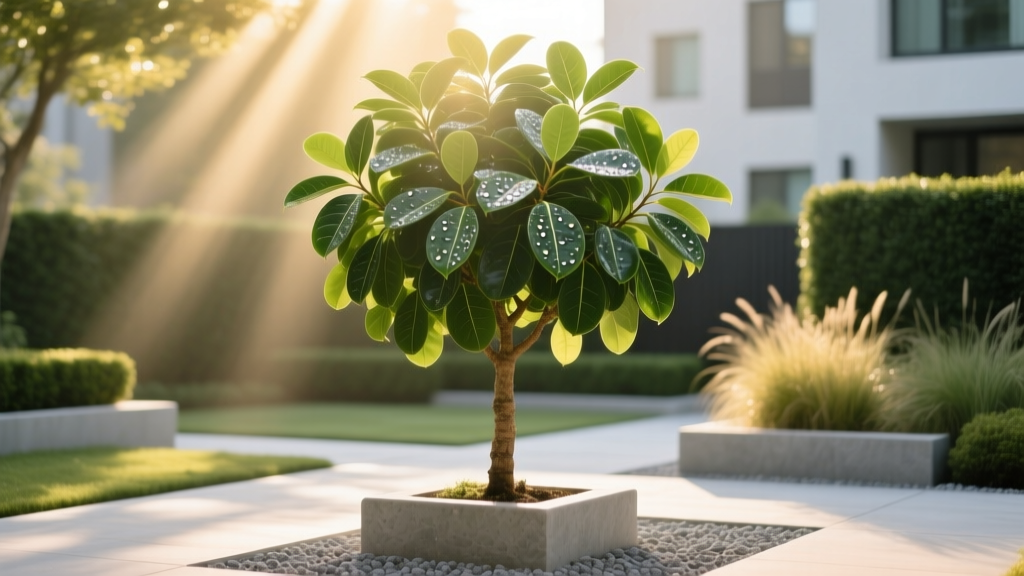
How Much Light Do Money Trees Need? Dosage & Cost Guide
The Exact Light Dosage for Pachira Aquatica
When determining how much light do money trees need, homeowners often rely on vague terms like 'bright, indirect light.' However, precise horticultural dosage is required to maintain the structural integrity of the braided trunk and the dense umbrella canopy of Pachira aquatica. Light is not just a binary on/off switch; it is a measurable nutrient.
Money Tree Light Dosage Targets
- Maintenance Threshold: 1,500 to 3,000 lux (150–300 foot-candles). The plant will survive but growth will stall.
- Optimal Growth Zone: 5,000 to 10,000 lux (500–1,000 foot-candles). Promotes active leaf unfurling and trunk thickening.
- Daily Light Integral (DLI): Target 6 to 12 mol/m²/d over a 12-hour photoperiod.
- Photoperiod: 6 to 8 hours of direct/filtered light, or 10 to 12 hours of artificial grow light exposure.
According to horticultural guidelines from Penn State Extension, tropical understory trees like the money tree evolved to capture dappled sunlight. Exposing them to unfiltered midday sun exceeding 30,000 lux will cause photo-oxidative stress, resulting in bleached, necrotic leaf spots.
Window Placement Matrix: Maximizing Natural Coverage
Natural light coverage fluctuates based on your home's orientation and the season. Use this decision matrix to position your money tree for optimal dosage without risking leaf scorch.
| Window Direction | Average Lux Range | Coverage Verdict & Adjustments |
|---|---|---|
| North-Facing | 500 – 1,500 lux | Insufficient. Will cause etiolation (stretching). Requires supplemental LED lighting. |
| East-Facing | 2,500 – 8,000 lux | Ideal. Provides gentle morning sun. Place within 2 feet of the glass for maximum canopy density. |
| South-Facing | 15,000 – 40,000+ lux | High Risk. Must be filtered through sheer curtains or pushed 4–6 feet back into the room to avoid scorch. |
| West-Facing | 5,000 – 15,000 lux | Good with caution. Afternoon heat spikes can dehydrate leaves. Use blinds to diffuse peak 2 PM to 5 PM rays. |
Artificial Lighting: Equipment Costs and Coverage Footprints
If your home lacks adequate natural fenestration, artificial lighting is mandatory. The Missouri Botanical Garden notes that standard household LED bulbs lack the specific Photosynthetically Active Radiation (PAR) spectrum required for robust photosynthesis. You need dedicated full-spectrum horticultural LEDs.
Tier 1: Budget Bulb Replacement (Best for Single Trees)
- Product: Sansi 15W LED Grow Light Bulb
- Cost: ~$16.00
- Coverage Footprint: 2x2 feet at a 12-inch hanging distance.
- Performance: Delivers approximately 45 µmol/m²/s (PPFD) at 12 inches. Perfect for a standard 3-foot braided money tree. Screw it into any standard E26 desk lamp or pendant fixture.
Tier 2: Mid-Range Ring Light (Best for Desk/Corner Placement)
- Product: Roleadro 75W LED Grow Light Panel
- Cost: ~$45.00
- Coverage Footprint: 3x3 feet.
- Performance: Provides a wider, more even canopy spread, preventing the lower leaves from dropping due to self-shading. Mounts easily to walls or shelving units.
Tier 3: High-Output Quantum Board (Best for Indoor Jungles)
- Product: Mars Hydro TS1000
- Cost: ~$150.00
- Coverage Footprint: 3x3 feet (flowering) / 4x4 feet (vegetative).
- Performance: Overkill for a single money tree, but highly cost-effective if you are cultivating multiple tropical specimens. Dimmable driver allows you to dial the dosage back to 40% to prevent light toxicity.
Calculating Your Monthly Electricity Cost
Understanding the financial dosage of running grow lights is crucial for long-term indoor tree care. With the 2026 average US residential electricity rate hovering around $0.17 per kWh, here is the exact math for running a supplemental light regimen.
Cost Formula & Example
Formula: (Wattage × Daily Hours) ÷ 1000 = Daily kWh
Scenario: Running the Sansi 15W bulb for 10 hours a day.
- (15W × 10 hours) ÷ 1000 = 0.15 kWh per day
- 0.15 kWh × 30 days = 4.5 kWh per month
- 4.5 kWh × $0.17 = $0.76 per month
Even running a high-output Mars Hydro TS1000 dimmed to 100W for 12 hours a day will only cost approximately $6.12 per month. The cost of artificial light dosage is negligible compared to the cost of replacing a $150 mature braided money tree lost to etiolation.
Diagnosing Light Stress: Deficiency vs. Toxicity
Misinterpreting light stress signals often leads homeowners to incorrectly adjust watering or fertilizer, compounding the problem. Use this diagnostic framework to read your money tree's foliage.
Symptoms of Light Deficiency (Under-Dosage)
- Etiolation: The distance between leaf nodes on the stem stretches significantly. The trunk may lean aggressively toward the nearest light source.
- Chlorosis: New leaves emerge pale green or yellow, and older lower leaves drop prematurely as the plant cannibalizes them for energy.
- Stunted Canopy: The plant stops producing new fronds entirely, despite adequate soil moisture and ambient humidity.
Symptoms of Light Toxicity (Over-Dosage)
- Photo-bleaching: Leaves develop dry, crispy, white or pale yellow patches, typically on the side facing the window or grow light.
- Leaf Curling: Foliage curls inward or downward (taco-shaping) to reduce its surface area and minimize light absorption.
- Rapid Soil Desiccation: High-intensity light combined with thermal radiation from south-facing windows bakes the root ball, requiring daily watering to prevent drought stress.
Seasonal Adjustments and Canopy Rotation
Light dosage is not static. As the earth's axial tilt changes, the angle and intensity of natural light shifting through your windows will vary drastically. According to UF IFAS Gardening Solutions, indoor tropicals require seasonal repositioning.
During the winter solstice, a south-facing window may only provide 3,000 lux, making it a perfect spot for your money tree. However, by the summer solstice, that exact same window may push 25,000+ lux, requiring you to move the plant 5 feet back into the room or install UV-filtering window film.
Furthermore, money trees exhibit strong phototropism. To ensure the braided trunk remains straight and the canopy grows symmetrically, you must rotate the pot 90 degrees every two weeks. This ensures all sides of the plant receive an equal dosage of PAR, preventing the structural weakening that occurs when a heavy canopy leans entirely to one side.