
Tree Care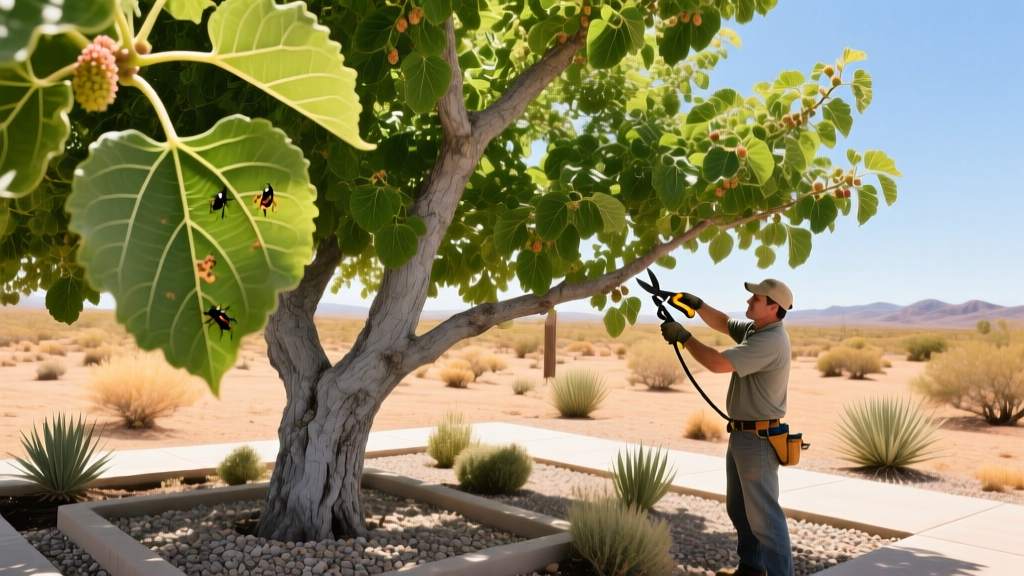
Mulberry Tree Arizona Guide: Planting and Desert Care Tips
The Legal Reality: Navigating Arizona's Pollen Bans
Before purchasing a mulberry tree in Arizona, you must understand local municipal codes. In the 1980s and 1990s, Maricopa County (Phoenix metro) and Pima County (Tucson) enacted strict bans on the planting of fruitless mulberry trees (*Morus alba* 'Fruitless'). Male fruitless mulberries produce massive amounts of highly allergenic pollen in early spring, which became a severe public health nuisance. According to Maricopa County Environmental Services, planting, selling, or propagating fruitless mulberries remains illegal in these jurisdictions, and violations can result in code enforcement fines and mandatory removal.
Legal Workaround: The ban specifically targets fruitless (male) varieties. Fruiting (female) mulberries are perfectly legal, as their pollen is heavy, sticky, and primarily transferred by insects rather than wind. Excellent legal fruiting varieties for Arizona include the Dwarf Everbearing (*Morus alba*), which produces continuous, manageable crops of sweet, dark berries, and the Black Mulberry (*Morus nigra*), prized for its superior flavor and high heat tolerance.
Site Selection and the Caliche Problem
Mulberries are fast-growing and can reach 30 feet in height with an equal spread. They require full sun but will suffer if planted in spaces where their aggressive root systems will lift concrete. Plant your tree at least 15 to 20 feet away from driveways, patios, and foundations to prevent structural damage and to keep staining fruit drops off your hardscaping.
The greatest challenge to establishing any tree in Arizona is caliche—a rock-hard layer of calcium carbonate that sits 1 to 3 feet below the desert topsoil. If a mulberry's taproot hits caliche and cannot penetrate it, the roots will girdle, leading to stunted growth and eventual death within 3 to 5 years.
The Rebar Percolation Test
- Dig your proposed planting hole to a depth of 24 inches and a width of 36 inches.
- Fill the hole with water and let it drain completely.
- Refill the hole with water. Drive a piece of 3/8-inch steel rebar into the bottom of the hole.
- If the rebar stops abruptly before reaching 12 inches of depth, you have hit caliche. You must either use a pickaxe and digging bar to fracture the caliche layer entirely, or abandon the spot and choose a location with deeper soil.
Step-by-Step Planting Protocol
Arizona's native soil is highly alkaline, often registering a pH of 8.0 to 8.5, while mulberries prefer a slightly acidic to neutral pH (6.0 to 7.0). Do not simply dig a hole and drop the tree in; you must create a transitional soil environment.
- Amend the Backfill: Mix 30% high-quality compost with 70% native soil. Add 5 pounds of elemental sulfur per 100 square feet of planting area to gradually lower the soil pH.
- Planting Depth: Locate the root flare (where the trunk widens at the base). The root flare must sit exactly 1 to 2 inches above the surrounding soil grade. Planting too deep will suffocate the roots and invite collar rot.
- Establish a Basin: Build a 4-inch-tall soil berm in a 3-foot radius around the trunk to capture water and direct it down to the root zone.
Desert Watering Framework
Newly planted mulberries require consistent moisture to establish, but overwatering in heavy clay soils leads to root rot. Transition to a drip irrigation system immediately. Use 2-gallon-per-hour (GPH) pressure-compensating emitters placed in a ring 18 inches from the trunk, expanding the ring outward as the canopy grows.
| Season | Frequency | Duration (Drip) | Emitter Placement |
|---|---|---|---|
| Spring (Mar-May) | 2x per week | 3 hours | 18 inches from trunk |
| Summer (Jun-Aug) | 3x per week | 4 hours | Drip line (canopy edge) |
| Fall (Sep-Nov) | 1x per week | 3 hours | Drip line |
| Winter (Dec-Feb) | 1x per month | 4 hours | Mid-way to drip line |
Sunscald Prevention: Whitewashing the Trunk
Young mulberry trees possess thin, tender bark that is highly susceptible to sunscald from intense Arizona UV radiation, especially on the south and west-facing sides. Sunscald causes the bark to split, inviting wood-boring insects and fungal pathogens.
Expert Application Tip: Mix a 50/50 solution of untinted, interior white latex paint and water. Do not use exterior paint or oil-based paints, as they will suffocate the tree's lenticels (breathing pores). Paint the trunk from the soil line up to the first major branch crotch. Reapply annually in late autumn until the canopy is dense enough to shade its own trunk (usually 3 to 4 years).
Managing Iron Chlorosis in Alkaline Soil
If your mulberry's new leaves emerge pale yellow with dark green veins, the tree is suffering from iron chlorosis. In Arizona's high-pH soils, iron becomes chemically locked up and unavailable to the roots. Standard iron treatments (Fe-EDTA) fail in soils with a pH above 7.5.
To correct this, you must use an iron chelate containing the ortho-ortho EDDHA isomer (such as Miller's Ferriplus or Sequestrene 138). Apply 2 to 3 ounces of Fe-EDDHA per 100 square feet of canopy area in early February, just before spring bud break. Water it in deeply. This specific chelate remains stable and available to the tree even at a pH of 8.5, according to soil management guidelines from the University of Arizona Cooperative Extension.
Pruning for Airflow and Canopy Health
Mulberries bleed a milky, irritating sap when cut. To minimize sap loss and reduce the risk of disease, prune during the dormant winter months (December and January). Avoid heavy pruning in late spring or summer; exposing the inner bark to sudden, direct desert sunlight will result in severe tissue burn.
The Open-Center Pruning Method
- Year 1: Head the central leader back to 30 inches above the soil to encourage lateral branching.
- Year 2: Select 3 to 4 strong, wide-angled scaffold branches spaced evenly around the trunk. Remove all competing vertical shoots.
- Maintenance: Annually remove crossing branches, water sprouts (vigorous vertical shoots), and any branches that droop low enough to interfere with mowing or irrigation infrastructure. Aim for an open canopy that allows dappled sunlight to penetrate the center, which improves fruit ripening and reduces fungal pressure.

