
Tree Care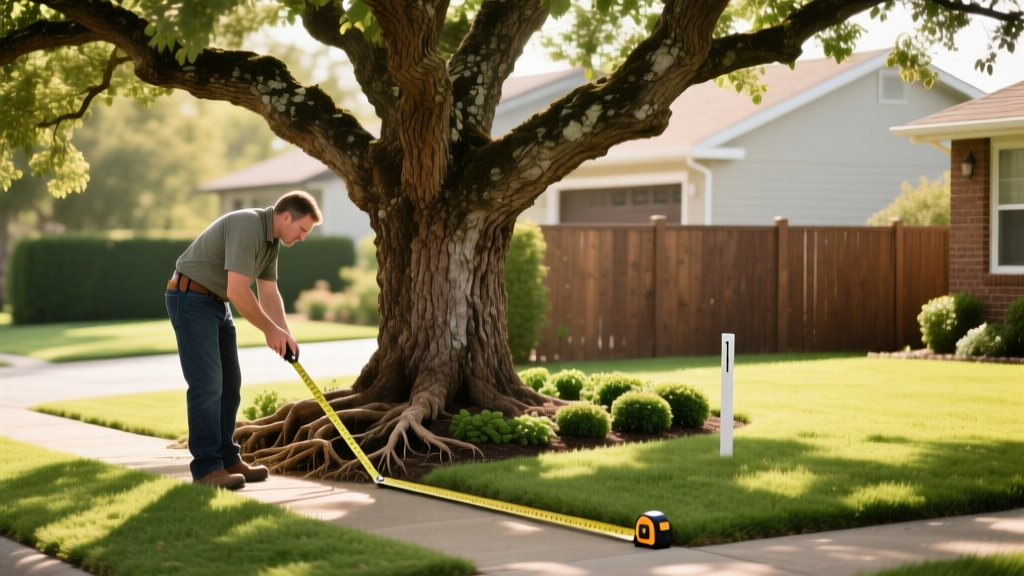
What to Do If a Neighbor's Tree Is Growing Over My Property Line
The Golden Rule of Property Lines and Tree Ownership
When a neighbor's tree branches or roots cross into your yard, the situation immediately shifts from a landscaping issue to a matter of property law. The foundational principle in almost all U.S. jurisdictions is straightforward: tree ownership is determined by the location of the trunk. If the trunk sits entirely on your neighbor's land, they own the tree, even if 80% of the canopy shades your lawn or drops leaves into your pool.
However, you possess rights to the airspace above your property and the soil beneath it. Understanding exactly what to do if a neighbors tree growing over my property requires navigating the intersection of arboriculture science and state-specific trespass laws. Missteps here do not just result in neighborly disputes; they can trigger 'timber trespass' lawsuits with financial penalties exceeding $15,000 for a single mature shade tree.
⚠️ The Boundary Tree Exception: If the trunk of the tree grows directly on the property line, it is considered a 'boundary tree' or 'line tree.' In this scenario, both you and your neighbor are co-owners. Neither party can prune, treat, or remove the tree without the explicit written consent of the other. Unauthorized work on a boundary tree is universally treated as property destruction.
Your Legal Rights: Pruning Overhanging Branches
U.S. courts generally rely on two legal frameworks to handle overhanging branches and encroaching roots: the Massachusetts Rule and the Hawaii Rule. Knowing which one your state follows dictates your leverage.
- The Massachusetts Rule (Majority of States): You have the right to 'self-help.' This means you may trim branches and cut roots up to your property line at your own expense. However, you cannot sue your neighbor for damages caused by roots or branches (like cracked driveways) unless the tree poses an imminent threat of physical harm or death.
- The Hawaii Rule (Minority of States, e.g., CA, NY, HI): You retain the right to self-help, but you can also sue your neighbor for nuisance damages if the encroaching roots or branches cause actual harm to your property, such as lifting a sidewalk or damaging a foundation.
According to legal overviews provided by Nolo's legal encyclopedia, the universal restriction across both rules is that your self-help pruning must not kill or structurally compromise the tree. If your pruning causes the tree to decline or fall, you are liable for its replacement value.
| Action | Legal Status | Potential Penalty |
|---|---|---|
| Trim branches exactly to the vertical property line | Legal (Self-Help) | None (You pay for the pruning) |
| Step onto neighbor's property to make the cut | Illegal (Civil Trespass) | Fines, restraining orders, civil suit |
| Apply herbicide to cut stumps/roots on your side | Illegal (Timber Trespass) | Up to 3x the appraised value of the tree |
| Harvest fruit from overhanging branches | Illegal (Theft/Conversion) | Value of the crop, civil damages |
| Demand neighbor pay for routine leaf/debris cleanup | Not Actionable | None (Leaves are considered a natural nuisance) |
Step-by-Step Action Plan for Overhanging Branches
Do not grab a chainsaw and start cutting. Follow this precise sequence to protect yourself from liability and ensure the health of the tree.
Step 1: Commission a Professional Property Survey
Fences, hedges, and retaining walls are notoriously inaccurate indicators of property lines. In many suburban subdivisions, fences are offset by 2 to 5 feet inside the actual property boundary to maintain easement access. Hire a licensed land surveyor to mark the exact boundary with iron pins and spray paint. Expect to pay between $500 and $1,200 for a residential boundary survey in 2026. This survey is your ultimate legal shield if the neighbor later claims you trespassed.
Step 2: Hire an ISA Certified Arborist (Not a Handyman)
Cutting large limbs flush against a property line requires directional felling and precise collar cuts to prevent disease ingress. If a handyman tears the bark or cuts a structural limb improperly, the tree may succumb to heart rot and fall on your neighbor's house three years later. You will be held financially responsible. Hire an arborist with an ISA (International Society of Arboriculture) Certification and, ideally, a TRAQ (Tree Risk Assessment Qualification). According to the ISA consumer guidelines, a TRAQ-qualified arborist can systematically evaluate the structural integrity of the tree before making boundary cuts. Budget $150 to $300 per hour for a qualified arborist crew.
Step 3: Send a Formal Notice via Certified Mail
While you legally do not need your neighbor's permission to trim up to the property line (in most states), providing written notice prevents misunderstandings and establishes a paper trail. Send a letter via USPS Certified Mail with a Return Receipt. State your intent to prune the encroaching branches to the property line on a specific date, and clarify that you will handle the debris removal on your side of the line.
Dealing with Root Encroachment and Hardscape Damage
Roots are significantly more complex than branches. While you generally have the right to sever roots that cross your property line, doing so without understanding tree biomechanics can result in catastrophic failure.
'Cutting structural roots to solve a driveway heave issue is often a trade-off between a $2,000 concrete repair and a $50,000 liability lawsuit when the compromised tree blows over in a windstorm.' — Urban Forestry Risk Management Principle
To determine if you can safely cut a root, you must calculate the tree's Critical Root Zone (CRZ). The standard arboricultural formula is 1 foot of CRZ radius for every 1 inch of trunk Diameter at Breast Height (DBH).
- Measure the DBH: Measure the circumference of the trunk at 4.5 feet above the ground, then divide by 3.14 (Pi) to get the diameter.
- Calculate the CRZ: A tree with a 20-inch DBH has a 20-foot CRZ radius from the center of the trunk.
- The Cutting Rule: Never sever a root larger than 3 inches in diameter, and never cut any root inside the CRZ without an engineer's or arborist's approval. Cutting roots inside the CRZ compromises the tree's anchorage and water uptake.
If roots from a neighbor's tree are destroying your foundation or sewer lines, and you live in a 'Hawaii Rule' state, you can compel the neighbor to pay for the damages or the removal of the tree. In 'Massachusetts Rule' states, your only self-help remedy is to install a physical root barrier (like a 24-inch deep HDPE plastic trench wall) on your side of the property line, which costs roughly $40 to $75 per linear foot to install.
When the Tree Poses an Imminent Hazard
If the neighbor's tree is dead, heavily diseased (e.g., advanced Armillaria root rot or sudden oak death), or leaning dangerously toward your home, the standard 'self-help' rules are superseded by negligence laws. A property owner has a legal duty to mitigate known hazards.
✅ Documentation Checklist for Hazard Trees:
- Take time-stamped, high-resolution photos of the hazard (e.g., fungal conks on the trunk, severe lean, deadwood in the canopy).
- Hire an ISA TRAQ arborist to write a formal 'Tree Risk Assessment Report' (Cost: $250 - $500).
- Mail the report and a demand for removal to the neighbor via Certified Mail.
- Provide a copy of the report to your homeowner's insurance agent to establish that you took proactive steps to mitigate risk.
If the neighbor ignores a documented, professional hazard assessment and the tree subsequently falls on your roof during a storm, their homeowner's insurance will likely deny the claim based on 'known negligence,' and the neighbor will be personally liable for your structural damages. For deeper insights into how courts define property nuisance and imminent harm, the Cornell Law School Legal Information Institute provides extensive case law summaries on property encroachment and nuisance liabilities.
Dispute Resolution and Legal Escalation
If communication breaks down and the neighbor physically blocks you from exercising your right to self-help, do not engage in a physical confrontation or attempt to trim the tree covertly. Escalate the matter methodically:
- Mediation: Many municipalities offer free or low-cost community mediation services. A neutral third party can often negotiate a cost-sharing agreement for a professional pruning crew.
- Code Enforcement: If the overhanging branches block a public sidewalk or obscure a street sign, local municipal code enforcement can issue a citation, forcing the owner to trim the tree to municipal clearance standards (usually 8 feet over sidewalks and 14 feet over roads).
- Civil Litigation: As a last resort, you can file a civil suit for 'quiet enjoyment' or nuisance. If the tree's encroachment is causing quantifiable damage to your property (like destroying a retaining wall), you can sue in small claims court (limits typically range from $5,000 to $10,000 depending on the state) or civil court for higher amounts.
Ultimately, managing a neighbor's overhanging tree requires balancing your legal property rights with the biological realities of tree health. By relying on professional surveys, certified arborists, and documented communication, you can protect your property's value and your own financial liability without triggering a neighborhood war.

