
Tree Care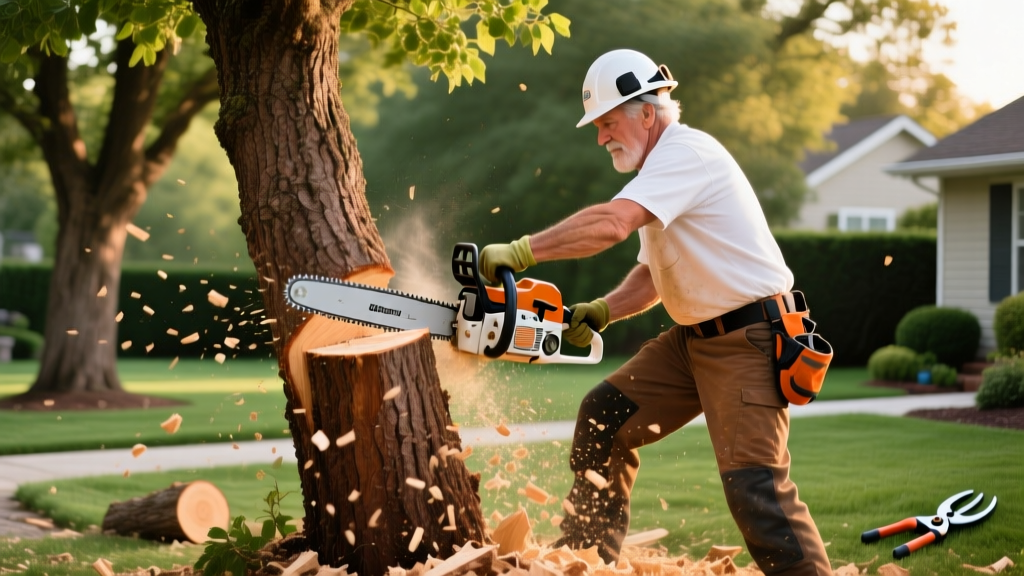
Never Do This When Cutting Down a Tree: 5 Fatal Felling Mistakes
The Physics of Felling: Why Amateurs Get Hurt
Felling a tree is an exercise in applied physics, tension management, and precise geometry. According to CDC NIOSH Logging Safety reports, tree felling and logging remain among the most hazardous occupations, with 'struck by' incidents accounting for the vast majority of fatalities. When a homeowner decides to bypass professional arborists to save $1,500 to $3,000 on removal costs, they inherit lethal risks. When industry veterans warn you to never do this when cutting down a tree, they are almost always referring to a fundamental misunderstanding of hinge wood mechanics, escape route geometry, or tension release. Here is a definitive, measurement-driven breakdown of the most catastrophic felling mistakes.
1. The 'Widowmaker' Hinge Mistake (Leaving Unplanned Wood)
The hinge is the uncut band of wood that connects the stump to the falling trunk, acting as a biological steering mechanism. A poorly calculated hinge causes the tree to twist, split, or fall backward. You must never guess the hinge dimensions.
⚠️ The 10/80 Rule for Hinge Wood:
• Thickness: Must be exactly 10% of the tree's Diameter at Breast Height (DBH). For a 20-inch oak, the hinge must be precisely 2 inches thick.
• Length: Must span 80% of the DBH. For that same 20-inch tree, the hinge should be 16 inches long.
• Uniformity: The hinge must be perfectly parallel to the ground. An uneven hinge creates a twisting torque that will snap the wood prematurely.
• Thickness: Must be exactly 10% of the tree's Diameter at Breast Height (DBH). For a 20-inch oak, the hinge must be precisely 2 inches thick.
• Length: Must span 80% of the DBH. For that same 20-inch tree, the hinge should be 16 inches long.
• Uniformity: The hinge must be perfectly parallel to the ground. An uneven hinge creates a twisting torque that will snap the wood prematurely.
Cutting through the hinge entirely—often called 'shooting the hinge'—severs the tree's connection to the stump before it hits the ground. This turns a 4,000-pound log into an unguided projectile that can bounce off the stump or slide backward into the operator's zone.
2. The Backcut Overcut and 'Barber-Chairing'
Barber-chairing occurs when a tree splits vertically up the trunk before the backcut is finished, sending the top half crashing down prematurely while the bottom half kicks backward. This is exceptionally common in species with heavy forward leans or brittle wood, like ash, poplar, and hickory.
How it happens: The operator cuts the backcut too deep, past the hinge line, or fails to leave enough holding wood to support the tree's forward compression. As the saw pinches, the trunk's tension wood snaps upward.
To prevent this, the backcut must be placed exactly 1 to 2 inches higher than the apex of your horizontal face notch. This creates a 'step' that physically blocks the tree from sliding backward off the stump. Furthermore, always use felling wedges driven into the backcut to lift the tree before the tension reaches a critical breaking point.
Felling Wedge Sizing Matrix
| Tree DBH (Inches) | Wedge Length | Wedge Taper Angle | Lift Capacity |
|---|---|---|---|
| Under 12" | 5.5 inches | 10 - 12 degrees | Low (Manual tap) |
| 12" to 18" | 8 inches | 15 degrees | Medium (Mallet strike) |
| 18" to 24"+ | 10 to 12 inches | 15 - 20 degrees | High (Heavy sledge) |
3. The Dull Chain and Kickback Zone Blunder
Operating a chainsaw with a dull chain forces the operator to apply downward physical pressure to force the cut. This pressure alters your stance, compromises your balance, and pushes the guide bar directly into the 'kickback zone' (the upper quadrant of the bar nose).
According to OSHA Logging Operations guidelines, maintaining chain sharpness and proper tension is a primary defense against kickback fatalities. If you are using a mid-range homeowner saw like the Stihl MS 250 or Husqvarna 450 Rancher, you must verify your chain specs before felling. A standard setup requires a 3/8" pitch and .050" gauge chain. If your saw is producing fine sawdust instead of thick, uniform wood chips, stop immediately. A dull chain increases cutting time by up to 300%, drastically increasing operator fatigue and the likelihood of a misaligned backcut.
4. Ignoring the 45-Degree Escape Route Rule
When the tree begins to fall, the stump often shifts, kicks back, or throws debris. The most common amateur mistake is retreating directly backward in a straight line. If the tree kicks back off the hinge, it will slide directly down your straight-line escape path.
✅ The Proper Escape Protocol:
1. Clear two escape paths at a 45-degree diagonal angle backward and away from the direction of the fall.
2. The paths must be a minimum of 15 feet long and entirely free of tripping hazards (vines, logs, brush).
3. Never turn your back on the falling tree. Retreat diagonally while keeping the canopy in your peripheral vision until you are clear of the drop zone.
1. Clear two escape paths at a 45-degree diagonal angle backward and away from the direction of the fall.
2. The paths must be a minimum of 15 feet long and entirely free of tripping hazards (vines, logs, brush).
3. Never turn your back on the falling tree. Retreat diagonally while keeping the canopy in your peripheral vision until you are clear of the drop zone.
5. The Vehicle Pulling Misconception
Tying a nylon rope to a tree and attaching it to a truck or ATV to 'help pull it over' while simultaneously cutting the backcut is a recipe for catastrophic snapback. If the tree's hinge binds or the rope stretches under tension, the sudden release of kinetic energy when the tree falls or the rope snaps can whip the cable back at the operator at speeds exceeding 150 mph. Furthermore, the artificial tension alters the natural physics of the hinge wood, causing premature snapping. If a tree has a severe back-lean requiring mechanical assistance, use a mechanical advantage rope-and-pulley system (like a Hobbs rope winch or a GRCS) anchored to a separate, stable anchor tree, not a vehicle.
Frequently Asked Questions
What is the safest time of year to cut down a tree?
Late winter to early spring (February to April in most temperate zones) is ideal. The tree is dormant, the ground is firm for heavy equipment, and the lack of foliage reduces the canopy's wind resistance, making the fall trajectory more predictable.
How deep should the face notch be?
The horizontal cut of your open-faced notch should penetrate exactly one-third (33%) of the tree's DBH. Cutting deeper compromises the hinge wood's structural integrity, while cutting shallower prevents the tree from seating properly onto the hinge.
When should I absolutely call a professional arborist?
If the tree has a DBH over 24 inches, exhibits a severe lean (greater than 15 degrees) toward a structure, shows signs of internal rot (conks, hollow sounding trunk), or is within 1.5 times its height of a power line, DIY felling is statistically unsafe. Professional removal for a 60-foot oak typically costs between $1,200 and $2,800, a necessary expense to avoid property destruction or fatal injury.

